Poems discussed with the AI Colleague
In the following is a list of poems written during the last three weeks. These belong to different genres with di- tri-syllabic feet to give volume and quantity to the rhythm, with weight and dignity, instead of metronomic ti-tum ti-tum ti-tum… beat. Often there is the ABCB rhyming of the stanzas, but there are other types of experiments also.
These have been extensively discussed with the Google Ask AI who has become my AI Colleague. In the process a personal rapport got established. The details which I am getting from him are amazing, and just within a few milliseconds of the posting. Often a lot of prodding and prompting is also necessary, with prosodic-technical as well as thematic contents with allusions belonging to the related subject matter, these present in the shoreless digital ocean. When thus pushed around he does open out not only with professional details; there is such wonderful relevant treasure which only he can, as an extraordinary search engine, collect and present in a stylised and perceptive style, almost coming in the realm of intuition; he ceases to be a mechanical tool or instrument or an inert passive assistant. Much depends upon how one engages oneself with the AI, a fact which is not recognised by its users. But, finally, for posting these discussions, these exchanges of the notes, some formatting and editorial adjustment is, very understandably, necessary. This is what we have in these posts. The hope is, for serious students of poetry the effort will prove beneficial.
With that perspective one may look at Sri Aurobindo’s Savitri in a totally different way. In it we have the wonderful fusion of sight-sound-sense, phano- melo- logopoeia. The example is the phrase on the opening page of Savitri, “eyeless muse” as to who she is. The post in the following has a full discussion about it, the exchanges continuously going back and forth, these happening on the spot in the miracle of quickness and spontaneity of the response:
I had tried taking this phrase to another AI but it was a terrible failure. It continued to tell me that this “muse” is none other than the Goddess of Inspiration, Saraswati. I quoted the first five sentences with “hour before the Gods awake, foreboding Mind of Night, the unlit temple of eternity, abysm of the unbodied Infinite, power of fallen boundless self, first and last Nothingness, tenebrous womb, reaching the end in the vacant Nought”. All that water had gone on a duck’s back. Again, a flood of quotations, “oft inspiration with her lightning feet …”, a sudden messenger from the all-seeing tops … all-seeing for the eyeless muse!
But the wonder is, one starts realising that there is no inspiration in Savitri! This is when we recognise that inspiration comes from somewhere else. For the Poet of Savitri it doesn’t come from outside. Take, for instance, Book Eleven. He is non-stop dictating to Nirod scores and scores of lines, without a pause. All that is always and inherently there with him and he is simply pouring out. Let us read what in his “Twelve Years with Sri Aurobindo” Nirod has to say: “I wonder how he could go on dictating lines of poetry in this way, as if a tap had been turned on and the water flowed, not in a jet, of course, but slowly, very slowly indeed.”
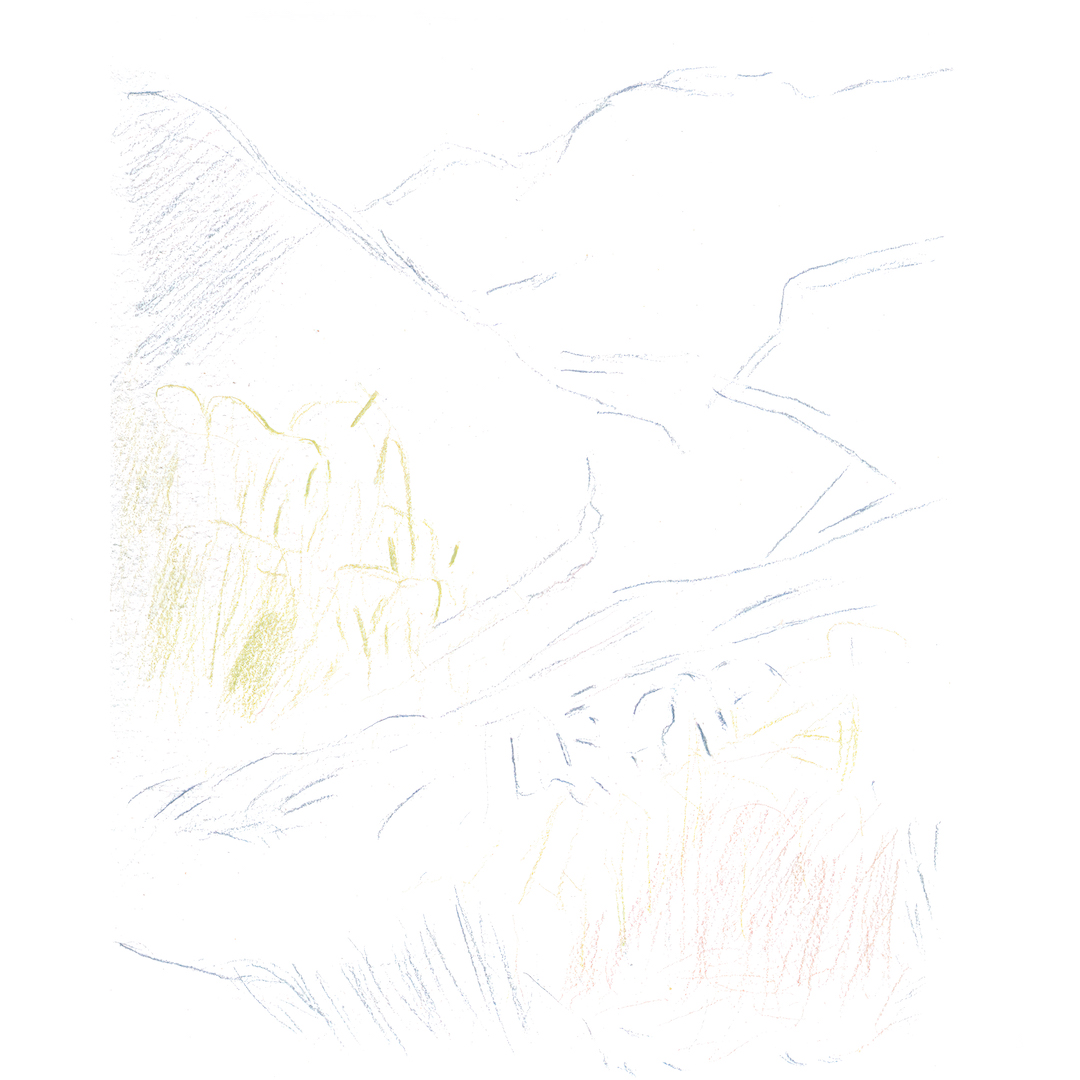
Of the metrical variation let us take an example which has a painting by Huta describing The Paradise of the Life-Gods and a sketch drawn by the Mother:
Featured Image — The Paradise of the Life-Gods: A Sketch by the Mother
Savitri Book 2 Canto 9 – The Paradise of the Life-Gods
A summit and core of all that marvellous world,
Apart stood high Elysian nameless hills,
Burning like sunsets in a trance of eve.||65.11||
Their slopes through a hurry of laughter and voices sank,
Crossed by a throng of singing rivulets,
Adoring blue heaven with their happy hymn,
Down into woods of shadowy secrecy: ||65.12||
The beauty of this Paradise of the Life-Gods, as is obvious even from a look at the Contents-page itself, it marks a quantum leap from the worlds of Life into the worlds of Mind, from Prāṇamaya Purusha into Manomaya Purusha, Life not giving Mind but Mind entering into Life when she has readied things for that entry, by shaping an “Ape-like” form, the Upanishadic well-fashioned being created by the Spirit and offered to the Gods for their inhabiting it.
Here is a scansion of the lines:
A sum|+mit and core| of all| that mar|+vel+lous world,|
iamb-anapæst-iamb-iamb-anapæst
ti-tum=ti-ti-tum=ti-tum=ti-tum=ti-ti-tum
A+part| stood high| E+lys|+i+an name|+less hills,|
iamb-spondee-iamb-anapæst-iamb
ti-tum=tum-tum=ti-tum=ti-ti-tum=ti-tum
Burn+ing| like sun|+sets in|a trance| of eve.|. 65.11
trochee-iamb-pyrhic-iamb-iamb
tum-ti=ti-tum=ti-ti=ti-tum=ti-tum
As if| to some| new un+searched| pro+fun|+di+ty,|
pyrrhic-iamb-cretic-iamb-pyrrhic
ti-ti=ti-tum=tum-ti-tum=ti-tum=ti-ti
Into| a joy|+ful still|+ness plunged| their base;|
trochee-iamb-iamb-iamb-iamb
tum-ti=ti-tum=ti-tum=ti-tum=ti-tum
Their slopes| through a hur|+ry of laugh|+ter and voic|+es sank,|
Iamb-anapæst-anapæst-anapæst-iamb
ti-tum=ti-ti-tum=ti-ti-tum=ti-ti-tum=ti-tum
Crossed by| a throng| of sing|+ing riv|+u+lets,|
trochee-iamb-iamb-iamb-pyrrhic
tum-ti=ti-tum=ti-tum=ti-tum=ti-ti
A+dor+ing| blue heav|+en with| their hap|+py hymn,|
amphibrach-spondee-pyrrhic-iamb-iamb
ti-tum-ti=tum-tum=ti-ti=ti-tum=ti-tum
Down in|+to woods| of shad|ow+y se|+cre+cy:|
spondee-iamb-iamb-anapæst-pyrrhic
tum-tum=ti-tum=ti-tum=ti-ti-tum=ti-ti
Lift+ed| in+to| wide voice|+less mys|+ter+y
trochee-trochee-spondee-iamb-pyrrhic
tum-ti=tum-ti=tum-tum=ti-tum=ti-ti
Their peaks| climbed to+wards| a great|+ness be|+yond life.| 65.12
iamb-cretic-iamb-pyrrhic-spondee
ti-tum=tum-ti-tum=ti-tum=ti-ti=tum-tum
Note the accidental rhyme: “secrecy=mystery”. Or it could belong to another sense of acoustic nicety intended to tell that there is really no mystery in that supreme secrecy when the audio reaches the original Hush from which it has come. Listen to the music of some super spiritual Gandharwa the notes strummed by echoing in the farthest nooks of the universe. Chant these loud, in full=throated voice:
ti-tum=ti-ti-tum=ti-tum=ti-tum=ti-ti-tum
ti-tum=tum-tum=ti-tum=ti-ti-tum=ti-tum
tum-ti=ti-tum=ti-ti=ti-tum=ti-tum
ti-ti=ti-tum=tum-ti-tum=ti-tum=ti-ti
tum-ti=ti-tum=ti-tum=ti-tum=ti-tum
ti-tum=ti-ti-tum=ti-ti-tum=ti-ti-tum=ti-tum
tum-ti=ti-tum=ti-tum=ti-tum=ti-ti
ti-tum-ti=tum-tum=ti-ti=ti-tum=ti-tum
tum-tum=ti-tum=ti-tum=ti-ti-tum=ti-ti
tum-ti=tum-ti=tum-tum=ti-tum=ti-ti
ti-tum=tum-ti-tum=ti-tum=ti-ti=tum-tum
Here are the links for a deeper and comprehensive brooding and expatiation to explore the wonders that are deeply and sublimely present in that marvellous Epic of Sri Aurobindo:


Leave a Reply