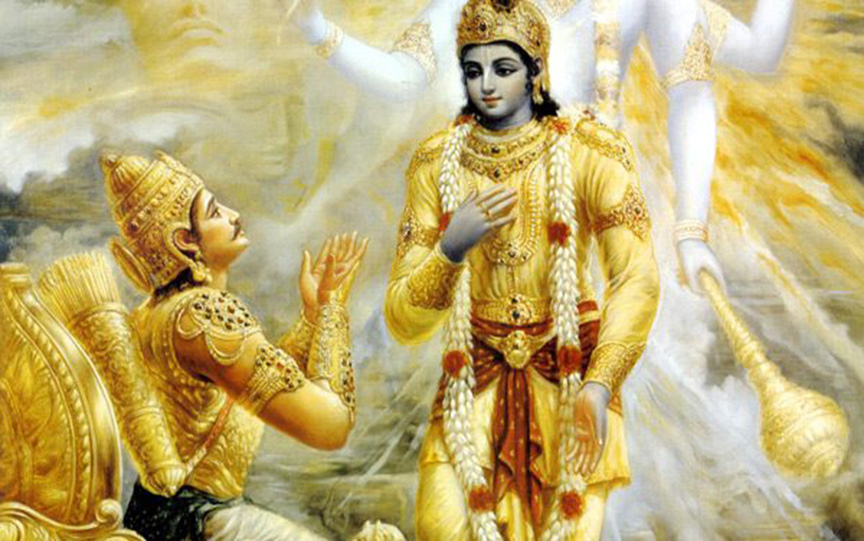
“The Para Prakrti has become the Jīva”
Parā Prakṛtir Jīvabhūtā
(A criticism examined)
[Vide Modern Review, August 1942, page 177]
(By T. V. Kapali Sastri)
Sri Aurobindo’s Essays on the Gita contain an early adumbration of the philosophy which is so magnificently expounded in The Life Divine. But the Essays were not written in the traditional spirit of orthodox exponents of systems, to will support for their teachings by proving their conformity to the accepted authorities. He saw that his own realisations bore testimony to the truths embodied in the teachings of the Gita and expounded it in the light of his wisdom for the benefit of those who are prepared to go from the letter of the scripture to the spirit beyond it. His unique contribution to the under-standing of the Gita lies in his interpretation of the Purushottama doctrine—the three Purushas and the two Prakrtis. A pregnant phrase in the Gita is “parā prakṛtir jīvabhūtā” which Sri Aurobindo explains as meaning “the Para Prakrti has become the Jīva”. Objection is taken to this interpretation and it has been argued with a certain amount of plausibility that the compound jīvabhūtā according to the canons of Grammar cannot mean “become the Jīva”, and to express this latter meaning we need the compound jīvībhūtā and that is why Achārya Shankara has rightly taken it to mean “Jīva Itself”. To persons not conversant with Sanskrit grammar, this argument presented with a show of learning may become a stumbling-block to the acceptance of Sri Aurobindo’s interpretation, but a careful study of the relevant rules of Grammar will show convincingly that not only does Sri Aurobindo’s interpretation do no violence to the language, but that in the context it is the right interpretation, the only interpretation possible. We are not concerned here to examine the general philosophic position of Shankara or to expound that of Sri Aurobindo, nor even to show that the latter conforms to the spirit of the teachings of the Upanishads and the Gita. We confine ourselves to this one point in Grammar and show that far from twisting the text to fit it to his own system, Sri Aurobindo explains the phrase naturally and in strict accordance with the precepts of grammar.
It has been urged that jīvabhūtā means jīva itself (the same as jīva) and that it can never mean what has become the jīva, and that for the latter sense the expression must be jīvībhūtā. We shall presently see that the latter compound should not be used in all cases of “becoming” and it can be used only under certain conditions, and where such conditions are not present we have to use the first compound to convey the sense of “becoming” and that Āchārya Shankara himself and others following him have done so.
Let us then study the import of the taddhita affix cvi, by which compounds like jīvībhūtā are formed, and understand where it could be used and where it should not, so that we can show that bhū in the sense of “become” can be and is used even when it is not preceded by, cvi. The Sutra is “kṛ–bhv‘ astiyoge sampadya-kartari cviḥ”. “Abhūta-tad-bhāve” is the Vārtika on this Sutra of Pāṇini, [V. 4. 50]. The Vārtika is very important, so important that the Kāśikā reads it in the Sutra itself. “When the word expresses the new state attained by the agent and the verbs kṛ, bhū, and as are joined to it, the affix cvi comes after that word” The case of a thing arriving at a state of being what it was, not is called “abhūta-tad-bhāva“. That is to say, when something has become that which it was not previously, this affix cvi is added to the stem. Let us pause here and note the implication of the Vārtika. The cvi affix is added only when the agent completely changes and arrives at the modified state, “yatra prakṛti-svarūpam eva vikāra-rūpatām āpadyamānam vivakṣyate“. Thus when we say “paṭaḥ śuklī bhavati” the cloth has become white, we mean that the whole cloth has become white. If we mean a partial whitening, we have to say so expressly ‘ekadeśena’. Pānini, V. 4. 52 gives optionally the affix sāti as a substitute for cvi to convey the sense of total change. Cvi by itself is used to convey the sense of total change. This will be obvious from Bhaṭṭojī’s vṛtti on Pāṇini sutras, V. 4—50, 52, 53 in his Kaumudi.
Therefore, wherever the affix cvi does not apply, we use simply bhūta and form the compound ”sup supa” (noun-joined to a noun) in the sense of “become”, for the root bhū means “to be” as well as “to become” as we shall see presently. Here the Gita rightly avoids the cvi as it does not mean that the Supreme Nature in its totality has become the jīva. Sri Aurobindo has made it abundantly clear in the Essays that this Supreme Nature is not identical with the jīva in the sense “that there is nothing else or that it is only nature of becoming and not at all of being; that could not be the supreme Nature of the Spirit . . . Even in time it is something more”.1
Now that we have shown why bhūta without a cvi is used in the sense of becoming, we shall proceed to point out that Āchārya Shankara and others following him have interpreted the compounds ending in bhūta as in Brahmabhūta, Jīvabhūtā in the sense of becoming or attaining the state of Brahman, assuming the form of Jīva, as the case may be. Shankarananda is considered to be the most famous among the Advaitic commentators on the Gita. He says—Jīvabhūtaḥ “nāma-rūpa vyākaraṇāya kṣetrajñatām gataḥ pramāta bhūtvā tiṣṭhati”—(the eternal portion, sanātana aṁśa having attained or assumed the condition of kṣetrajña, the Knower of the field, for the purpose of manifesting or developing Name and Form, has become the cogniser). Note that gataḥ and bhūtvā connote respectively the senses of attaining a state and becoming. This Advaitin is no mean authority. Is he wrong in having rendered in this way mamaiva aṁśaḥ sanātano jīvabhūtaḥ? In unmistakable terms he has taken the compound to mean that the eternal portion of the Supreme has attained the state of kṣetrajña and has become the Cogniser (of course phenomenally, to meet the requirements of the doctrine of Māyā). Again, Shankara himself in his commentary on this verse is confronted with the question of the Partless niraṁśa having a part aṁśa. He explains aṁśa jīvabhūta (portion as jīva) to mean that the jīva is formed (apparently or illusorily) as a portion of Myself! (sa ca jīvo mad-aṁśatvena kalpitaḥ). These two instances are enough to show how jīvabhūta is construed by Shankara and another of the same school. Shankara himself earlier in the commentary rightly takes aṁśa as the uddeśya and jīva as the vidheya; that means that aṁśa or portion is the subject and jīvatva or the state of jīva is predicated of it. He could have straightly said aṁśaḥ jīvatvena kalpitaḥ. For the purpose of his philosophy he makes the jīva appear as formed into the aṁśa of the Supreme. Be it as it may; what matters is that the act of forming or attaining or becoming is implicit in these renderings of jīvabhūta and Shankarananda quoted above makes it quite explicit.
Let us take another example of a compound ending in bhūta and show from Shankara’s commentary on the Gita that becoming or attaining is implicit in the sense of the compound “brahma-bhūtaḥ” Ch. XVIII. 54. Shankara says “brahma prāptaḥ”; that is—one who has attained the Brahman. He does not say that it is the same as Brahman or Brahman itself, as the critic holds. According to the critic, the compound here must be rendered as ‘the same as Brahman’, ‘Brahman Itself’ but Shankara holds differently. Why does he use verb pra-āp in explaining brahma-bhūta as brahma prāptaḥ? Here it is necessary to consider the Sanskrit verbs that are commonly used to denote ‘becoming’. Pāṇini uses the verb sam-pad as in sampadya-kartari V. 4. 50, abhividhau sampadā V. 4. 53. The act of attaining the state of something or somebody is the meaning of the verb; and because this sampatti is the same as prāpti (attainment), Shankara has rendered brahma-bhūtaḥ into brahma prāptaḥ (one who has attained the state of Brahman) Here he has rightly taken the verb bhū to mean ‘to become’, ‘sampad’; only he has used the transitive verb pra-āp.
Bhū is often used in the sense of becoming; forms derived from it are often so used. We shall again quote Shankara from his commentary on the Gita, Ch. XIII.30. Brahma sampādyate, brahmaiva bhavati (‘he attains Brahman’ means ‘he becomes Brahman’). The Tikākāra Ānandagiri gives a note on this, ‘brahma-sampattir nāma pūrṇatvena abhivyakti-hetoḥ sarvasya ātma-satkrtatvāt ca, brahmaiveti”—brahma-sampatti means “becoming Brahman or being Brahman itself”, because of the manifestation in fullness and of all being the Self”. Again Ch.XVIII.54,—“brahma-bhūyāya kalpate”—brahma-bhavanāya samartho bhavati. On this Ānandagiri says, brahmaṇo bhavanam, anusandhāna–paripāka–paryantam sākṣāt karaṇam’.(Calm continuous search or enquiry ripens into realization—this is called attaining the state of Brahman or becoming Brahman).
Thus it will. Be seen that the verbs bhū and sam-pad are used in the sense of becoming. We have given instances mainly from the Gita and its Advaitic commentators. But if we turn to the Upanishads, we can better appreciate the phrases of the Gita, bhūta–bhāvana, bhūtabhāvōdbhavakara, madhāvabhāvita, brahmabhūya, brahmabhūta, jīvabhūta, etc The Advaitin Nīlakaṇṭha, the commentator on the Mahābhārata in explaining the verse XV.7.quotes the Taittiriya Upanishad II.6. (Tatsṛṣtvā tadevānuprāviśat . . . satyam abhavat)to show that it isBrahmanthat has become everything, abhavat. The conception of becoming is essential, indispensable for a proper understanding of the Gita and the Upanishads. The root bhū served the purpose of the ancient seers and thinkers to denote becoming or manifestation which was also their conception—or, shall we say, perception—of the truth of Creation. We may note, for instance, that bhava means birth which is manifestation and does not mean existence for which the root as is used,—sat, existence. But this distinction is not always made in common usage. Nevertheless, we cannot afford to ignore the radical significance of these words in the ancient texts. And it is because the commentators were aware of the sense of becoming attached to bhū that they have rendered the term jīvabhūta in the way that we have shown from their writings.
Thus far we have made mention of the Advaitic commentaries on the Gita and cited instances of the usage of bhūta in the sense of ‘attained the state of’ or ‘become’. It is superfluous to multiply citations from the vast field of Sanskrit literature in general; nevertheless, it would be profitable to go straight to the source-books on Sanskrit grammar and consult standard authorities on the point at issue. When we do so and examine passages that are relevant for our enquiry, we find that the great grammarians have settled the question and decisively put a final seal on the derivative significance of bhūta at the end of compounds such as pramāṇa-bhūta, jīva-bhūta, etc. In the Mahābhāṣya, the monumental gloss of Patañjali on Pānini’s sutras, we meet with the phrase pramāṇa-bhūta ācāryaḥ under the Vṛddhi-samjñā-sutra. Kaiyaṭa’s note on it reads, “prāmānyam prāpta ity‘arthaḥ“, meaning “the ācārya who has attained (the position of) authority” He further elucidates the phrase pramāṇa–bhūta by deriving bhūta form bhū prāptau, a root as a tenth conjugation. Here arises a doubt; if bhū is taken as a tenth conjugational root and the past participle ta is suffixed to it, the result would be bhāvita and not bhūta. But it is cleared thus: there is a group of fifty roots including the root bhū prāptau in the tenth conjugation which optionally drop the tenth conjugational sign nic (aya) (A dhṛśād vā; vibhāshita nickāh); so much so that the third person present singular is bhāvayate or bhavate and the past part is bhāvita, or bhūta, which means prāpta, as Kaiyaṭa has explained. Commenting on this passage of Kaiyaṭa, Nāgeśa in his Uddyota explains the necessity of deriving bhūta from bhū of the tenth conj which means ‘to attain’ or ‘to obtain’. He says that as bhū of the 1st conj. means ‘to be’ or ‘to be born’, there will have to be cvi before it, thereby conveying the sense of a total change of the agent—which in the example is ācārya—into the thing denoted by the word (pramāṇa) preceding bhūta. In that case it would be pramāṇibhūta. As that is not the sense meant to be conveyed, that is to say, as what is meant is not that the acārya has completely changed into pramāṇa, we avoid the cvi and mean by the phrase pramāna-bhūta ācāryaḥ ‘the ācārya, who has modally become the authority’ pramāṇam ācāryaḥ prakā rāntareṇa bhūtaḥ.
This is interesting and precisely applicable to the case of ‘parā prakṛtir jivahbūtā’. By adapting Nagesha’s language, we may say, ‘parā prakṛtir jivahbūtā’ means ‘jīvaḥ parā prakṛtiḥ prakārāntarēṇa bhūtā’, the Supreme Nature has modally attained the state of Jīva. Again, it would be instructive to note what the Chāyā, Vaidyanātha’s annotation on Nagesha, saya in this connection. It puts the pertinent question: “if pramāṇa-bhūta means the same as pramāṇa then pramāṇam alone would do; why should there be bhūta added to it?” The answer is that pramāṇa-bhūta is note the as pramāṇa; it means pramāṇa-bhūta bhāvita which is the same as pramāṇyam prāpta. From the foregoing brief discussion it would be clear that pramāṇam is not the same as pramāṇī-bhūta or pramāṇa-bhūta; these three expression differ in their significances and are not interchangeable. 2
Now let us take the present case of parā prakṛitir jīvībhūtā. If it be meant that the Supreme Nature is the same as Jīva or the Jīva Itself, then the expression would be `parā prakṛtir Jīvah’; if it were intended to convey the sense that parā prakṛiti, the Supreme Nature has completely changed and become in its totality the Jīva, then parā prakṛitir Jīvībhūtā would be the phrasing; but when it is not meant that the Supreme Nature has absolutely changed into and therefore in that sense become the Jīva or that it is itself the Jīva or the same as Jīva, but meant that the Supreme Nature is the Jīva in some way or mode, prakāra, to use the word of the grammarian quoted already, or in some aspect or part, aṁśa, as the Gita reminds us, then the correct expression is none other than the one that we have discussed, parā prakṛtir Jīvabhūtā.
And this is precisely the construction put upon the phrase in Sri Aurobindo’s exposition of the Gita: for in unequivocal terms he has reiterated the idea that the Supreme Nature is the nature of the One Supreme Spirit which is higher than its manifestation as Jīva, that it is not in its essence the, Jīva, Jīvātmikā but it is Jīvabhūtā has formulated itself as Jīva providing a spiritual basis for the manifold becoming in the cosmos. Tested and thus dissolved, the difficulty of grammar that ushered in the objection turns helpful, leaving us to appreciate better the interpretation of the great phrase rich with profound thought—an interpretation which, as has been shown, is in perfect accord with the usage and strictly conforms to the canons of Sanskrit grammar.
- Sri Aurobindo, Essays on the Gita: The Two Natures ↩
- When earlier in the Mahābhāsya Kaiyaṭa explains `sāmānya–bhūtam’ as ‘sāmānyam iva’, the Uddyota dissents from the view that the word bhūta can be treated as upamā-vācaka; but it has been the convention to resolve the compounds. Such as pitṛ–bhūta into pitrā tulyaḥ or samaḥ, ‘like a father’. This is indeed loosely done; but it is taken to be equivalent to pitṛtvam prāptaḥ ‘attained the position of a father’ which is the same as ‘become a father in a way’ prakārāntareṇa pitā bhūtaḥ. The same applies to paṇyabhūtam śarīram, the body has attained the state of an article of merchandise, which is the same as saying loosely that the body is an article of merchandise; the same is the case with other expressions such as aṅgabhūta or aṁśabhūta, ‘has attained the status of or become a limb or a part’. ↩
Image: Sri Aurobindo embracing Champaklal

It is impossible to write anything about my experience on 5 December 1950 [the day Sri Aurobindo left his body], when, holding me in his intimate embrace, Sri Aurobindo kissed me again and again. Those of his attendants who were present were a witness to that scene.
I mention it here only to emphasize how he responds to one’s aspiration – as I said earlier, since childhood I had aspired for the same intimacy with my Guru that Vivekananda had experienced with Sri Ramakrishna. That was the fulfilment of my aspiration.
Even now, in an ever increasing measure, Sri Aurobindo is showering his infinite Grace; its boundless action is felt everywhere and anywhere. Though he is not in his body, his response is even greater.
Ref: Champaklal Speaks


Leave a Reply to RY DeshpandeCancel reply