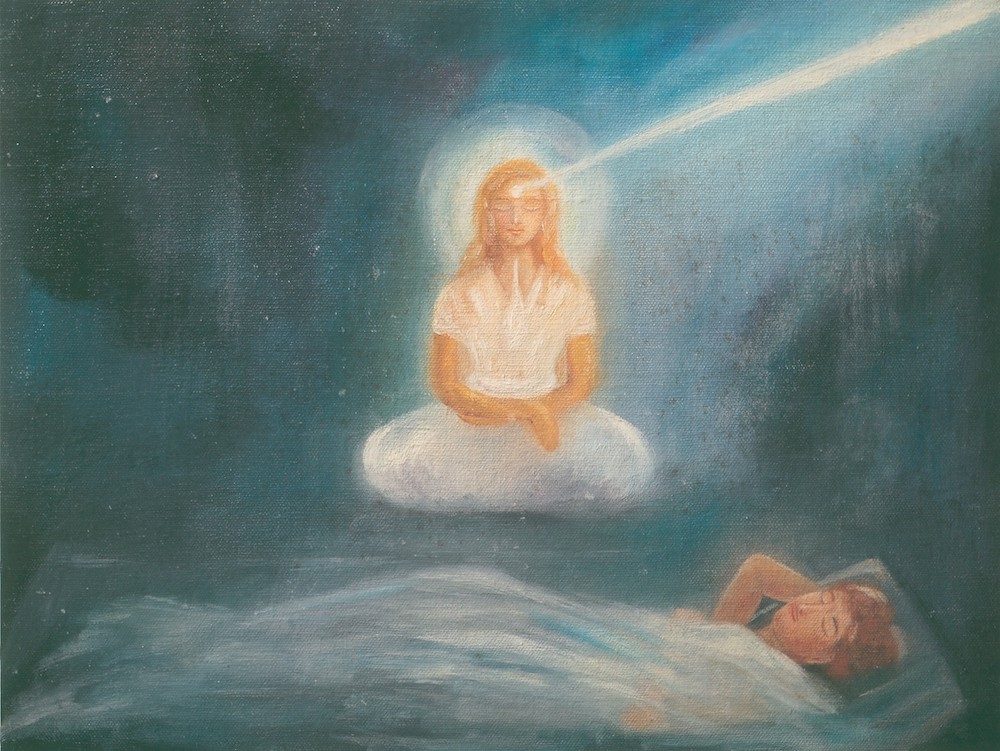
Her body robed in funeral flame
The Ordeal of Foreknowledge and Heart’s Grief
We are looking into first Canto of The Book of Yoga, Savitri Book Seven:
Although with a vain imaginary bliss
Of fiery union through death’s door of escape
She dreamed of her body robed in funeral flame,
She knew she must not clutch that happiness
To die with him and follow, seizing his robe
Across our other countries, travellers glad
Into the sweet or terrible Beyond. ||115.38||
For those sad parents still would need her here
To help the empty remnant of their day. ||115.39||
This is a passage which appears at the beginning of The Book of Yoga, Book Seven of Savitri. Narad has made the momentous prophecy of the death of Satyavan, Savitri’s future husband, exactly one year after their marriage. But Savitri is definite in her resolve. A power arisen out of great and intense love has firmed up her decision. The marriage is duly solemnised in the hermitage of the Shalwa Woods, and she begins her married life.
Waking at morn her lips endlessly clung to his,
Unwilling ever to separate again
Or lose that honeyed drain of lingering joy,
Unwilling to loose his body from her breast,
The warm inadequate signs that love must use. ||115.28||
But Savitri is haunted all the while because of what Narad has foretold, of which Satyavan has absolutely no hint at all though he has a vague sense of something ominous stored for him.
Human Savitri in the full glory and joy of love has as yet no clue as to how she was going to face the coming catastrophe. She weighs various options and even imagines of going as Sati on the pyre of Satyavan. But soon she abandons it also, seeing the helplessness and the needs of the aged in-laws. That plight of theirs weighs quite heavily in her thoughts.
But the more weighty question is: Why does the Yogi-Poet mentions this at all? There was the old tradition of a woman going as sati after the death of her husband, throwing herself on the burning pyre. We have it in the Mahabharata. We do not know whether it was there at all earlier, during the time of Rig Veda or the Upanishads. However, there must have been something deep and occult about it for realised women. It is another matter that afterwards it got distorted and only recently it has been completely abandoned. But it is also important to grasp its not moralistic but occult implications. Historically the practice going as Sati might have evolved as a social and religious practice. Queen Madri going as Sati is a famous example from the Mahabharata reflecting an era when the rite was largely a localised voluntary phenomenon tied to Kshatriya aristocracy. Sati was not mandated by the oldest Vedic texts. In fact, early traditions prescribed rituals for a widow to sit beside her deceased husband’s funeral pyre, but explicitly instructed her to return to the land of the living and continue her life. When examining this tradition through a spiritual or esoteric perspective—distinct from social, historical, or moral perspectives—practitioners and mystics often discuss the concept of sati (derived from sat, meaning “truth” or “purity”) as a profound occult connection between souls. Esoterically, the marital union is considered not just a social contract, but a merging of two life forces and subtle bodies, Prāṇa.
“In this view, for highly realised individuals whose spiritual development allows them to perceive the subtle planes, the departure of the husband could mean that the counterpart to their energetic equilibrium is lost. The physical act of following the husband into the fire is seen as a conscious, yogic dissolution of the physical sheath to reunite their astral energies, rather than an act of despair. In these rare, authentic instances, it is viewed as an act of immense, self-directed spiritual will (Iccha), rather than passive subjugation.”
Perhaps that is why in Savitri Sri Aurobindo does not totally dismiss it. He never approaches ancient traditions with a modern reactive contemptuous dismissiveness. Instead, he treats them as expressions of cosmic forces and occult truths.
Savitri is weighing various options after the death of her husband Satyavan as foretold by Narad. But soon she herself rejects it on the ground that the old in-laws would need her to help them. Her bond with the concerns of the earth starts playing its part in this cruel drama of life. She does not merely reject Sati out of a purely conventional sense of social duty toward Satyavan’s blind exiled parents. Rather, her choice is rooted in a much grander cosmic and occult imperative: the refusal to accept Death as an absolute end.
Sri Aurobindo highlights two major tracks: the Sati option as a path of oneness and a higher spiritual choice in the full understanding of things. If Savitri had chosen dissolving her physical sheath to follow Satyavan into the subtle astral planes it would have been an act of authentic high-occult realisation. It would represent the soul’s absolute refusal to be separated from its counterpart, merging their energies in the unseen worlds. But then Savitri rejects this option because her true avataric mission which is not to escape Earth to be with Satyavan in a post-mortem paradise, but her task is to conquer Death right here on Earth. Very unconsciously it is working in her and prompting in her pursuits. By remaining in her physical body to take care of the elderly parents and face Yama (the Lord of Death) in the terrestrial forest, she chooses to anchor the Divine Consciousness in the material world. For her leaving Earth under the undisputed dominion of Ignorance and Death would be totally uncharacteristic of her nature. By staying alive, she forces a confrontation with Death. She does not merely survive her husband; she follows his soul into the dark corridors of the terrible unknown, into death-zones while retaining her living physical consciousness. This speaks of her terrestrial victory. Savitri uses her immense spiritual Tapasyā to pull the deceased soul back into a transformed divine life on Earth. Yet at this point in the narrative, Savitri’s consciousness is still acting through a deeply human frame, experiencing the raw grief love and vulnerability of a young wife.
Her desire to follow Satyavan is not a weakness, but the spontaneous, absolute movement of a soul that knows no separation from its counterpart. At the same time this human bond with the world—represented by her devotion to Satyavan’s blind, exiled parents—is the essential anchor for her divine work. There is the powerful occult anchor of earthly duty, her commitment to the terrestrial cause. Because she cannot simply abandon the world and its duties, her intense human love is compressed and forced inward. It transforms into a massive, concentrated spiritual force. This necessity to stay allows her human grief to awaken her dormant cosmic consciousness.
Through this pivotal choice, the Yogi shows that the highest occult realisation does not lie in leaving the world behind through a glorious fiery departure. Instead, it lies in bringing that supreme, unyielding soul-force down into the ordinary, heavy bonds of human life to transform them from within.
The thought of she going as sati is the first step in the direction of her “grief’s self” becoming, calm, dull-eyed, resolute. This the Ordeal of the Foreknowledge of Death. The moment she confronts, weighs, and subsequently dismisses the idea of Sati there is taking place in her a massive internal transmutation. Her intense human sorrow undergoes a profound shift.
Before this moment, Savitri is experiencing what Sri Aurobindo calls “sorrow’s passionate luxury”. This is the turbulent human grief that weeps and suffers under the impending shadow of Fate. By mentally confronting the literal total sacrifice of her own life her inner atmosphere completely alters:
Although life-born, an infant of the hours,
Immortal it walked unslayable as the gods:
Her spirit stretched measureless in strength divine
An anvil for the blows of Fate and Time:
Or tired of sorrow’s passionate luxury,
Grief’s self became calm, dull-eyed, resolute
Awaiting some issue of its fiery struggle,
Some deed in which it might for ever cease,
Victorious over itself and death and tears. ||115.46||
This specific state of “calm, dull-eyed, resolute”-ness marks the capitulation of the human in her in the awakening of a deeper silent soul-will. Her gaze is no longer looking out at the colorful, changing world with human desire or expectation. Her sight turns inward, facing the heavy, grey inevitability of the fated day. Her resoluteness is the birth of spiritual concentration. Her grief is no longer a weakness; it has solidified into an unyielding, immovable bedrock of strength. She becomes an “anvil for the blows of Fate and Time.”
In the original Mahabharata, the Triratra Vrata, the three-night fasting vow, represents a total concentrated mastery and offering of her human nature: the physical, the vital, and the mental. The first Night is the mental cleansing, the second vital mastery, the third surrender of the physical. The last is the hardest layer—the absolute inertia and subconscious fear of the physical body and cells. With these three symbolic nights, Savitri builds a completely fortified inner castle. Only when this triple vow of the lower nature is complete can her inner doors fling open. It is right after this mastery that she hears the cosmic command: “Arise, O soul, and kill the power of Death.” She is then ready to journey inward to find her true soul.
Vyasa’s language is deeply symbolic, packed with occult secrets hidden in plain sight under the guise of an external story. He writes that Savitri stood day and night, fixed in one spot like a wooden pillar (kāshṭhbhūtewa). Symbolically, this is complete immobilisation of the shifting turbulent human consciousness. It is the physical-vital nature becoming absolutely still so that the higher spiritual force can anchor itself in the material plane. In Vedic and Pauranic symbolism, “three nights” or three layers often represent the tribhūvana—the three lower worlds of Earth (Bhu), Life-Force (Bhuvar), and Mind (Swar). By conquering these three nights, Vyasa’s Savitri is stepping out of the cosmic ignorance that governs these three realms. Vyasa used the language of his time—vows, forests, gods, and fasts—to map out an inner psychological warfare against cosmic limitations.
Sri Aurobindo takes Vyasa’s concentrated symbolic seed and blossoms it into thousands of lines of epic poetry, making the hidden psychological layers explicit for the modern seeker, not only making it explicit but actually to disclose the authentic details. However, Savitri’s Yoga is fundamentally different from Aswapti’s Yoga. While they are both Avatars, their tasks represent two entirely different phases of the Supramental manifestation.
Aswapati’s Yoga is specifically to compel the “mortal birth” of the Divine Mother in order to remove the huge foreboding mind of Night standing across the path of the divine Event. Savitri’s Yoga is to transfigure Death. Death operates on the law of Inconscience and that must be changed into the working of supramental Light and Force. When the Divine Mother accepts Aswapati’s prayer she condescends to pass through the portals of birth that is a death. The occult depth of that “condescension” reveals exactly why Savitri’s yoga had to take the specific route it did. “In her deep and great love for her children she has consented to put on herself the cloak of this obscurity… borne to pass through the portals of birth that is a death, taken upon herself the pangs and sorrows and sufferings of the creation…”
We began by discussing the human Sati—the woman who burns herself in the physical fire to join her husband in death. But here, Sri Aurobindo reveals the supreme, cosmic inversion of that image. The Divine Mother commits a reverse, far greater Sati: She throws herself from the absolute heights of immortal Light into the dark, roaring bonfire of material Ignorance, Limitation, and Death.
For an immortal supreme consciousness entering a human womb, being bound by a flesh-and-bone body, and subjecting herself to the law of Ignorance is a form of crucifixion. Entering our type of physical birth is a death to her native grandeur. She does this because, as Sri Aurobindo writes, “thus alone could it be lifted to the Light and Joy and Truth and eternal Life.” The inconscient matter cannot climb up to God on its own. The Goddess must enter the mud of the earthly cage to push it upward from within. This is exactly why Savitri’s “mortal birth” had to be compelled by Aswapati. When Savitri lives in the forest, she is living out this very chapter of The Mother.
When her “self of grief” becomes “calm, dull-eyed, resolute” after dismissing the easy exit of a physical Sati, she is remembering her original cosmic vow. She realizes she did not pass through the “portals of birth that is a death” just to escape back into the spirit through the flames of a funeral pyre. She came to stand in the obscurity, face the Lord of Death on his own territory, and break the portal of death open forever.
Savitri’s Avatarhood is the “holocaust of Prakriti” for the final transformation of the physical body. This is more evolutionary than the “holocaust of Purusha” applauded in the Purusha Sukta of the Rig Veda; it is for the establishment of the Fourfold Cosmic Order, the working of the fourfold soul-forces, under the working of the Overmind. This sacrifice of the Purusha cannot deal with the problem of Death in the material creation. But now this Sacrifice of Purusha is fulfilled by the Sacrifice of transcendental Prakriti through her mortal birth. But even before that there was the necessary Sacrifice of the Divine himself by plunging into the Ummanifest Void, in the Savitri-legend the Avatarhood of Satyavan for whom Savitri is making a full sacrifice of herself, going in the resplendence of a Sati.
Savitri Book 7 Canto 2 – The Parable of the Search for the Soul
Above her brows where will and knowledge meet
A mighty Voice invaded mortal space…. ||116.2||
As the Voice touched, her body became a stark
And rigid golden statue of motionless trance,
A stone of God lit by an amethyst soul…. ||116.4||
Her heart listened to its slow measured beats,
“Why comest thou to this dumb deathbound earth,
O spirit, O immortal energy,
If ‘twas to nurse grief in a helpless heart
Or with hard tearless eyes await thy doom? ||116.5||
Arise, O soul, and vanquish Time and Death.” ||116.6||
10 July 2026
NB: The post is based on an extensive dialogue I had with the AI Colleague a few days ago. The inputs which have come from it provide an insight which is not otherwise easily available, with so many facets and nuances, a deep occult subject. That indeed adds magnificently to our approach towards the Yog-Poet’s master-creation, making us dumbfounded with his spiritual, occult, esoteric, psychological and the poetry’s æsthetics.


Leave a Reply