Sanskrit and English for Future Poetry
Is it a good idea at all to compare the merits of English and Sanskrit as languages for the future poetry envisaged by Sri Aurobindo? This of course does not imply any national or personal biases or prejudices. The intention is to enter into the very spirit of the respective tongues and go by liberal thought and perception and excellences. Nor is it just an academic exercise. When we access Sri Aurobindo’s writings across The Future Poetry and Letters on Overhead Poetry these do offer a rich comparative framework for evaluating them. While Sanskrit is acknowledged as a supremely finished linguistic instrument, English emerges as the more predestined medium for the specific æsthetic and intuitive task that future poetry is expected to accomplish. While we could make a comparative analysis we should also see the nature or Piṇda of the languages, Piṇda a tangible mass or lump or form or intrinsic character signifying the transition from formless into defined individual shape or substance with its own baseline consciousness and originality and personality or disposition.
Sanskrit: A Supremely Finished but Historically Constrained Instrument
First thing we immediately recognise in Sanskrit is its formal perfection and prosodic richness. It
is described as “perhaps the most remarkably finished and capable instrument of thought yet fashioned, at any rate by the Aryan mind, lucid with the utmost possible clarity, precise to the farthest limit of precision, always compact and at its best sparing in its formation of phrase, yet with all this never poor or bare.” This extraordinary precision is paired with “a pregnant opulence of meaning, a capacity of high richness and beauty, a natural grandeur of sound and diction inherited from the ancient days.” About the later-day poetry we may say the following.
The prosodic structure of classical Sanskrit poetry is equally remarkable. “The great and subtle and musical rhythms of the classical poetry with their imaginative, attractive and beautiful names, manifold in capacity, careful in structure, are of themselves a mould that insists on perfection and hardly admits the possibility of a mean or slovenly workmanship or a defective movement.” The classical Sanskrit poet worked within “one of the infinite harmonic variations of the four-lined stanza with which our classical prosody teems, or else the couplet called Arya, noble verse; and within these narrow limits he sought to give vividly some beautiful single picture, some great or apposite thought, some fine-edged sentiment.” [2]
The ideal of the Subhashita — “a thing well said and therefore memorable” — captures the essence of this tradition: “if a picture, it might be crowded with felicitous detail; if a thought, with pregnant suggestion; if a sentiment, with happy shades of feeling; but the whole must be perfectly lucid and firm in its unity.” Classical Sanskrit literature as a whole is “governed by an inner stress of spirit which urges it to a sort of lucid density of literary structure; in style a careful blending of curious richness with concentrated force and directness of expression, in thought and matter a crowded vividness and pregnant lucidity.”
Despite these extraordinary qualities, Sanskrit underwent a historical trajectory of increasing artificiality and eventual exhaustion as a living literary medium. The language of the epics had “all the vigour, freedom, spontaneous force and appeal of a speech that leaps straight from the founts of life,” but “the speech of Kalidasa is an accomplished art, an intellectual and æsthetic creation consummate, deliberate, finely ornate, carved like a statue, coloured like a painting.” In later writers, “the elements of artifice and device increase and predominate,” their language becoming “a laborious and deliberate though a powerful and beautiful construction” that “appeals only to an erudite audience, a learned elite.”
Ultimately, “the genius rapidly fades out from it, it becomes stiff, heavy and artificial and only a scholastic talent remains to keep it in continuance.” Sanskrit became “the language of the Pundits and except for certain philosophical, religious and learned purposes no longer a first-hand expression of the life and mind of the people.” Although “poetry of the classical type continues to be written especially in the South down to a comparatively late period,” Sanskrit’s essential character is that of “an aristocratic speech developing and holding to the necessity of a noble aspiration and the great manner a high spiritual, intellectual, ethical and aesthetic culture.” That aristocracy has a nobility but it starts becoming specialised and exclusive.
Sanskrit’s spiritual poetry and its limitations for the Future start becoming perceptible when we look into poetry that is entering into realms of gold climbing up the ladder of ascension. Even in its highest spiritual expressions, Sanskrit poetry — such as the Upanishads — is acknowledged as a precedent for the inmost language of the spirit. The attempt to “speak in poetry the inmost things of the spirit” has been made before, including “the lofty philosophic and spiritual poetry of the Upanishads,” but “for the most part and except in rare moments of an unusually inspired speech it has used some kind of figure or symbol more than a direct language of inmost experience; or else, where it has used such a language, it has been within the limited province of a purely inward experience.”]This suggests that even Sanskrit’s greatest spiritual poetry, while magnificent, operated within a “limited province” rather than achieving the full, outward-turning, universally expressive spiritual utterance that future poetry demands.
The difficulty of translating Sanskrit into English further illustrates the structural gap between the two dissimilar languages: “The diffuseness of English will neither lend itself to the brief suggestiveness of the Sanskrit without being too high-strung, nervous and bare in its strength and so falsifying its flowing harmony and sweetness; nor to its easy harmony without losing close-knit precision and so falsifying its brevity, gravity and majesty.” This mutual untranslatability points to fundamentally different linguistic natures, difference in their Piṇdas.
English: A Predestined Instrument for Future Poetry
If we are not chauvinistic we can say thatEnglish possesses a unique character born of its historical and linguistic heritage. “The fortunate accident of the reshaping of a Teutonic tongue by French and Latinistic influences” gave it “clearer and more flowing forms and turned it into a fine though difficult linguistic material sufficiently malleable, sufficiently plastic for Poetry to produce in it both her larger and her subtler effects, but also sufficiently difficult to compel her to put forth her greatest energies.” Crucially, “a stuff of speech which, without being harsh and inapt, does not tempt by too great a facility, but offers a certain resistance in the material, increases the strength of the artist by the measure of the difficulty conquered and can be thrown into shapes at once of beauty and of concentrated power. That is eminently the character of the English language.” [7]
This productive resistance distinguishes English from Latin tongues, whose “speech has been cast in the mould of a clear or high intellectuality rather than into the native utterance of imaginative vision adventuring beyond the normal bounds of a high poetic intelligence.” Even a poet like Mallarmé was “driven to break the mould of French speech in his desperate effort to force it to utter what is to its natural clear lucidity almost unutterable.” No such difficulty presents itself in English: “The depths, the vistas of suggestion, the power to open the doors of the infinite are already there, ready to hand for the mind rightly gifted to evoke them, waiting and almost asking to be used for the highest purposes.”
The spirit of English and its assimilative power are not fixed in any primitive or narrow form. “The spirit of a language ought to be strong enough to assimilate any amount of imported elements or changes of structure and measure.” English prosody has absorbed rhyme, foot-scansion, line lengths, stanza forms and many other elements from outside, yet “the spirit of the language has found itself as much in these developments as in the first free alliterative verse — as much and more.” This assimilative vitality is precisely what future poetry requires, since it must forge new rhythms and new forms adequate to a new spiritual vision.
English poetry has followed “strictly successive steps” corresponding to “the natural ascending order of our developing perceptions as the human consciousness rises from the first physical view of things through the more inward life-vision, through the constructing and pondering intellect and last through a vivid or a brooding intuition to the gateways of the spirit.” This evolutionary trajectory — from external clarity, through vital poetry, through intellectual mastery, to spiritual intuition — positions English as a language that has organically prepared itself for the final step into the fully spiritual.
The literature has “long done great things but has neither exhausted its great natural vigour nor fixed itself in any dominant tradition, but rather has constantly shown a free spirit of poetical adventure and a perfect readiness to depart from old moorings and set its sail to undiscovered countries.” It possesses “an unsurpassed power of imaginative and intuitive language” and has demonstrated it “to a very high degree in the intuitive expression of the life soul and to some degree in that of the inspired intelligence.” It therefore “seems a predestined instrument for the new poetic language of the intuitive spirit.”
What is needed is ability to move toward “the impersonal and universal by heightening to a point where they are liberated into the impersonal and universal expression.” English poetry’s “high intensity of speech,” its “power of giving the fullest and richest value to the word and the image, is needed for the expression of the values of the spiritual, which will be one of the aims of a supreme intuitive utterance.”
The future poetry must “express them in the inmost way” by speaking “wholly in the language of an intuitive mind and vision and imagination, intuitive sense, intuitive emotion, intuitive vital feeling, which can seize in a peculiarly intimate light of knowledge by a spiritual identity the inmost thought, sight, image, sense, life, feeling of that which it is missioned to utter.” The voice of poetry comes from “a region above us, a plane of our being above and beyond our personal intelligence, a supermind which sees things in their innermost and largest truth by a spiritual identity and with a lustrous effulgency and rapture and its native language is a revelatory, inspired, intuitive word limpid or subtly vibrant or densely packed with the glory of this ecstasy and lustre.” [13]
English, having already developed “all the close lights and shades, the heights and depths, the recesses of fathomless sense needed by the poet,” is structurally prepared to carry this revelatory word. The intimate and intuitive poetry of the future will need to encompass “all the inexhaustible range and profound complexities of the cosmic imagination” as well as “those bare and absolute simplicities of utter and essential sight in which thought sublimates into a translucidity of light and vision, feeling passes beyond itself into sheer spiritual ecstasy and the word rarefies into a pure voice out of the silence. There is the danger for English arising from its Anglo-Saxon mind. However, this danger is being addressed: “the language is no longer the tongue only of the English people: the Irish mind with its Celtic originality and psychic delicacy of vision and purpose has entered into this poetic field.” This broadening of English beyond its Anglo-Saxon roots — and indeed the entry of Indian minds into English poetry — further liberates it for the greater task.
The comparison yields a clear conclusion. Sanskrit, for all its formal perfection, its prosodic richness, its “pregnant opulence of meaning”, and its historical role as a vehicle for the highest spiritual thought, has followed a trajectory from living spontaneity to aristocratic refinement to scholarly stiffness. Its spiritual poetry, while profound, operated within a “limited province of a purely inward experience.” Its very precision and density, while admirable, make it resistant to the outward-turning, universally communicative, and dynamically evolving character that future poetry requires.
English, by contrast, possesses the “free spirit of poetical adventure”, the assimilative power to absorb new influences, the “unsurpassed power of imaginative and intuitive language”, and the structural depths — “the vistas of suggestion, the power to open the doors of the infinite” — that are “already there, ready to hand.” If the necessary change is effected — overcoming the pull of Anglo-Saxon externality — “the natural powers of the English spirit will be of the highest value to the future poetry,” and “this long stream of strong creation and utterance may arrive at a point where it will discover a supreme utility for all its past powers.” English is thus not merely a suitable but a “predestined instrument for the new poetic language of the intuitive spirit.” Is this misplaced zeal for the language? it a “predestined instrument”?
Is that the reason why Sri Aurobindo himself chose English, making that language itself richer in terms of what he later called the Overhead Poetry? But the question is: What makes that English a “predestined instrument”? We have the thesis of this presented by him only in his Arya-series written during 1917-20. The historical background is: Movement of Modern Literature, Poets of the Dawn, Victorian and Recent English Poetry. Although this was mostly British or Island English it did find extraordinary creative in the Irish genius. We have glimpses of it in far lands also, in Emerson’s Brahman himself:
If the red slayer think he slays,
Or if the slain think he is slain,
They know not well the subtle ways
I keep, and pass, and turn again.
Far or forgot to me is near;
Shadow and sunlight are the same;
The vanished gods to me appear;
And one to me are shame and fame.
They reckon ill who leave me out;
When me they fly, I am the wings;
I am the doubter and the doubt,
I am the hymn the Brahmin sings.
The strong gods pine for my abode,
And pine in vain the sacred Seven;
But thou, meek lover of the good!
Find me, and turn thy back on heaven.
Emerson wrote “Brahma” in the summer of 1856 and it was subsequently published in the November 1857 debut issue of The Atlantic. In his The Rhodora he describes the power of a rhododendron flower and its ability to outshine and improve all the elements around it. It expresses a spiritual connection that can be possible between nature and its occupants, such as between man and nature.
Rhodora! if the sages ask thee why
This charm is wasted on the earth and sky,
Tell them, dear, that, if eyes were made for seeing,
Then beauty is its own excuse for Being;
Do amphibrachs at the end of the last two lines prosodically make Rhodora more beautiful? What a poetic logic in them! stated so simply, naturally! and with such confidence! The Mother’s deeper significance of the flower is “Abundance of Beauty, A beauty that blossoms freely and abundantly.” The vivid mystical elements in this poetry do show wider and more wholesome ease and spontaneity for poetry yet to climb beauteous crests of the Muse.
And there is the phenomenon of Walt Whtiman. Sri Aurobindo calls his a voice most Homeric, after Homer. Homer relies on the natural, rolling surge of the hexameter, which sounds like the rising and falling of ocean waves. Whitman rejects traditional rhyme and meter for a free-verse chant that Sri Aurobindo describes as a large, oceanic movement. In English poetry, rhythm is traditionally governed by accent (stressed and unstressed syllables) and slurring (skipping or rushing over syllables to fit a rigid metrical frame). Walt Whitman completely bypassed this delicate, syllable-counting tradition. Instead, he built his rhythm on physical volume, breath, and structural mass. This unhurried, uncompressed accumulation creates a literal massiveness of sound. Like Homer enumerating the Greek ships in the Iliad, Whitman’s lists of American trades, rivers, and workers sound like a heavy, chanting march. This unhurried, uncompressed accumulation creates a literal massiveness of sound. Like Homer enumerating the Greek ships in the Iliad, Whitman’s lists of American trades, rivers, and workers sound like a heavy, chanting march. When you read Whitman aloud, the jaw and chest must physically work harder than they do for traditional English lyrics.
We already see in these creative explorations, in these creations, robust but strongly breathing seeds of new poetry sprouting in the happy well-furrowed fields. We shall look into it.
Sri Aurobindo’s Choice of English and the Enrichment of Language Through Overhead Poetry
The question of why Sri Aurobindo chose English as his primary medium for poetry — and whether this choice was connected to his vision of “Overhead Poetry” — is addressed in terms of the intrinsic capacities of the English language, its historical and evolutionary trajectory, its suitability for mystical expression, and the unique demands of the highest poetic inspiration. An “unfettered play of poetic energy and power” — it is that which distinguishes English from other literary traditions.
Crucially, Sri Aurobindo identifies in English a capacity for depth and suggestion that Latin-derived tongues lack. He argues that in English, “the depths, the vistas of suggestion, the power to open the doors of the infinite are already there, ready to hand for the mind rightly gifted to evoke them, waiting and almost asking to be used for the highest purposes”. By contrast, French poetry, cast in “the mould of a clear or high intellectuality,” struggles with this limitation — he cites Mallarmé being “driven to break the mould of French speech in his desperate effort to force it to utter what is to its natural clear lucidity almost unutterable”. No such structural obstacle exists in English, which has “developed all the close lights and shades, the heights and depths, the recesses of fathomless sense needed by the poet”.
This makes English, in Sri Aurobindo’s view, “a predestined instrument for the new poetic language of the intuitive spirit”. The language already possesses “an unsurpassed power of imaginative and intuitive language” and has demonstrated it “to a very high degree in the intuitive expression of the life soul and to some degree in that of the inspired intelligence”.
In December 1935 Sri Aurobindo writes a letter saying that “the English tongue is the most widespread and is capable of profound turns of mystic expression which make it admirably fitted for the purpose; if it could be used for the highest spiritual expression, that is worth trying”. This is a direct statement of purpose: his choice of English is not incidental but deliberate, grounded in the language’s demonstrated capacity for mystic depth. He further argues that the aim of Indo-English spiritual poetry is “to arrive at the expression of spiritual truth and experience of all kinds in poetry”.
The language is thus chosen as a vehicle for a spiritual mission, not a cultural or nationalistic one. This is reinforced by noting that English is receiving “an element or at least an embassy and message from the higher spiritual mind and imagination of India”, and that “it is here among European tongues that there is the largest present chance of the revolution of the human spirit finding most easily its poetic utterance”. This trajectory shows English poetry naturally ascending toward the spiritual.
Does it mean that it is its very course, its very destiny, its unbeatable triumph?
But the hope is not in proud “English poetry”; it is in poetry written in English. Sri Aurobindo notes that the language is “no longer the tongue only of the English people” — the Irish mind with its “Celtic originality and psychic delicacy of vision and purpose has entered into this poetic field”, and Whitman’s poetry shows “what large and new elements” the countries beyond the seas can bring. There is absolutely no chauvinism at all, no particular pride or prejudice. Certainly, we have to dismiss Kathlene Raine’s claim that only one born with British blood can write true poetry, the English poetry. She would not admit even Yeats and AE even while she categorically dismisses Sri Aurobindo’s poetry in English.
This internationalisation of English is a key reason for its suitability: it is becoming a universal medium. The language has “long done great things but has neither exhausted its great natural vigour nor fixed itself in any dominant tradition, but rather has constantly shown a free spirit of poetical adventure and a perfect readiness to depart from old moorings and set its sail to undiscovered countries”. This openness and non-fixity make it uniquely receptive to the new spiritual impulse. It is not a desh-bhasha, belonging to any particular country, it is the bhasha, the language, the tongue, of the human soul itself.
But the question is: Is this the only language possible for the soul to express verities, creative imaginations and sights and sounds and words of wisdom? Certainly, it cannot be so. Enough Vāk-Tapas, the Austerity of the Speech, has to go into them, in them the fiery and progressive-expressive spirit set ablaze by invoking the descending Silence in combination of the ascending Voice. The language must meet the demands of the Overhead Poetry in terms of Logopoeia, Melopoeia, Phanopoeia, and much more than all that, the first not just a “dance of the intellectual among the word”, but the power of the revelation the Word has.
Regarding Overhead Poetry Sri Aurobindo describes the voice of poetry as coming “from a region above us, a plane of our being above and beyond our personal intelligence, a supermind which sees things in their innermost and largest truth by a spiritual identity”. The “native language” of this source is “a revelatory, inspired, intuitive word limpid or subtly vibrant or densely packed with the glory of this ecstasy and lustre”.
The Four Levels of Overhead Poetry
Sri Aurobindo saw four distinct planes of overhead inspiration, each with its own unique sound, rhythm, and visual quality: (1) The Higher Mind:vast, conceptual, spiritual thought rather than logical intellect; (2) The Illumined Mind: domain of direct spiritual sight and vision; (3) The Intuition: plane of immediate, lightning-fast contact with the truth, skipping both thought and imagery; (4) The Overmind. We have an elaborate description of these planes in Book Ten Canto Four of Savitri. But actually the origin goes back to the Rig Veda, for instance, Mandala 5 Hymn 5 Rik 8:
इळा सरस्वती मही तिस्रो देवीर्मयोभुवः । बर्हिः सीदन्त्वस्रिधः ॥
Iḷā sarasvatī mahī tisro devīrmayo bhuvaḥ, barhiḥ sīdantvasridha
May Ila, Saraswati, and Mahi, the three goddesses who bring birth to the bliss, take their place upon the sacrificial seat, they who stumble not.”
In fact the Four are: Discernment-Inspiration-Intuition-Revelation, Dakshiṇā-Iḷā-Saraswatī-Mahī
However, Sri Aurobindo is candid about the unease between this higher inspiration and the medium of language. He notes that “the Overmind has to use a language which has been made by mind, not by itself, and therefore fully capable of receiving and expressing its greater light and greater truth, its extraordinary powers, its forms of greatness, perfection and beauty. It can only strain and intensify this medium as much as possible for its own uses, but not change its fundamental or characteristically mental law and method; it has to observe them and do what it can to heighten, deepen and enlarge”. This is a crucial qualification: even the highest inspiration cannot simply transform the language from within; it must work with what the language already is, stretching and intensifying it.
This is precisely where English’s pre-existing capacities become decisive. Because English already possesses “the depths, the vistas of suggestion, the power to open the doors of the infinite”, it offers the Overmind the richest possible medium to work with. The language does not need to be broken or remade (as Mallarmé attempted with French) — it already has the “close lights and shades, the heights and depths, the recesses of fathomless sense” that the highest poetry requires.
The Question of Inevitability and Perfection in Overhead Poetry
Sri Aurobindo holds that an Indian who is “at once a mystic and a true poet and able to write in English as if in his mother-tongue (that is essential) would have his full chance”. It means that this is not Island English, of Kathlene Raine, and certainly not American English. He has created another English and that is his Savitri. Compared with it nothing comes closer to it. If the Riks of the Rig Veda kindle the fire in the soul, the mystic Agni coming down from above, Savitri firms up the very Word in the last bit of the physical also. That is real Mantra.
Sri Aurobindo’s creative and linguistic identity is something he has created himself, and that Savitri is the supreme expression of that self-created linguistic and spiritual identity. He directly engaged with “the doctrine that no one who is not a born and bred Englishman, especially no Oriental, should try to write or can really write English poetry because the traditions, sentiments, expressions of the English language… are so different from others and so peculiar to itself that a foreigner cannot acquire them.” He rejected this doctrine, pointing out that “birth does not matter. A pure Italian by blood like Rossetti or his sister Christina, a Pole like Conrad, a Spaniard like Santayana… can do as well in English as born English writers.”
The Vedic Dimension: Savitri as a Symbol
The self-created language of Savitri also draws on a Vedic symbolic inheritance that is neither British nor American. The Vedic Savitri is described as a solar power whose “creation is the Truth,” who shall “create in a great wideness and force of our physical being, in a rich abundance of our mental and by its undiminishable vastness… uphold all the worlds of our existence.” This Vedic Savitri is “the Seer robed in light who first stretched out his two arms of knowledge and power to create the world,” who “as Twashtri the Fashioner of things… made and makes all things.” Sri Aurobindo’s poem inherits this creative, world-fashioning dimension — just as the Vedic Savitri creates Truth and Immortality for “man the thinker born in a body”.
The poem’s own verse captures this vision of divine creation and transformation:
He sang of the glory and marvel still to be born,
Of Godhead throwing off at last its veil,
Of bodies made divine and life made bliss.
This is the aspiration that enlivens the self-created language of Savitri — a language forged not in the literary academies of England or America, but in the depths of yogic consciousness reaching toward a new expression of the Eternal.
Poetry as Creative Hush and Sounding Silence: Sphota and Dhwani,
Sri Aurobindo’s poetics as prophetically proclaimed in The Future Poetry and Letters on Poetry and Art, encompasses both poles of the creative mystery: the originary creative impulse — the “Hush” from which the Word bursts forth — and the resonant, reverberating silence into which the Word dissolves, carrying the soul into rasa, dhwani, and ānanda. These two movements are not opposed but form a single arc of highest æsthetic creation and reception. In it “neither the intelligence, the imagination nor the ear are the true or at least the deepest or highest recipients of the poetic delight, even as they are not its true or highest creators; they are only its channels and instruments: the true creator, the true hearer is the soul.” The joy of the soul is both the source and the destination of the poetic word.
The creative Hush — the silence before the Word — is a state of supreme consciousness not yet expressing itself. “The most genuine and perfect poetry is written when the original source is able to throw its inspiration pure and undiminished into the vital and there takes its true native form and power of speech exactly reproducing the inspiration, while the outer consciousness is entirely passive and transmits without alteration what it receives from the godheads of the inner or the superior spaces.”
That is the original source of inspiration the pre-verbal, pre-formal spiritual depth from which the Word erupts. This “inrush from above” is the Sphota-moment — the sudden bursting of the Word from its hidden source into manifest speech.
“The poet is a magician who hardly knows the secret of his own spell; even the part taken by the consciously critical or constructive mind is less intellectual than intuitive; he creates by an afflatus of spiritual power of which his mind is the channel and instrument and the appreciation of it in himself and others comes not by an intellectual judgment but by a spiritual feeling.” The creative hush is not a void but a charged silence, a condition of receptivity to what Sri Aurobindo elsewhere calls the “godheads of the inner or the superior spaces.”
The moment of creative eruption is accompanied by a specific quality of joy: “there is always a joy in creation, that joy along with a certain enthousiasmos — not enthusiasm, if you please, but an invasion and exultation of creative force and creative ecstasy, ānandamaya āveśa — must always be there, whatever the source.” This ānandamaya āveśa — the blissful invasion of creative force — is the experiential correlate of the Sphota: the moment when the Word breaks through from the creative hush into living expression.
Once the Word has erupted from the creative hush, it carries within it a resonance that exceeds its surface meaning — this is the dhwani, the “soul-suggestion” or overtone of the word. “Poetry… brings out not only the definitive intellectual value of the word, not only its power of emotion and sensation, its vital suggestion, but through and beyond these aids its soul-suggestion, its spirit. So poetry arrives at the indication of infinite meanings beyond the finite intellectual meaning the word carries.” The word thus becomes a vehicle for what cannot be said directly — it points beyond itself into a resonant silence.
This soul-suggestion is what distinguishes true poetry from mere verse. “A true poem contains something more which has to be felt just as you feel music, and that is its more important and essential part… This something else is an inner content or suggestion, a soul-feeling or soul-experience, a life-feeling or life-experience, a mental emotion, vision or experience (not merely an idea), and it is only when you can catch this and reproduce some vibration of the experience — if not the experience itself — in you that you have got what the poem can give you, not otherwise.” The “sounds of silence” are precisely this inner content — the vibration that the words carry but cannot fully contain.
Rhythm is the primary instrument by which the word carries its silence-resonance. “Rhythm is the most potent, founding element of poetic expression.” More profoundly, “it is not the artistic intelligence or the listening physical ear that is most at work, but something within that is trying to bring out the echo of a hidden harmony, to discover a secret of rhythmic infinities within us.” The rhythm of great poetry is not merely metrical — it opens into a deeper music.
“In these higher harmonies and melodies the metrical rhythm is taken up by the spiritual; it is filled with or sometimes it seems rolled away and lost in a music that has really another unseizable and spiritual secret of movement.” This is the “sounds of silence” — the point where audible rhythm dissolves into a music that is no longer merely sonic but spiritual.
The reception of this silence-music is described through the Upanishadic image: “The listener seems to be that other vaster and yet identical eternal spirit whom the Upanishad speaks of as the ear of the ear, he who listens to all hearings; ‘behind the instabilities of word and speech’ it is the profound inevitable harmonies of his own thought and vision for which he is listening.” The “sounds of silence” are thus heard not by the physical ear but by the soul — the universal spirit recognising its own harmonies in the poet’s word.
“The ancient Indian critics defined the essence of poetry as Rasa, Kāvya-Rasa: The Delight of Joyous Wonders. By that word they meant a concentrated taste, a spiritual essence of emotion, an essential æsthesis, the soul’s rapture in the pure and perfect sources of feeling.” Rasa is not mere aesthetic pleasure but a “spiritual essence” — it is the soul’s direct contact with the delight that underlies all existence.
The Rasa of poetry is inseparable from Beauty and Delight. “Delight is the soul of existence, beauty the intense impression, the concentrated form of delight; and these two fundamental things tend to be one for the mind of the artist and the poet.” Sri Aurobindo uses the Vedic image of Soma to convey this: “For the poet the moon of beauty and delight is a greater godhead even than the sun of truth or the breath of life, as in the symbolic image of the Vedic moon-god Soma, whose plant of intoxication has to be gathered on lonely mountain heights in the moonlight and whose purified juice and essence is the sacred wine and nectar of sweetness, rasa, madhu, amṛta, without which the gods themselves could not be immortal.”
The highest Rasa is Ānanda — the divine delight of the Spirit. “Poetry has not really done its work, at least its highest work, until it has raised the pleasure of the instrument and transmuted it into the deeper delight of the soul. A divine Ānanda, a delight interpretative, creative, revealing, formative — one might almost say, an inverse reflection of the joy which the universal Soul felt in its great release of energy when it rang out into the rhythmic forms of the universe the spiritual truth, the large interpretative idea, the life, the power, the emotion of things packed into an original creative vision — such spiritual joy is that which the soul of the poet feels and which, when he can conquer the human difficulties of his task, he succeeds in pouring also into all those who are prepared to receive it. This delight is not merely a godlike pastime; it is a great formative and illuminative power.”
This ānanda reaches its apex in the moment of poetic revelation: “That intensity comes where everything else may be present, but all is powerfully carried on the surge of a spiritual vision which has found its inspired and inevitable speech… it is not a style, but poetic style itself, the Word; it creates and carries with it its elements rather than is created by them.” The “joyous wonders” of kāvya-rasa are precisely this: the soul’s astonishment and delight at the Word that has found its inevitable form.
The Mantra is the supreme form of poetry in which the creative hush (Sphota), the resonant silence (Dhwani), and the delight of Rasa (Ānanda) are fused into one. “The mantra, poetic expression of the deepest spiritual reality, is only possible when three highest intensities of poetic speech meet and become indissolubly one, a highest intensity of rhythmic movement, a highest intensity of interwoven verbal form and thought-substance, of style, and a highest intensity of the soul’s vision of truth.”
The “world of word-music” — identified as a province of the vital World of Beauty — provides the inexhaustible rhythmic flow that makes the Mantra possible. This rhythmic power, when linked to the highest spiritual truths, becomes the vehicle of the Veda and Upanishads. [10] The “sounds of silence” are thus not an absence but a fullness — the fullness of the spirit’s own harmonies reverberating through the rhythmic word.
Sri Aurobindo’s poetics describes a complete arc: from the creative hush (the soul’s silence before the Word erupts), through the Sphota (the burst of inspired speech), through the Dhwani (the soul-suggestion and resonant overtone of the word), to the kavya-rasa (the spiritual delight and joyous wonder experienced by the soul of the hearer). “The more rapidly and transparently the rest do their work of transmission, the less they make of their separate claim to satisfaction, the more directly the word reaches and sinks deep into the soul, the greater the poetry.”
The “joyous wonders” of kavya-rasa are not merely aesthetic pleasures but participations in the universal ānanda — “the essential delight which the Infinite feels in itself and in its creation.” Poetry, at its highest, is thus a re-enactment of the original creative act of the Spirit: “an inverse reflection of the joy which the universal Soul felt in its great release of energy when it rang out into the rhythmic forms of the universe.” In this sense, both the creative hush (Sphota) and the sounds of silence (Dhwani) are present in every true poem — the first as its origin, the second as its resonance, and kāvya-rasa as delight in which both are accomplished.
In the totality of the context let us get back to our original thesis of English as a “predestined instrument” for the poetry of the future, yet not denying that possibility to other languages when ready. The supreme example of this success is in the glory and triumph of Savitri on a vast impressive and imposing scale and also the later sonnets Sri Aurobindo wrote in the late 1930s. In Book of Fate of Savitri we have a line coming from Narad: “A vast disguise conceals the Eternal’s bliss.” [111.16] It is the “Eternal’s bliss” who has put on that disguise. Seeing it from the “Eternal’s bliss” is the coming down of Poetry. Seeing it opening out is the ascension of Poetry. If Sanskrit is a prized language for the first, English wins the trophy for the second.
[The post draws extensively from the details coming from AI at https://incarnateword.in/ ]
5 July 2026
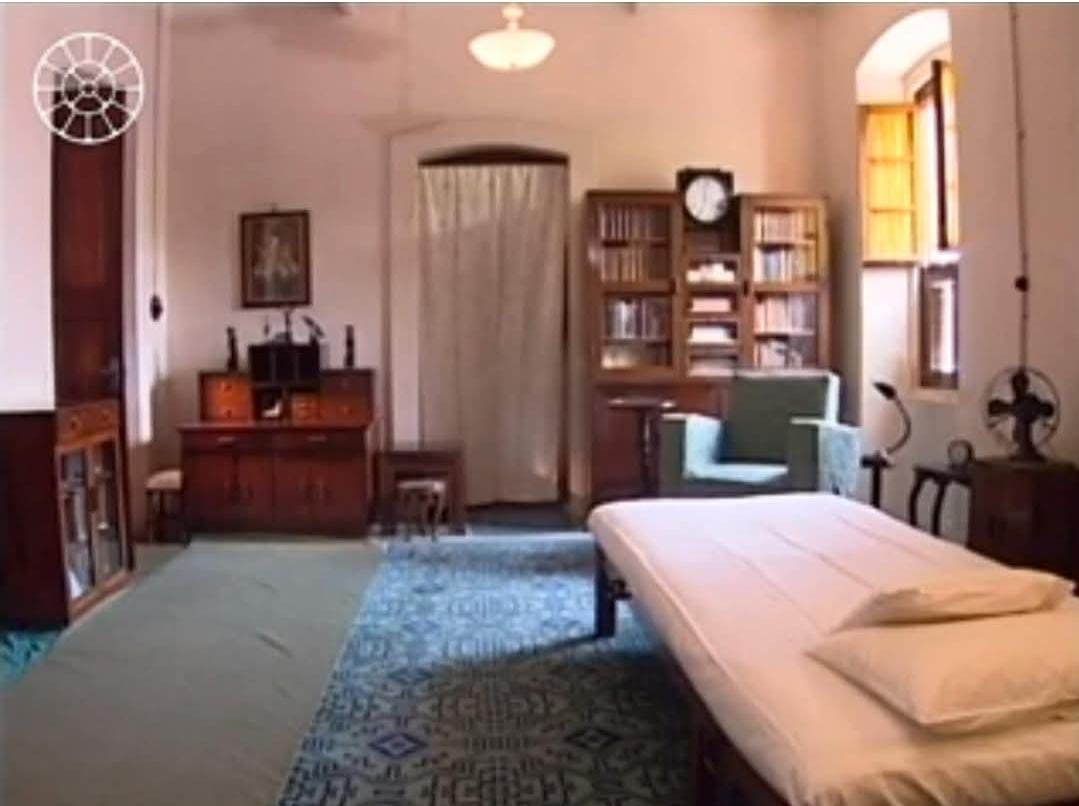
Featured Image: Sri Aurobindo’s Room where Savitri was born


Leave a Reply