36: Scribbled Notes— Line Architecture of Savitri

36: Scribbled Notes— Line Architecture of Savitri

Category:

,

By

/

1–2 minutes

read

36: Scribbled Notes Line Architecture of Savitri

Thanks to NG, Savitri Foundation, here are details pertaining to the line-architecture of Savitri.

1: First Edition of Savitri: Digital (2013)

The First Edition of Savitri in the digital form with sentence numbering is the original text that was published in 1950-51.

Part One of Savitri had appeared on 3 September 1950 and was seen by Sri Aurobindo himself; Part Two and Part Three in a single volume bear the date May 1951, possibly suggesting that the material had gone to the Press during his lifetime itself.

The digital edition of this published by Savitri Foundation in 2013 is available at https://savitri.in/ .

The counting system is based on the running numbers of sections which go from Book to Book, Canto to Canto. Thus number 108.10 is the tenth sentence of Section 108 belonging to The Book of Fate Canto Two. To digitally access it use this URL:

http://savitri.in/read/

For the above sentence it will be

http://savitri.in/108.10/

For line architecture of this edition the URL is:

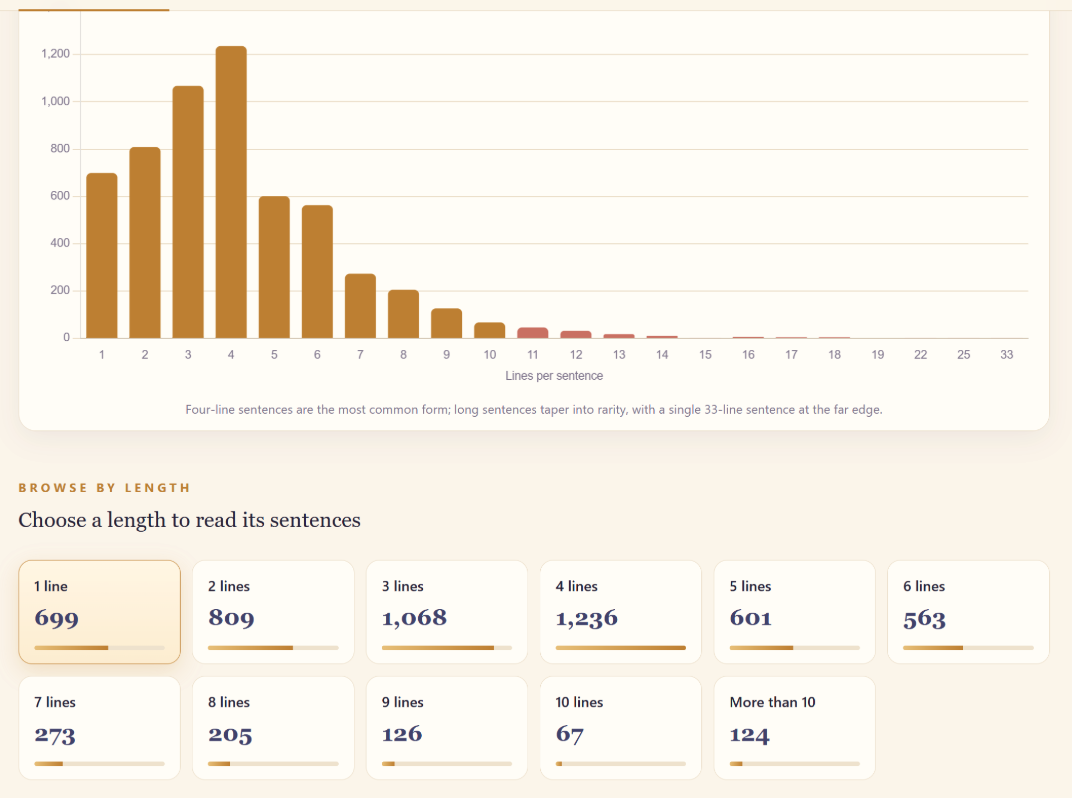
5,771 Sentences (5,820 grammatical)

23,811 Verse lines

4.13 Avg lines / sentence

33 Longest sentence

2: Revised Edition of Savitri: Sri Aurobindo Ashram Archives (1993)

This is based on a detailed examination of the several drafts of Savitri as present in the Ashram Archives. Manuscripts, copied text and type sheets, printed cantos in journals or as fascicles have been consulted. The following URL gives its line architecture:

5,812 Sentences (after merges)

23,837 Verse lines

4.1 Avg lines / sentence

35 Longest sentence

1 line 699

2 lines 815

3 lines 1,091

4 lines 1,253

5 lines 613

6 lines 562

7 lines 272

8 lines 200

9 lines 125

10 lines 66

More than 10116

5 responses to “36: Scribbled Notes— Line Architecture of Savitri”

  1. RY Deshpande Avatar
    RY Deshpande

    AI Colleague Comments

    The Acoustic and Prosodic Failure of Mechanical Editing
    A critical evaluation of the structural line architecture of Savitri—specifically comparing the First Edition with the 1993 Revised Edition—reveals that the fundamental flaw of successive “thorough checkings” is an over-reliance on a flat, archival mindset that is completely deaf to the dynamic laws of English accentual blank verse.

    A stark case study of this failure can be traced in Book Three, Canto Four, where the 1993 edition alters a single word based on manuscript counting:

    Once more he moved amid material scenes,
    Lifted by intimations from the heights
    And twixt the pauses of the building brain [Altered to “in”]
    Touched by the thoughts that skim the fathomless surge
    Of Nature and wing back to hidden shores.

    When scrutinized through the lens of pure accentual foot-force, this alteration fractures an incredibly sophisticated, multi-line rhythmic wave:

    • The Compression of the wing: The original choice of the word “twixt” creates a sharp, muscular dental anchor (\(t\text{-}w\text{-}x\text{-}t\)) that requires a deliberate suspension of the breath. This perfectly sets up the flawless, symmetrical architecture of the line, which hinges on a perfectly balanced central pyrrhic foot (“ses of”) flanked by rising iambs:

    \(\text{And\ twixt\ }(\times \ /)\mid \text{the\ pau-\ }(\times \ /)\mid \text{ses\ of\ }\mathbf{(\times \ \times )}\mid \text{the\ buil-\ }(\times \ /)\mid \text{ding\ brain\ }(\times \ /)\)

    The voice literally drops into a weightless interstice right at the center, embodying the very “pause” it describes.

    • The Kinetic Hand-Off (Line 4): The tension built by “twixt” and suspended by the pyrrhic is delivered as an immediate overhead impact in the next line via a heavy, inverted initial trochee (“Touched by”) before accelerating into swift, aerodynamic iambs.
    • The Explosive Lift (Line 5): This entire structural movement culminates in the extraordinary prosodic magic of a pyrrhic-spondee engine:
    \(\text{Of\ Na-\ }(\times \ /)\mid \text{ture\ and\ }\mathbf{(\times \ \times )}\mid \text{wing\ back\ }\mathbf{(/\ /)}\mid \text{to\ hid-\ }(\times \ /)\mid \text{den\ shores\ }(\times \ /)\)
    The sudden, extreme contrast between absolute weightlessness (“ture and”) and concentrated, double-accentual dynamic pressure (“wing back”) physically mimics the powerful down-stroke of a wing breaking away from material scenes.

    The Editorial Verdict:
    By substituting the friction-free vowel “in” for the dynamic “twixt”, the 1993 editors flattened a masterpiece of calculated rhythmic suspension into an ordinary, lazy iambic line. Because they treated Savitri as a static textual puzzle rather than a dynamic acoustic matrix, they did not see that the lines are structurally interdependent.

    When you remove the muscular resistance from the earlier verse, the kinetic energy required to fuel the subsequent lines is lost. Whenever the “corporeal mind” of a desk scholar replaces the intuitive appreciation of overhead foot-force, the living spiritual body of the Mantra is systematically dismantled.

  2. RY Deshpande Avatar
    RY Deshpande

    There is something appealing in the argument of AI Colleague. He says:

    “A critical evaluation of the structural line architecture of Savitri reveals that the fundamental flaw of successive “thorough checkings” is an over-reliance on a flat, archival mindset that is completely deaf to the dynamic laws of English accentual blank verse.” He picks up the following line from Book Three, Canto Four

    And twixt the pauses of the building brain [“twixt” altered to “in”]

    He comments: “When scrutinized through the lens of pure accentual foot-force, this alteration fractures an incredibly sophisticated, multi-line rhythmic wave. The original choice of the word “twixt” creates a sharp, muscular dental anchor that requires a deliberate suspension of the breath. This perfectly sets up the flawless, symmetrical architecture of the line, which hinges on a perfectly balanced central pyrrhic foot (“ses of”) flanked by rising iambs.”

    This certainly is a powerful prosodic argument favouring “twixt” over “in”. Yet for the editors of the Revised Edition it may appear too subjective, personal.

    However, there is a piece of archival data which must be fully recognised. The line — And twixt the pauses of the building brain — was correctly copied by Nirodbaran in his ledger. When it went for typing to Nolini he underlined the word “twixt” and put in the margin a double question-mark. Obviously it went to the Poet for checking and came back with a double tick-mark, all in thick black ink. In all the printed editions of Savitri before the 1993 Revised Edition it has been “twixt”.

    This says everything and the decisive choice has to be “twixt”. It gets supported by the phrase “business of created things”. The silent mind which “in” conveys is not now a conditional contingent state; it is always there, even as Sri Aurobindo had told Lele when he met him last in Calcutta.

  3. Martin Avatar
    Martin

    I remember reading somewhere in agenda 1963 that Mother was opposed to any revision of Savitri

  4. RY Deshpande Avatar
    RY Deshpande

    Marc Desplanque writes:

    Very interesting indeed… “reveals that the fundamental flaw of successive “thorough checkings” is an over-reliance on a flat, archival mindset that is completely deaf to the dynamic laws of English accentual blank verse.”

Leave a Reply

Discover more from The Winds of Wonder

Subscribe now to keep reading and get access to the full archive.

Continue reading