A Two-line Passage from Savitri
The most dramatic and decisive two-line sentence in Savitri is from Book Six Canto One, The Book of Fate. It holds the splendour of a wonderful destiny of the evolutionary earth waiting for a divine manifestation, of divine life in a divine body. Savitri meets Satyavan in the lonely Shalwa Woods and they pledge to be together in marriage. With a jubilant heart she rushes to her parents’ palace in Madra to let them know about the choice she has made. But already is present there the heavenly sage from Paradise who makes a very purposeful visit connected with the occasion. He comes with a stunning prophecy and tells the hosts, that
Twelve swift-winged months are given to him and her;
This day returning Satyavan must die. ||106.146||
Twelve swift|-winged months| are giv+en| to him| and her;|
This day| re+turn|+ing Sat|+ya+van| must die.|
Spondee-spondee-amphibrach-iamb-iamb
Iamb-iamb-iamb-pyrrhic-iamb
With two spondees and an amphibrach the first line carries tremendous tons of gold to tell that Satyavan “has” to die. The second line has the relieving felicity of iambic flow. There is a specificity of Satyavan’s death only if he is going to get married with Savitri. The unrhymed couplet has the quantitative load of a voice that echoes Anushtubha of the Sanskrit prosody.I am not sure if in Savitri we have any other two-line couplet which can come any close to this marvel.
However, we have a remarkable passage in the same Book, Canto Two, which brings out the narrative wonder of poetry. Narad takes the opportunity of his visit to justify the ways of God to man. When he had made the announcement of Satyavan’s death he was at once challenged if it was his God who had made this harsh calamitous law or some disastrous power usurped it:
Is it thy God who made this cruel law? ||107.11||
Or some disastrous Power has marred his work
And he stands helpless to defend or save? ||107.12||
Narad was ready with his answer. He knows who Savitri is, the Divine Mother herself, the incarnate to whom he had come to adore and be in her physical company as an exceptional privilege. She has come to redeem the mortal’s lot in the challenging circumstance under the full sway of the inconscient working. The immediate task is not to take a dangerous road, not to follow the Titan’s road. The Titan’s single will is to thwart every Godward attempt and drag the soul towards abysmal perdition:
Haste not towards Godhead on a dangerous road,
Open not thy doorways to a nameless Power,
Climb not to Godhead by the Titan’s road. ||110.4||
Against the Law he pits his single will,
Across its way he throws his pride of might. ||110.5||
Heavenward he clambers on a stair of storms
Aspiring to live near the deathless Sun. ||110.6||
His pain and others’ pain he makes his means:
On death and suffering he builds his throne. ||110.11||
He sees his little self as very God. ||110.18||
Following this is a perfect poem in eight couplets, a narrative that can stand independently. Let us give it a title:
World-Redeemer faces the Titan’s Pride of Might
His little “I” has swallowed the whole world,
His ego has stretched into infinity. ||110.19||
His mind, a beat in original Nothingness,
Ciphers his thought on a slate of hourless Time. ||110.20||
He builds on a mighty vacancy of soul
A huge philosophy of Nothingness. ||110.21||
In him Nirvana lives and speaks and acts
Impossibly creating a universe. ||110.22||
An eternal zero is his formless self,
His spirit the void impersonal absolute. ||110.23||
Take not that stride, O growing soul of man;
Cast not thy self into that night of God. ||110.24||
The soul suffering is not eternity’s key,
Or ransom by sorrow, heaven’s demand on life. ||110.25||
O mortal, bear, but ask not for the stroke,
Too soon will grief and anguish find thee out. ||110.26||
The caution for the Redeemer has the occult force which itself gives not only protection; it also carries a winning force to deal with the Adversary of the Divine who, in fact, knows now that time for his disappearance has arrived. To this we may gainfully add the following also. There is a power already present in the Redeemer and that must become operationally active. That is initiating the Redeemer into Yoga. He must first find his soul and in it harbour the Divine Force to conquer the Opponent, he having taking birth in the human circumstance.
Too enormous is that venture for thy will;
Only in limits can man’s strength be safe;
Yet is infinity thy spirit’s goal;
Its bliss is there behind the world’s face of tears. ||110.27||
A power is in thee that thou knowest not;
Thou art a vessel of the imprisoned spark. ||110.28||
Let us scan this narrative piece:
His lit|+tle “I”| has swal|+lowed the| whole world,|
His e+go| has stretched| in+to| in+fin|+i+ty.|
His mind,| a beat| in o+rig|+i+nal Noth|+ing+ness,|
Ci+phers| his thought| on a slate| of hour|+less Time.|
He builds| on a might|+y va|+can+cy| of soul|
A huge| phi+los|+o+phy| of Noth|+ing+ness.|
In him| Nir+va|+na lives| and speaks| and acts|
Im+pos|+si+bly| cre+at|+ing a u|+ni+verse.|
An e+ter|+nal ze|+ro is| his form|+less self,|
His spir+it| the void| im+per|+son+al ab|+so+lute.|
Take not| that stride,| O grow|+ing soul| of man;|
Cast not| thy self| in+to| that night| of God.|
The soul| suf+fer+ing| is not| e+ter|+ni+ty’s key,|
Or ran+som| by sorrow,| heav+en’s| de+mand| on life.|
O mor|+tal, bear,| but ask| not for| the stroke,|
Too soon| will grief| and an|+guish find| thee out.|
Too e+nor|+mous is| that ven|+ture for| thy will;|
On+ly| in lim|+its can| man’s strength| be safe;|
Yet is| in+fin|+i+ty| thy spir|+it’s goal;|
Its bliss| is there| be+hind| the world’s| face of tears.|
A pow|+er is| in thee| that thou know|+est not;|
Thou art| a ves|+sel of| the im+pris|+oned spark.|
The iambic pentameter has its wonderful sway in the entire passage, giving to what looks otherwise abstract-metaphysical the enthrallment and fluency unhindered by any ruggedness. We have in Savitri this magical charm and greatness of unrhymed couplets in several other places also, for instance:
My God is Will and triumphs in his paths,
My God is Love and sweetly suffers all. ||137.92||
To him I have offered hope for sacrifice
And gave my longings as a sacrament. ||137.93||
Who shall prohibit or hedge in his course,
The wonderful, the charioteer, the swift? ||137.94||
About Savitri’s structural manifold Sri Aurobindo himself has something to explain. Long before the epic took the final shape he wrote to Amal Kiran:
… when I attempted the single-line blank verse base on a large scale in Savitri, I found myself falling involuntarily into a series of four-line movement. But even though I was careful in the building, I found it led to a stiff monotony and had to make a principle of variation—one line, two line, three line, four line or longer passages (paragraphs as it were) alternating with each other; otherwise the system would be a failure. [18 July 1933]
Although there is constant foot-variation and line-variation in a sentence, the overall picture is that, on an average, there are four lines per sentence in the totality of a Section or of a Canto or a Book. The plain fact is, in the poem of about 24,000 lines there 6000 sentences, giving four lines per sentence. The longest sentence has 33 lines which in the nature of the grammar and punctuation could in fact be counted as 38 lines, these appearing in Book Ten Canto Four. “Look on these forms … the world walks its own way?” [144.14-18]
We have the beauty of “one line, two line, three line, four line or longer passages” variations, that not allowing at all the metronomic beat or ti-tum drumming with its monotony to hit our ears. Apart from this poetic art, the vowel and consonant variation, end-stopped lines with occasional enjambement with a line overflowing into the next, admitting at times even accidental rhymes in a set of lines, “A greatness and a sweetness and a light” iamb-pyrrhic-iamb-pyrrhic-iamb in a spiritual tango coming from the sublime Buenos Aires. See, for instance this enjambement:
Then none could answer to her words. Silent
They sat and looked into the eyes of Fate. ||106.201||
This is when Savitri firmly affirms her will to remain with Satyavan though he may have to die one year after the marriage:
If for a year, that year is all my life
And yet I know this is not all my fate
Only to live and love awhile and die. ||106.198||
For I know now why my spirit came on earth
And who I am and who he is I love. ||106.199||
I have looked at him from my immortal Self,
I have seen God smile at me in Satyavan;
I have seen the Eternal in a human face. ||106.200||
See the fiery magic of that couplet “For I know now…” making it superlatively powerful. That “now” has the full strength of the discovery of love that has awakened the soul of Savitri. It is not a mantra but it is something more than that, the narrative itself holding the divine force and intention in the execution of what it is holding, the power of Love conquering Death.
27 May 2026
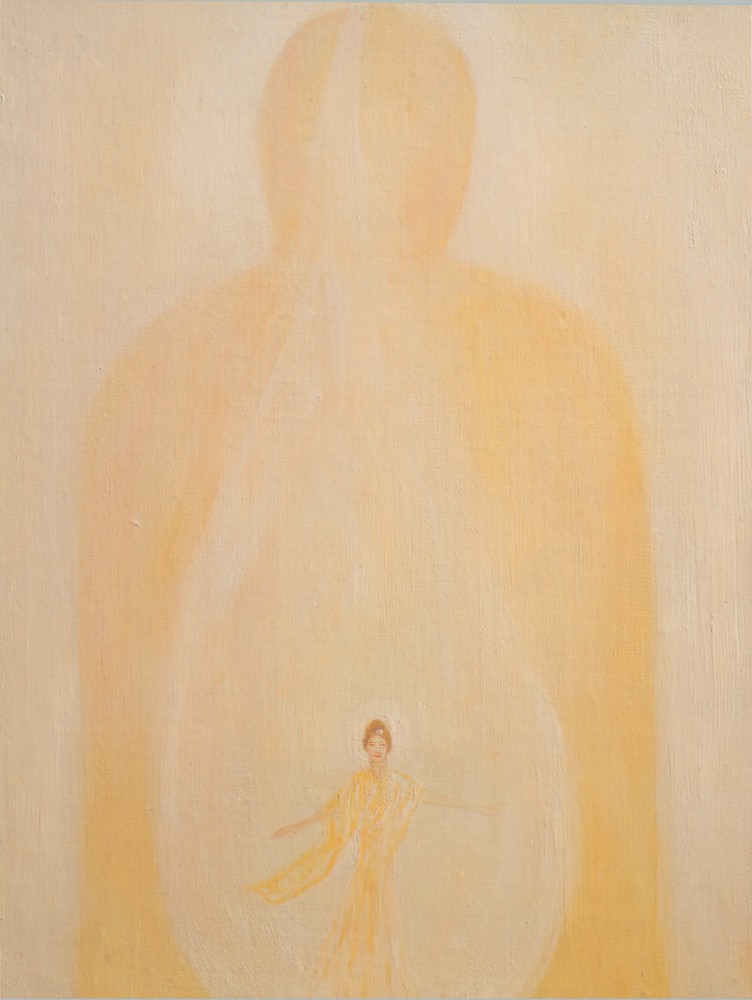
The featured image is a painting by Huta
Savitri Book 6 Canto 1 – The Word of Fate
But Savitri replied with steadfast eyes… ||106.190||
If for a year, that year is all my life.
And yet I know this is not all my fate
Only to live and love awhile and die. ||106.198||
For I know now why my spirit came on earth
And who I am and who he is I love. ||106.199||
I have looked at him from my immortal Self,
I have seen God smile at me in Satyavan;
I have seen the Eternal in a human face. ||106.200||
Line Architecture of Savitri

Here is the link for the !993 Revised Edition of Savitri:

Leave a Reply