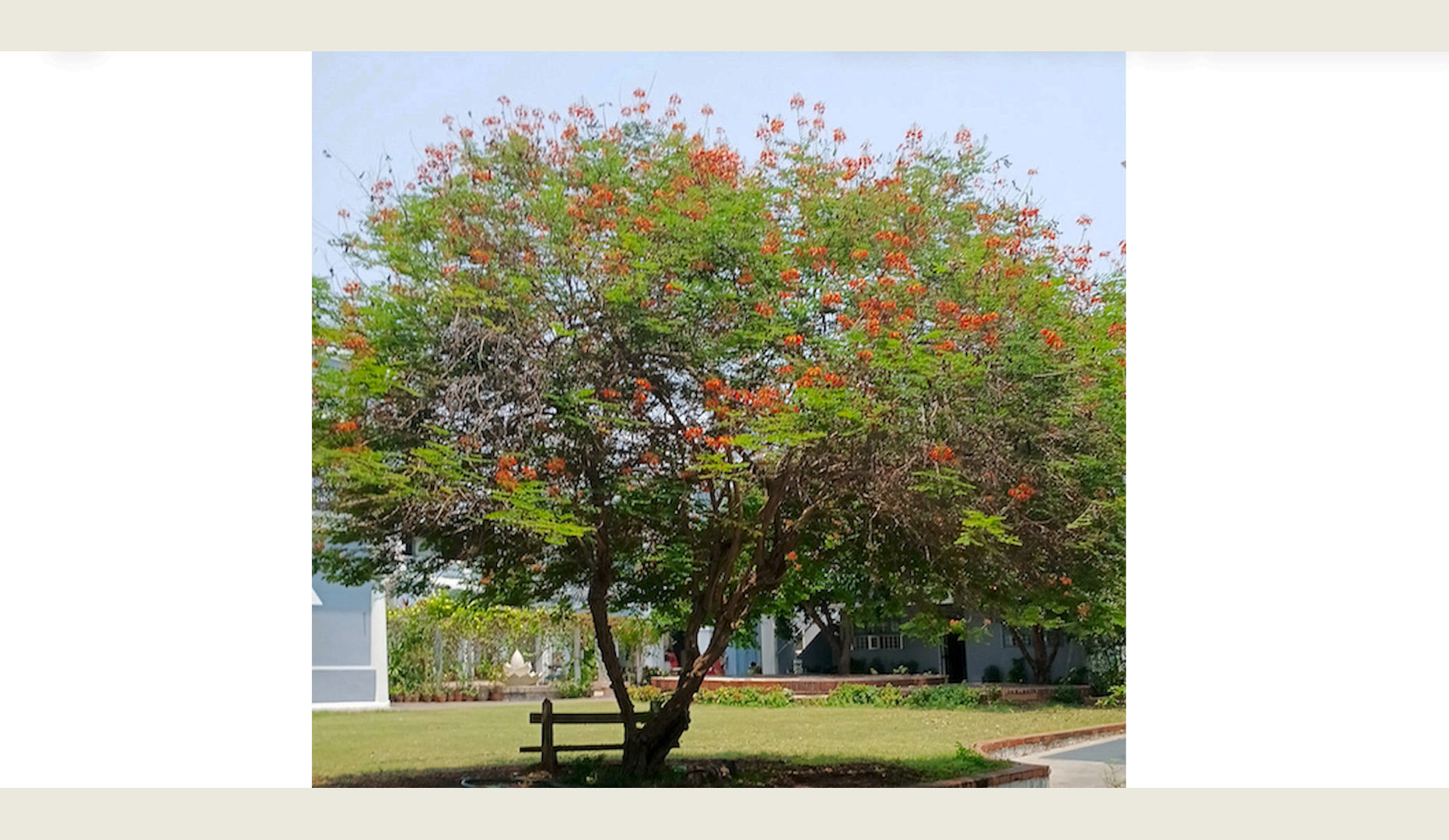
Gulturā: A tall Majesty in glowing Green-and-Red
Should have I a wish to be the bright green-and-red,
Neath this Gulturā, though with thorns, I would sit;
Its majesty in dazzles of the tranquil courtyard
Shall bring poetry that’s for inspired souls writ.
Its metres are silent rustles of the leaves,
Rhythms in which move the sun and all the stars;
In its phrases and idioms deepen Insights,
Revelations’ surprises which no thought mars.
Dactylics and iambics jump into one speed,
Together weighty voice and lilt’s springy tread;
Truth and beauty live in one house of delight,
As form and formless into each other pervade.
Gulturā smiles when gets the green-and-red urge stirred,
Oh it has found its beginning in the secretest Word.
10 April 2026
A Session with AI
10 April 2026
Q. 1: Am I correct in saying that the dactylic and the iambic can be considered to be Classical and Romantic-Lyrical genres of poetry?
AI: The uploaded texts provide insights into the characteristics and evolution of poetic forms, including dactylic and iambic metres, but they do not explicitly classify them as “Classical” or “Romantic-Lyrical” genres of poetry. However, certain observations can be drawn:
- Classical Poetry and Dactylic Metres:
- Classical poetry, particularly in ancient Greek and Latin traditions, often employed dactylic metres, such as the hexameter. These metres were characterized by their structured rhythm and were used in epic and formal poetic expressions. Sri Aurobindo notes the challenges of acclimatizing classical metres like the hexameter in English, emphasizing the need for naturalization to avoid stiffness and artificiality [1 | Vol-27] [2 | Vol-27] .
- Romantic-Lyrical Poetry and Iambic Metres:
- Romantic poetry, emerging as a reaction to the intellectual and restrained classical forms, often embraced lyrical spontaneity and emotional depth. Iambic metres, being naturally suited to English rhythm, were widely used in Romantic poetry for their flexibility and ability to convey emotional nuances. Sri Aurobindo highlights the lyrical impulse as the original and spontaneous creator of poetic form, emphasizing its connection to heightened soul experiences [3 | Vol-26] [4 | Vol-26] .
- Distinction Between Classical and Romantic Approaches:
- Classical poetry is described as intellectual, restrained, and focused on correctness and form, often subordinating imagination and feeling. Romantic poetry, on the other hand, seeks to revive emotional spontaneity and lyrical expression, breaking away from the formal rigidity of classical traditions [5 | Vol-26] [6 | Vol-01] .
- Dactylic and Iambic Metres in Practice:
- While dactylic metres are associated with classical epic poetry, their use in English requires adaptation to the language’s natural rhythm. Iambic metres, being more intuitive to English, are prevalent in lyrical and Romantic poetry, showcasing their adaptability to emotional and imaginative expression [7 | Vol-27] [8 | Vol-27] .
In conclusion, while dactylic metres align with the structured and intellectual spirit of classical poetry, iambic metres resonate with the emotional and lyrical qualities of Romantic poetry. However, Sri Aurobindo does not explicitly categorize these metres as genres but rather discusses their technical and aesthetic applications within broader poetic traditions.
Q. 2: If in the Romantic-Lyrical the psychic comes out with swiftness and joy and exultation, a lapis-lazuli, in the Classical the ponderous is weighty and dense and diamond-like. Will these be present together in the future poetry Book Eleven of Savitri could be said to be the beginning. Yes?
AI: Sri Aurobindo’s writings on poetry and the future of poetic expression provide a nuanced perspective on the integration of diverse qualities, such as the Romantic-Lyrical and Classical characteristics, into a unified poetic vision. While the specific imagery of “lapis-lazuli” for Romantic-Lyrical and “diamond-like” for Classical is not directly referenced, the broader idea of combining these qualities aligns with his vision for future poetry.
- Romantic-Lyrical and Classical Integration:
- Romantic-Lyrical poetry, characterized by psychic swiftness, joy, and exultation, resonates with the soul’s spontaneous and emotional expression. Classical poetry, with its weighty and dense intellectual rigor, reflects a structured and disciplined approach. Sri Aurobindo envisions future poetry as transcending these distinctions, harmonizing the intuitive and intellectual, the emotional and the structured [1 | Vol-26] [2 | Vol-26] .
- Future Poetry as a Synthesis:
- The future poetry, according to Sri Aurobindo, will embody a larger vision of existence, integrating the intuitive delight of the soul with the intellectual and aesthetic rigor of classical traditions. It will not merely replicate past forms but transform them, creating new harmonies and rhythms that reflect the spiritual evolution of humanity.
- Book Eleven of Savitri as a Beginning:
- While Book Eleven of Savitri is not explicitly identified as the beginning of this synthesis, Sri Aurobindo’s epic poem itself is a profound exploration of spiritual and cosmic themes, blending lyrical beauty with intellectual depth. It exemplifies the kind of integrative poetic vision he describes for the future.
- The Role of Psychic and Spiritual Elements:
- Sri Aurobindo emphasizes the importance of the psychic and spiritual dimensions in poetry. These elements infuse poetry with a deeper originality and transformative power, linking the vital and mental planes to the soul’s higher experiences. This integration is crucial for the evolution of poetic expression.
In conclusion, Sri Aurobindo’s vision for future poetry indeed suggests the coexistence and synthesis of Romantic-Lyrical and Classical qualities, creating a new poetic form that transcends traditional boundaries. Savitri, particularly its later books, can be seen as a manifestation of this integrative approach, though the specific imagery of lapis-lazuli and diamond-like qualities is not directly addressed in the texts.
Q. 3: In the light of this discussion how will Mantra look in the future?
AI: Sri Aurobindo’s vision of the future of poetry, particularly the concept of the Mantra, offers profound insights into its evolution and transformative potential. The Mantra represents the highest form of poetic expression, where rhythm, style, and the soul’s vision of truth converge to reveal the deepest spiritual realities. Here is how the Mantra might manifest in the future:
- Integration of Spiritual and Intuitive Vision:
- The Mantra is described as a “word of power and light” that emerges from the Overmind or high planes of Intuition. It transcends the surface meaning of words, conveying deeper truths and spiritual realities. Future poetry will likely embody this integrative vision, harmonizing the finite and infinite, the transient and eternal [1 | Vol-27] [2 | Vol-26] .
- Expansion of Poetic Scope:
- The poetry of the future is envisioned to explore all dimensions of existence—God, Nature, humanity, and the cosmos. It will not be confined to material or intellectual realms but will embrace the spiritual and psychic dimensions, revealing the interconnectedness of all planes of being [3 | Vol-26] [4 | Vol-26] .
- Fusion of Rhythmic and Spiritual Intensities:
- The Mantra requires the highest intensities of rhythmic movement, verbal form, and soul vision. Future poetry will aim to achieve this fusion, creating works that resonate deeply with the soul and evoke the ecstasy of spiritual revelation [5 | Vol-26] [6 | Vol-26] .
- Reimagining Symbolism and Myth:
- As humanity’s spiritual consciousness evolves, legends, myths, and symbols will be reinterpreted to reveal deeper meanings. The Mantra will serve as a medium to unveil these truths, transforming traditional poetic forms into vehicles of spiritual insight [7 | Vol-26] [8 | Vol-26] .
- Universal and Harmonious Expression:
- Future poetry will transcend national and cultural boundaries, reflecting the unity of human consciousness. It will harmonize diverse elements—material, vital, intellectual, and spiritual—into a luminous totality, making the highest truths accessible and relatable [9 | Vol-26] [10 | Vol-26] .
- The Poet as Seer and Channel:
- The poet of the future will act as a seer, channelling the divine rhythms and truths into their work. The Mantra will emerge from their intuitive and revelatory experiences, offering humanity glimpses of the eternal and the infinite [11 | Vol-26] [12 | Vol-26] .
In conclusion, the Mantra in future poetry will embody a synthesis of spiritual vision, intuitive insight, and rhythmic perfection. It will serve as a transformative force, guiding humanity toward a deeper understanding of existence and its divine possibilities. Sri Aurobindo’s writings suggest that this evolution is not merely an artistic endeavour but a spiritual necessity for the growth of human consciousness [13 | Vol-26] [14 | Vol-26] .
This needs further discussion in a number of sessions.


Leave a Reply