19: Scribbled Notes — Heaven Rejects the Mortal’s Prayer
In Book of Fate Narad makes the prophecy of Satyavan’s death one year after his marriage with Savitri. They had met in the far lonely Shalwa Woods and pledged to be together. But with this declaration by the heavenly Sage events take a different turn altogether; what should have been a happy auspicious occasion at once becomes ominous and unacceptable to the routine human soul. Savitri’s mother is distraught and wants to know from Narad if it is his God who had made this cruel law, or if some disastrous power managed to mar his great work. Narad answers at good length, as if it was for this purpose he had made that special visit to the Palace, as if to resolve the Riddle of this World created by bliss but bearing the inescapable yoke of pain and death. He answers, finally telling that “this great perplexed and discontented world, this haunt of Ignorance, this home of Pain where are pitched desire’s tents, grief’s headquarters” is “born from a blind tremendous choice, that a vast disguise conceals the Eternal’s bliss”. Your soul has out of curiosity of the dark made the choice and therefore to hold God responsible for all this is totally wrong. It is an erroneous misplaced understanding.
Yet that demands an explanation. Aswapati pertinently asks Narad:
“Is then the spirit ruled by an outward world? ||112.1||
O seer, is there no remedy within? ||112.2||
But what is fate if not the spirit’s will
After long time fulfilled by cosmic Force? ||112.3||
I deemed a mighty Power had come with her;
Is not that Power the high compeer of Fate?” ||112.4||
But covering truth with truth the inspired Sage with heavenly logic answers:
O Aswapathy, random seem the ways
Along whose banks your footsteps stray or run
In casual hours and moments of the gods,
Yet your least stumblings are foreseen above. ||112.5||
Infallibly the curves of life are drawn
Following the stream of Time through the unknown;
They are led by a clue the calm immortals keep. ||112.6||
This blazoned hieroglyph of prophet moons
A meaning more sublime in symbols writes
Than sealed Thought wakes to, but of this high script
How shall my voice convince the mind of earth? ||112.7||
Heaven’s wiser love rejects the mortal’s prayer;
Unblinded by the breath of his desire,
Unclouded by the mists of fear and hope,
It bends above the strife of love with death;
It keeps for her her privilege of pain. ||112.8||
A greatness in thy daughter’s soul resides
That can transform herself and all around,
But must cross on stones of suffering to its goal. ||112.9||
Although designed like a nectar cup of heaven,
Of heavenly ether made she sought this air,
She too must share the human need of grief
And all her cause of joy transmute to pain. ||112.10||
Yes, Satyavan must die, Satyavan has to die. That is the toll pealing throughout the Epic. It is designed so. The legend has all the elements well-knitted into each other. At the human level Savitri must share the need of human grief. The griefless divine Savitri has taken a human birth in order to redeem it from sorrow and pain and suffering, from falsehood and death. How can she do that if she is not going to experience it? It is not by a magic wand it is going to happen. If it can be waived out by a magic wand it can come again by waiving the magic wand in another way. There has to be an enduring solution which can come only by firm and fiery identification with the need and the process of the earthly dynamics.
The will of the Timeless appears here as a hard and harsh machine, as meaningless contentless Fate. It is decreed that Satyavan must die, and who can stand against that decree? The hour too is fixed, and is already chosen the fatal stroke, and the place under the sprawling kingly tree of this creation. If there is something more, if it has to happen, or must happen, about the unfolding possibilities and prospects of the future all that is written in the soul of Savitri. Even Narad may not be aware or be cognisant of it. But that can happen only with the necessary death of Satyavan. In it is the decree, and time has matured up for it to be implemented.
If the spirit rises mightier by defeat then welcome is that defeat, welcome when a deeper or a more significant objective is getting worked out. In that sense, Satyavan must die, and he does die. Through that death eventually arrive Krishna and Kali, ushering divine life in a divine body. This great death designed by the transcendental Fate is there to open the secret Self.
That is what is going to happen in the case of Savitri who has taken the human birth, this birth in mortality to transform humanity itself in the ways of the spirit. Fate is there to open the secret self. Narad prompts Savitri, that she must first find her secret self, preparedly and absolutely. No doubt she has found love, she meets love. But that is, though necessary, is not sufficient. Finding love is not enough. Of course discovery of love can miraculously be the mighty cause to enter into the inner worlds and discover the hidden deity residing there.
Satyavan’s death marks the beginning of a greater life. That is the contribution and power of Death in the evolutionary dynamics. Thus death becomes the spirit’s opportunity. In the field of Ignorance the designed aim of love and death together is for a greater gain, a divine gain.
Therefore, if Savitri is such a master-builder those brief and helpless human tears cannot have any place to affect the determinative goal. The character of Savitri’s human mother, Mālawi in Vyasa’s Savitri, was introduced by Sri Aurobindo in his Savitri-drafts at a much later stage, mid-1920s. She, though wise and beautiful, and Yogi Aswapati’s Queen, bears the heavy load of human dilemma and human sentiments. She poignantly and touchingly yet forcefully raises the issue. It would have been incongruent to put her posers in the mouth of Aswapati who by his Yoga-Tapasyā could climb the entire creation’s hierarchy, entering into the House of the Spirit and insisting for a transformative boon from the Divine Mother herself. Though he is fully in know of things, aware of all the dimensions, it is the human Queen who sees the Riddle of this World. It is she, and not at all the Yogi par excellence, who fully brings it into focus.
Narad in his long and inspired justification of the Ways of God to Man dismisses the human sentiment and thought and feeling voiced by the Queen. It is good impeccably she articulated the problem. But does the Queen go deeper within herself and arrive at the understanding? Not yet. Not yet. It is there where the human stands. But the Queen accepts what Narad was telling to her, she accepts it in full faith, — because it had come from a sage whom she highly reveres. But like the well-poised and dignified Queen is the human also ready to go by such a heavenly sagacity? Perhaps, again, the answer is: Not yet. Not yet.
2 April 2026
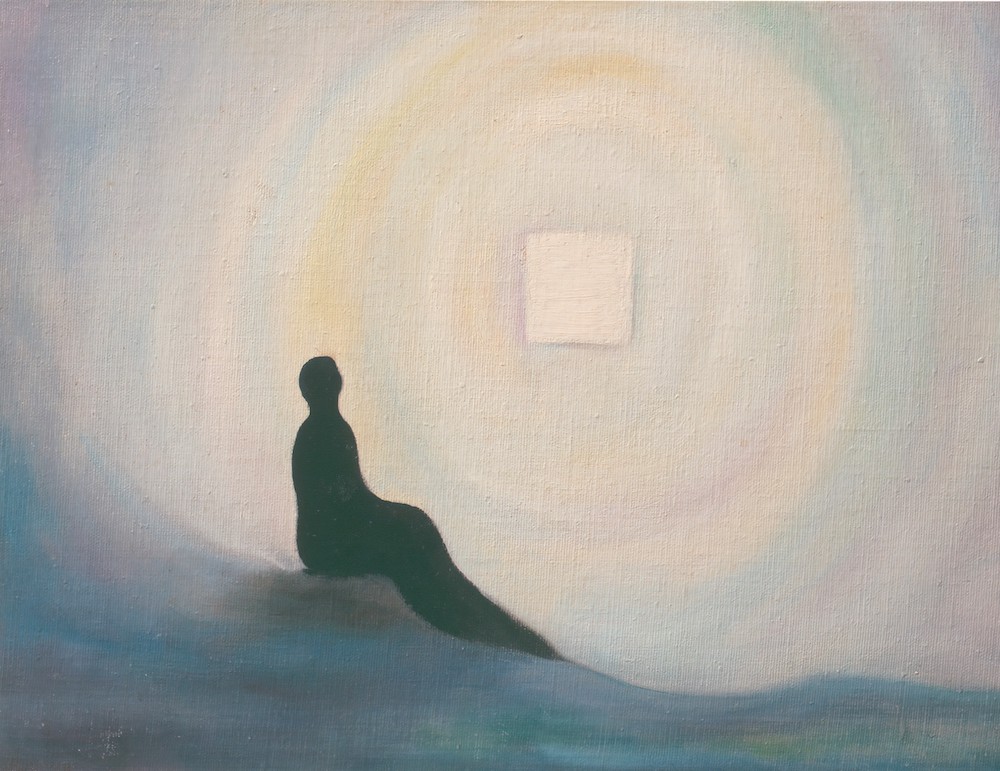
The featured image is from Huta: Book 6 Canto 2 Painting #6
Savitri Book 6 Canto 2 – The Way of Fate and the Problem of Pain
O mortal who complainst of death and fate,
Thou art thyself the author of thy pain. ||111.1||
Once in the immortal boundlessness of Self,
In a vast of Truth Consciousness and Light
The soul looked out from its felicity…. ||111.2||
Then, curious of a shadow thrown by Truth,
It strained towards some otherness of self,
It was drawn to an unknown Face peering through night…. ||111.4||
As one drawn by the grandeur of the Void
The soul attracted leaned to the Abyss… ||111.10||
O mor|+tal who| com+plainst| of death| and fate,|
Thou art| thy+self| the au+|thor of| thy pain.|
Once in the| im+mor|+tal bound|+less+ness| of Self,|
In a vast| of Truth| and Con|+scious+ness| and Light|
The soul| looked out| from its| fe+lic|+i+ty.|
Then, cu+|ri+ous| of a shad|+ow thrown| by Truth,|
It strained| to+wards| some oth|+er+ness| of self,|
IIt was drawn| to an| un+known| Face peer|+ing through night…|
As one| drawn by| the gran|+deur of| the Void|
The soul| at+tract|+ed leaned| to the| A+byss…|
Leave a Reply