18: Scribbled Notes — “Two looked upon each other, Soul saw Soul”
We are looking into the following line appearing in the early part of Book Eleven:
Two looked upon each other, Soul saw Soul. ||149.35||
Savitri has triumphed over Death and entered into the Transcendent. But there still is a “mute invisible and translucent wall” separating her from the spirit of Satyavan. That must disappear.
Although there is the transfiguration of the earlier Death, although the Falsehood has gone, Savitri has yet to clear a test. Instead of Death there is now One in whose limbs is gathered all the sweetness that can blind her heart to the beauty of the suns. Death’s sombre cowl has been cast away from Nature’s brow, and all glory and all divinity are collected in a single form. In him the Fourfold Being bears its crown. It is he and Savitri who look upon each other. Will Savitri pass the test? She is offered to stay in the House of the Spirit along with her Satyavan.
They look upon each other trying to gauge one another. There is the temptation for her:
A smile came rippling out in her wide eyes,
Its confident felicity’s messenger
As if the first beam of the morning sun
Rippled along two wakened lotus-pools:
“O besetter of man’s soul with life and death
And the world’s pleasure and pain and Day and Night,
Tempting his heart with the far lure of heaven,
Testing his strength with the close touch of hell,
I climb not to thy everlasting Day,
Even as I have shunned thy eternal Night.” ||151.2||
For her Earth is the chosen place and she will never forsake it. She maintains:
Let not the inconscient gulf swallow man’s race
That through earth’s ignorance struggles towards the Light.||151.22||
O thunderer with the lightnings of the soul,
Give not to darkness and to death thy sun,
Achieve thy wisdom’s hidden firm decree
And the mandate of thy secret world-wide love. ||151.23||
Their looking upon each other is significantly loaded with the future of the Earth, with the dense possibility of an evolutionary manifestation in her. Savitri rises to the occasion.
Let us look into the line — Two looked upon each other, Soul saw Soul —from various angles. One possibility is to approach the AI (at https://incarnateword.in/askai#! 7 April 2026) and see what it has to tell. Questions are followed by the answers coming from it.
Q. 1: In Book Eleven of Savitri there is this line: “Two looked upon each other, Soul saw Soul”. How will it differ if changed to “Two looked into each other, Soul saw Soul”?
AI: The line “Two looked upon each other, Soul saw Soul” from Book Eleven of Savitri carries a profound spiritual resonance, and altering it to “Two looked into each other, Soul saw Soul” would subtly shift its meaning and emphasis. Let us explore the nuances of both expressions:
“Two looked upon each other, Soul saw Soul”
- “Looked upon” suggests a mutual recognition, a gaze that acknowledges the presence of the other. It implies a meeting of two beings on equal footing, where the act of looking is outward yet penetrates deeply enough to reveal the soul.
- The phrase emphasizes the act of seeing as a revelation, where the soul’s essence is unveiled through the mutual gaze. It conveys a sense of transcendence, as if the souls are perceiving each other beyond the surface of individuality.
- This phrasing aligns with the integral vision of Sri Aurobindo, where the soul’s recognition is not just an inward journey but also a relational, universal act—acknowledging the divine in the other.
“Two looked into each other, Soul saw Soul”
- “Looked into” shifts the focus inward, suggesting a deeper probing or introspection within the other. It implies a more intimate, almost invasive act of seeking the soul within the other person.
- This phrasing emphasizes a journey of discovery, where the act of looking is more about delving into the depths of the other’s being. It suggests a more personal and perhaps psychological exploration rather than a universal recognition.
- While still profound, this version might feel more individualistic, focusing on the inner dynamics between the two rather than the broader, cosmic revelation of soul meeting soul.
The Difference in Spiritual Tone
- The original “looked upon” conveys a cosmic equality and universality, where the act of seeing is a shared, divine recognition. It resonates with the supramental vision of unity in diversity.
- The altered “looked into” conveys a more intimate and personal exploration, which might feel more psychological or relational but less universal in its scope.
Why the Original Matters
Sri Aurobindo’s choice of “looked upon” reflects his poetic precision and spiritual intent. It aligns with the overarching theme of Savitri, where the individual soul’s journey is always in harmony with the universal and transcendent. The phrase “looked upon” captures the balance between individuality and universality, while “looked into” might tilt the balance toward the individual and relational.
In conclusion, while “looked into” retains depth, it subtly narrows the scope of the encounter, making it more personal and introspective. The original “looked upon” preserves the vastness and universality of the soul’s recognition, which is central to the spiritual vision of Savitri.
Q. 2: In the line we have “Soul saw Soul”. With lower case/upper case we can have Soul saw Soul; Soul saw soul; soul saw Soul; soul saw soul. What differences will these carry?
AI: The variations in capitalization—Soul saw Soul, Soul saw soul, soul saw Soul, and soul saw soul—carry profound differences in meaning, reflecting the levels of consciousness, the nature of the encounter, and the spiritual or psychological depth of the experience. Let us explore each variation in detail:
1. Soul saw Soul
- Meaning: This represents the highest, most transcendent level of recognition. Here, the Soul refers to the eternal, divine essence within each being—the psychic being or the divine spark in Sri Aurobindo’s terminology. The capitalization of both “Soul” emphasizes the meeting of two divine presences, beyond individuality or personality.
- Implication: This is a cosmic, universal encounter where the divine within one being recognizes and communes with the divine within the other. It is a moment of pure spiritual realization, where the veil of separateness dissolves, and only the eternal truth remains.
- Tone: Majestic, universal, and transcendent. It aligns with the supramental vision of unity in diversity, where all beings are expressions of the One Divine.
2. Soul saw soul
- Meaning: Here, the first “Soul” still refers to the divine essence, but the second “soul” refers to the individual soul or personality—the unique, evolving aspect of a being. This suggests that the divine within one being perceives and understands the individuality or evolving consciousness of the other.
- Implication: This reflects a relationship where the higher consciousness (the psychic being) recognizes and embraces the uniqueness of the other’s journey. It is a compassionate, understanding gaze that sees the divine potential within the evolving human personality.
- Tone: Compassionate, integrative, and relational. It bridges the eternal and the temporal, the divine and the human.
3. soul saw Soul
- Meaning: Here, the first “soul” refers to the individual, evolving consciousness, while the second “Soul” refers to the eternal, divine essence. This suggests an upward gaze, where the individual soul aspires to perceive and connect with the divine within the other.
- Implication: This reflects the aspiration of the human consciousness to rise beyond its limitations and recognize the divine presence in another. It is a moment of spiritual seeking or awakening, where the finite glimpses the infinite.
- Tone: Aspirational, reverent, and transformative. It captures the yearning of the human soul to transcend its boundaries and touch the divine.
4. soul saw soul
- Meaning: Both “soul” here refer to the individual, evolving consciousness. This suggests a meeting at the level of personality or individuality, where two beings recognize each other’s unique qualities and experiences.
- Implication: This is a more human, psychological encounter, where the recognition is limited to the surface or intermediate levels of consciousness. It reflects empathy, understanding, or connection at the level of the mind, emotions, or personality.
- Tone: Personal, relational, and limited in scope. While meaningful, it does not carry the transcendent or universal resonance of the other variations.
Summary of Differences
Soul saw Soul
Divine essence recognizing divine essence; Universal, transcendent, eternal; Majestic, cosmic
Soul saw soul
Divine essence recognizing individuality; integrative, compassionate, relational; bridging, Compassionate
soul saw Soul
Individual aspiring to divine essence; Aspirational, transformative; Reverent, upward-looking
soul saw soul
Individual recognizing individuality; Personal, psychological, human; Relational, limited
In the Context of Savitri
In Savitri, the line “Soul saw Soul” reflects the highest spiritual realization, where the divine within one being recognizes the divine within another. This is not merely a personal or psychological connection but a universal and eternal communion. Altering the capitalization would shift the meaning and tone, potentially reducing the spiritual grandeur of the moment.
Sri Aurobindo’s choice of “Soul saw Soul” is deliberate, as it encapsulates the essence of his integral vision: the meeting of two divine presences, transcending the limitations of individuality and revealing the oneness of all existence.
Q. 3: Metrically the line “Two looked upon each other, Soul saw Soul” scans as spondee-iamb-spondee-iamb-spondee. But the line “Two looked into each other, Soul saw Soul” is with spondee-trochee-spondee-iamb-spondee. The rhythms are different. How will you perceive the poetry?
AI: The shift in rhythm between the two lines—“Two looked upon each other, Soul saw Soul” and “Two looked into each other, Soul saw Soul”—creates a distinct difference in the poetic experience, affecting both the emotional resonance and the spiritual tone of the verse. Let us explore how these rhythmic variations influence the perception of the poetry.
1. Original Line: “Two looked upon each other, Soul saw Soul”
- Meter: Spondee-iamb-spondee-iamb-spondee
- Two looked | upon | each oth- | er, Soul | saw Soul
- Rhythmic Quality:
- The alternation of spondees (two stressed syllables) and iambs (unstressed-stressed) creates a balanced, deliberate rhythm. The spondees give weight and gravitas, while the iambs introduce a natural, flowing cadence.
- This rhythm mirrors the profound, steady, and universal nature of the encounter. The spondees emphasize the solemnity of the moment, while the iambs provide a sense of movement and progression, reflecting the dynamic interplay of recognition between the two souls.
- Poetic Effect:
- The rhythm feels majestic and harmonious, evoking a sense of cosmic balance. It reflects the spiritual equality and universality of the meeting, where the divine essence in one soul recognizes the divine essence in the other.
- The steady alternation of stresses creates a meditative, almost mantra-like quality, drawing the reader into the depth of the experience.
2. Altered Line: “Two looked into each other, Soul saw Soul”
- Meter: Spondee-trochee-spondee-iamb-spondee
- Two looked | into | each oth- | er, Soul | saw Soul
- Rhythmic Quality:
- The introduction of a trochee (stressed-unstressed) in the second foot disrupts the balance of the original line. The trochee creates a sense of falling or descent, as the stress shifts from the first syllable to the second.
- This rhythm feels more dynamic and less steady, introducing a sense of probing or searching. The trochee suggests an inward movement, as if the act of “looking into” involves a deeper, more personal exploration.
- Poetic Effect:
- The rhythm feels more intimate and psychological, reflecting the inward focus of “looking into” rather than the outward, universal recognition of “looking upon.”
- The trochee introduces a slight asymmetry, which may evoke a sense of tension or yearning. This could suggest the effort or struggle involved in penetrating the depths of another’s being.
Comparison of Poetic Perception
Rhythmic Balance:
Original line: Balanced alternation of spondees and iambs
Altered line: Disrupted by the trochee, creating asymmetry
Tone
Original line: Majestic, universal, meditative
Altered line: Intimate, probing, psychological
Emotional Resonance
Original line: Cosmic harmony and equality
Altered line: Personal depth and searching
Spiritual Implication
Original line: Reflects a transcendent, divine recognition
Altered line: Suggests an inward, relational exploration
Why the Original Rhythm Matters
The original line’s rhythm—spondee-iamb-spondee-iamb-spondee—perfectly aligns with the spiritual grandeur of the moment described in Savitri. The steady alternation of stresses mirrors the cosmic balance and universality of the encounter, where the divine within one being recognizes the divine within another. The rhythm feels timeless, as if it echoes the eternal truth of the soul’s unity.
In contrast, the altered line’s rhythm introduces a more personal, psychological tone. The trochee disrupts the cosmic balance, drawing the focus inward and making the encounter feel more individualistic and relational. While this rhythm might suit a different poetic context, it diminishes the universal and transcendent quality that is central to Savitri.
Conclusion
The rhythmic structure of the original line enhances its spiritual and poetic power, creating a sense of cosmic harmony and divine recognition. The altered line, with its trochee, shifts the tone toward intimacy and introspection, which, while meaningful, lacks the majestic universality of the original. In Savitri, where every word and rhythm is meticulously crafted to convey the highest spiritual truths, the original rhythm is not just a matter of poetic preference but an essential part of the line’s deeper significance.
Q. 4: We were looking into the line “Two looked upon each other, Soul saw Soul” Instead of “upon” a suggestion for “into” was made. Your perception turned out to be in full accord with the nature of Savitri’s poetry and spirituality. I see that in the Poem we not only have perfect word, mot juste; there is also a kind of mathematical precision, and accuracy, in the expression. Please opine.
AI: The line “Two looked upon each other, Soul saw Soul” from Savitri is a profound encapsulation of the spiritual essence and poetic precision that defines Sri Aurobindo’s work. The suggestion to replace “upon” with “into” invites an interesting reflection on the nuances of perception and connection in the context of the poem’s spiritual depth.
- “Upon” vs. “Into”: The word “upon” conveys a sense of mutual recognition and a shared gaze that rests on the surface yet penetrates deeply through the soul’s inherent power. It suggests a meeting of equals, a balanced exchange of spiritual awareness. On the other hand, “into” might imply a more probing or inward movement, as if one soul is delving into the depths of the other. While “into” could emphasize intimacy, “upon” retains the balance and mutuality that aligns with the integral harmony of Savitri‘s vision.
- Mathematical Precision in Expression: Sri Aurobindo’s poetry is indeed marked by a meticulous precision, where every word is chosen not only for its meaning but also for its rhythm, sound, and spiritual resonance. The phrase “Soul saw Soul” exemplifies this precision, as it captures the essence of a profound spiritual encounter in the simplest yet most evocative terms. The repetition of “Soul” mirrors the unity and mutual recognition of the two beings, transcending individuality.
- Spiritual and Poetic Harmony: The line reflects the integral spirituality of Savitri, where the meeting of souls is not merely an emotional or intellectual connection but a revelation of the eternal truth within. This moment of recognition is a microcosm of the larger spiritual journey depicted in the poem, where the individual soul seeks and ultimately unites with the Divine.
- Mathematical and Spiritual Accuracy: The “mathematical precision” you mention is not just a stylistic feature but a reflection of the supramental consciousness that Sri Aurobindo sought to express. In this consciousness, every word and image is imbued with a multidimensional significance, resonating on physical, emotional, mental, and spiritual levels simultaneously.
In conclusion, while “into” might offer a slightly different shade of meaning, “upon” aligns more harmoniously with the balanced, mutual, and integrative vision of Savitri. The line, as it stands, is a perfect embodiment of the poem’s spiritual and poetic ideals, where every word is a precise and luminous expression of the infinite.
Q. 5: Soul saw Soul: It is the Divine Soul seeing the Incarnate Soul. Isn’t so?
AI: The line “Two looked upon each other, Soul saw Soul” from Savitri is a profound encapsulation of the spiritual essence and poetic precision that defines Sri Aurobindo’s work. The suggestion to replace “upon” with “into” invites an interesting reflection on the nuances of perception and connection in the context of the poem’s spiritual depth.
- “Upon” vs. “Into”: The word “upon” conveys a sense of mutual recognition and a shared gaze that rests on the surface yet penetrates deeply through the soul’s inherent power. It suggests a meeting of equals, a balanced exchange of spiritual awareness. On the other hand, “into” might imply a more probing or inward movement, as if one soul is delving into the depths of the other. While “into” could emphasize intimacy, “upon” retains the balance and mutuality that aligns with the integral harmony of Savitri‘s vision.
- Mathematical Precision in Expression: Sri Aurobindo’s poetry is indeed marked by a meticulous precision, where every word is chosen not only for its meaning but also for its rhythm, sound, and spiritual resonance. The phrase “Soul saw Soul” exemplifies this precision, as it captures the essence of a profound spiritual encounter in the simplest yet most evocative terms. The repetition of “Soul” mirrors the unity and mutual recognition of the two beings, transcending individuality.
- Spiritual and Poetic Harmony: The line reflects the integral spirituality of Savitri, where the meeting of souls is not merely an emotional or intellectual connection but a revelation of the eternal truth within. This moment of recognition is a microcosm of the larger spiritual journey depicted in the poem, where the individual soul seeks and ultimately unites with the Divine.
- Mathematical and Spiritual Accuracy: The “mathematical precision” you mention is not just a stylistic feature but a reflection of the supramental consciousness that Sri Aurobindo sought to express. In this consciousness, every word and image is imbued with a multidimensional significance, resonating on physical, emotional, mental, and spiritual levels simultaneously.
In conclusion, while “into” might offer a slightly different shade of meaning, “upon” aligns more harmoniously with the balanced, mutual, and integrative vision of Savitri. The line, as it stands, is a perfect embodiment of the poem’s spiritual and poetic ideals, where every word is a precise and luminous expression of the infinite.
7 April 2026
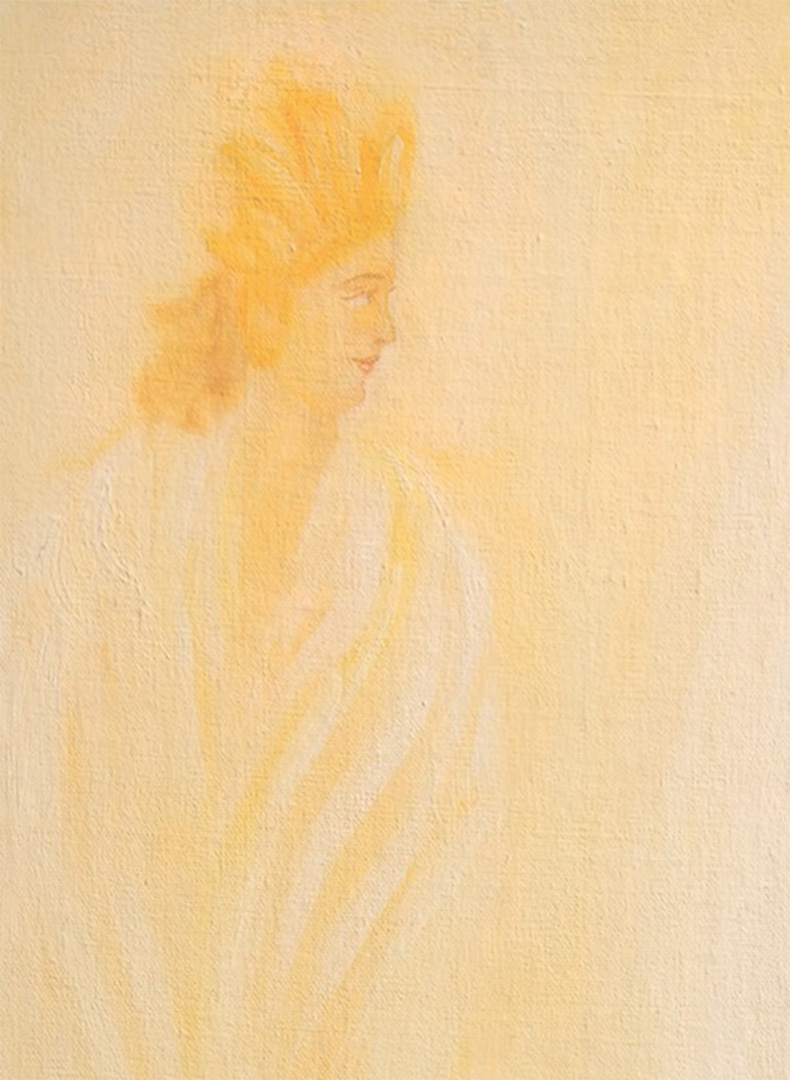
These paintings are by Huta


Leave a Reply