08: Scribbled Notes — Savitri is a Legend and a Symbol

08: Scribbled Notes — Savitri is a Legend and a Symbol

By

/

6–9 minutes

read

Savitri is a Legend and a Symbol

Sri Aurobindo’s magnum opus Savitri is a legend and a symbol, both at once. It received its final form during the last eight years of the Poet’s stay here, 1942-50. By this time the Mind of Light was fully operative in him, the mind of the physical opening to the supramental Light and Force, that which had entered in him on 8 August 1938, as we have in his sonnet The Golden Light. It was coming and going but soon it got dynamically into his body itself, gold and shining.

Thy golden Light came down into my brain

    And the grey rooms of mind sun-touched became

A bright reply to Wisdom’s occult plane,

    A calm illumination and a flame.

Thy golden Light came down into my throat,

    And all my speech is now a tune divine,

A paean song of Thee my single note;

    My words are drunk with the Immortal’s wine.

Thy golden Light came down into my heart

    Smiting my life with Thy eternity;

Now has it grown a temple where Thou art

    And all its passions point towards only Thee.

Thy golden Light came down into my feet;

My earth is now Thy playfield and Thy seat.

8 August 1938

Sri Aurobindo’s Savitri is a realisation of it in the Word. And the Word expresses itself in the form of a telling legend and a symbol. It is a rich narrative essentially based on the tale told by Vyasa in the Mahabharata but having its seeds in the far past going to the Vedic cycle. Earlier drafts of Sri Aurobindo prior to 1942, as narratives starting from 1916, were of the nature of a “field of experimentation” to explore how poetry could express yogic-spiritual consciousness creatively. It got its full glory and greatness in the splendour of a symbol in the final text. For instance, the Satyavan-Savitri love symbolises union of the eternal bride and bridegroom, embodying divine harmony and transformation leading to the arrival of the superior race:

One day I shall return, His hands in mine

And thou shalt see the face of the Absolute. ||124.71||

Then shall the holy marriage be achieved,

Then shall the divine family be born. ||124.72||

There shall be light and peace in all the worlds. ||124.73||

Thus we may understand why Savitri is called “A Legend and a Symbol” — because it combines the timeless appeal of a rich pregnant myth with profound spiritual symbolism, transforming an ancient tale into a universal epic of human and cosmic evolution.

Is not that myth present in the consciousness of the evolutionary race throughout the ages, speaking highly about the grade of the human soul?

AI answers: Sri Aurobindo’s writings suggest that myths, such as the story of Savitri, resonate deeply within the consciousness of the evolutionary race because they embody universal truths and archetypes that speak to the spiritual journey of humanity. This connection can be explored through several dimensions:

  1. Myths as Universal Archetypes:
    • Myths often represent the collective aspirations and struggles of humanity. They are not merely stories but symbolic expressions of deeper truths about the soul’s evolution and its quest for liberation. For instance, the myth of Savitri and Satyavan transcends its narrative form to symbolize the soul’s triumph over ignorance and death, reflecting the grade of the human soul striving for higher consciousness [3 | Vol-22] [4 | Vol-12] .
  2. Evolutionary Significance of Myths:
    • Sri Aurobindo emphasises that human consciousness evolves through stages, from the material and vital to the mental and spiritual. Myths serve as markers of this evolutionary journey, encapsulating the struggles and victories of the soul as it ascends towards greater self-awareness and unity with the divine. The persistence of such myths across ages indicates their role in guiding humanity’s spiritual development [5 | Vol-22] [6 | Vol-22] .
  3. Myths and the Collective Soul:
    • The collective consciousness of humanity often finds expression in myths, which act as repositories of spiritual wisdom and universal truths. These stories are not static; they evolve with the race, adapting to new contexts while retaining their core symbolic significance. This adaptability ensures their relevance and continued impact on the human soul’s journey [8 | Vol-12] [9 | Vol-12] .
  4. Myths as Instruments of Spiritual Aspiration:
    • The myth of Savitri, for example, embodies the aspiration of the human soul to transcend its limitations and unite with the divine. Such myths inspire individuals and societies to strive for higher ideals, serving as catalysts for spiritual growth and transformation [10 | Vol-22] .
  5. Integration of Myth into Evolutionary Framework:
    • Sri Aurobindo integrates myths into his broader philosophical framework, viewing them as expressions of the cosmic spirit’s evolutionary intent. They are not mere fabrications but manifestations of deeper realities that guide the soul’s progress through the cycles of birth and rebirth.

In conclusion, myths like Savitri’s are deeply embedded in the consciousness of the evolutionary race because they encapsulate universal truths about the soul’s journey, reflecting humanity’s spiritual aspirations and its quest for higher states of being. Their enduring presence across ages underscores their significance in shaping the collective and individual evolution of the human soul.

The utter beauty and glory is, this wonderful legend holding the Mind of Light transforms the adopted and adapted literary device into a concrete established realisation. It is a dynamic Force working into events and things that must divinely be. Eventually, “It was the hour before the Gods awake” has to turn in to the everlasting day when the Gods are fully awake, the supramental Gods. Savitri ends where it begins.

This epic is not an extended metaphor or an allegory like Paradise Lost or knights representing virtues in the Faerie Queene. Savitri is the blaze of a massive diamond present in secret rocky mountain of the earth, a symbol with multiple rays of light coming out in their intensities, stepping out in the open from it. Everything is gathered into it, ready to be sent around everywhere, a symbol tons luminously heavier and communicative than The Rime of the Ancient Mariner with its Albatross carrying the eternal Guilt.

In its modus operandi the main objective of Savitri is to dismiss, in fact to transfigure, the foreboding obstacle standing across the Path of the divine Event. Everything is arranged and organised around this central perspective, architecturally perfect and aesthetically beautiful. Right in the first few lines the intention is made explicit. The literary device gives to the creator the necessary flexibility and freedom for the entire development.

But Savitri must be seen far beyond a literary creation how-so-much marvellous or appealing it might be. We have to get out of the accouterments of a literary device and perceive or discern the spiritual thesis or philosophy with a sweeping and also a deepening intuition.

After all, a legend provides only a foundational story or is only a “scaffolding” for the poem. When the building is ready the supporting framework has to dismantled. The ceremony of house-entrance, griha-pravesha, has to be with the chant of the Name. It becomes a symbol when there are added layers of meaning in the act of expression of what is inexpressible.

Therefore, the symbol dawn with which the epic opens is significative of the awakening of the new consciousness that is deathless in the material creation, growing ever more and more.

18 March 2026

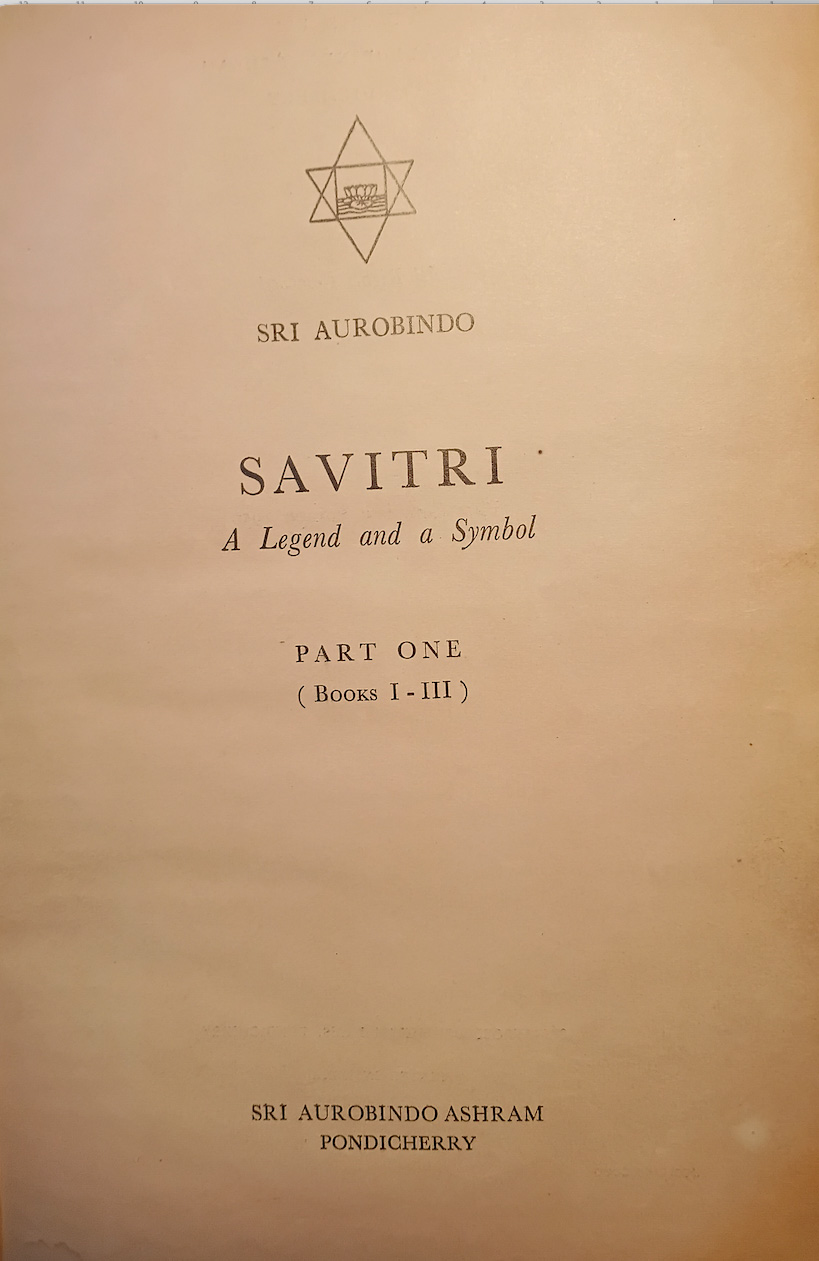
The featured image shows Part One of Savitri, Books I-III, published on 3 September 1950, seen by the Yogi-Poet himself. It has about 12000 lines, 92 Sections, 24 Cantos. Number 24 is significant, corresponding to 24 syllables of the Gayatri metre, also present in the Divine Boon received from the Divine Mother by Yogi Aswapati:

“O strong forerunner, I have heard thy cry. ||91.3||

One shall descend and break the iron Law,

Change Nature’s doom by the lone Spirit’s power. ||91.4||

A limitless Mind that can contain the world,

A sweet and violent heart of ardent calms

Moved by the passions of the gods shall come. ||91.5||

All mights and greatnesses shall join in her;

Beauty shall walk celestial on the earth,

Delight shall sleep in the cloud-net of her hair

And in her body as on his homing tree

Immortal Love shall beat his glorious wings. ||91.6||

A music of griefless things shall weave her charm;

The harps of the Perfect shall attune her voice,

The streams of Heaven shall murmur in her laugh,

Her lips shall be the honeycombs of God,

Her limbs his golden jars of ecstasy,

Her breasts the rapture-flowers of Paradise. ||91.7||

She shall bear Wisdom in her voiceless bosom,

Strength shall be with her like a conqueror’s sword

And from her eyes the Eternal’s bliss shall gaze. ||91.8||

A seed shall be sown in Death’s tremendous hour,

A branch of heaven transplant to human soil;

Nature shall overleap her mortal step;

Fate shall be changed by an unchanging will.” ||91.9||

9 responses to “08: Scribbled Notes — Savitri is a Legend and a Symbol”

  1. sylviekabir Avatar
    sylviekabir


    A symbol like Savitri can be read differently, as the intensification of a possibility already present, as the unveiling of a non-separation that does not depend on time, as the collapse of the apparent opposition between death and life within a single consciousness.


    In that reading, the myth reveals the structure of the ever present reality. The use of myth is one thing; the way it is interpreted is another.


    A symbol either discloses the Real or defers it.


    If the myth expresses a universal truth, then it must be readable as the structure of consciousness here and now. If it requires a future descent, a new species, or a cosmic event to be fulfilled, then it ceases to function as a symbol and as an active disclosure of truth and becomes an eschatology.


    The appeal to “evolutionary consciousness” does not resolve this; it formalizes it. It installs a graded, temporal process in which truth is no longer recognized but progressively “produced.” That move is not required by the symbol itself.


    A symbol does not require teleology to function. A true symbol points to what is already the case, not to what must still be achieved; temporal unfolding concerns only the modes of its appearance to contracted consciousness.


    Projecting truth into time is a choice, an interpretation that remains open to debate.

  2. sylviekabir Avatar
    sylviekabir


    The different cantos of Part One (Books 1–3) of Savitri were first published between 1946 and 1948 in various journals of the Sri Aurobindo Ashram and also in separate fascicles.


    Several cantos of Part Two (Books 4–8) and Part Three (Books 9–12) came out in the same way during 1949 and 1950. Part One, extensively revised and enlarged by the author, was printed in book form in 1950, shortly before Sri Aurobindo’s passing.


    A second volume comprising Part Two and Part Three was issued in 1951, thus completing the first edition of the epic.


    In 1968 the first edition of Part One was reprinted, with a number of textual emendations.Savitri reached its printed form through a complex process.


    Sri Aurobindo was assisted by disciples who copied the manuscript, made typescripts, and took dictation when his eyesight began to fail. This process left room for inadvertent deviations from his intention. These have been rectified whenever they have come to light. Some obvious errors in the first edition were emended in the second edition. A number of further emendations were introduced in the 1968 reprint of Part One and in the Centenary edition.The fourth, critically revised edition was published in 1993.

  3. sylviekabir Avatar
    sylviekabir


    The symbolic and mythic richness of Savitri does not require a teleology in order to be meaningful, nor does it require an evolutionary narrative pointing towards a “new species” to justify the human aspiration for truth, beauty, or unity.


    Myths express universal intuitions. They illuminate possibilities of consciousness.


    The human inclination toward the true, the beautiful, the good, and the Divine does not need to be grounded in a future fulfillment. It is already present as an immediate resonance of consciousness with itself, a recognition that may deepen, clarify, and stabilize, but does not depend on an evolutionary cosmology to be valid.


    To introduce a teleological framework is to shift from present recognition to future realization. It makes what is already accessible appear as something to be achieved.


    The symbolic power of Savitri can be fully preserved without turning it into a metaphysical program of evolution. Human consciousness does not need a supramental destiny to justify its orientation toward the highest. It already carries that orientation as its own nature.

  4. sylviekabir Avatar
    sylviekabir


    One can recognize that in Sri Aurobindo there are two coexisting discursive regimes:


    – oriented evolution, fulfillment, the supramental, transformation of nature.


    And


    – simultaneity of the temporal and the eternal, already accomplished presence of the Real, a fundamental identity always already given.


    These two registers are not always systematically integrated.This results in a space of internal tension, sometimes left open, sometimes dramatized.


    The text (here Savitri) is operative and symbolic. It functions through a superposition of planes rather than through conceptual reduction. Therefore, it is legitimate not to force coherence toward a single teleology. It is equally legitimate to read these tensions as opening a non-saturated space, where immediate recognition is not subordinated to a future fulfillment.


    Either one closes the system toward a dominant teleology; or one enters the interval of this paradox into an already operative non-duality.


    To “slip” into this in-between is a rigorous reading of the very conditions of the text, which never fully closes the relation between an eternity already given and a manifestation in becoming.

  5. RY Deshpande Avatar
    RY Deshpande

    Martin Lappierre writes the following in an email:

    I’ve read the posts number 8 which was very interesting.

    I found the comment of Sylvie Kabir somehow disturbing. This content makes a mental thing of Sri Aurobindo annd that is in my sense not appropriate as it is ignoring the yogic aspect of Sri Aurobindo’s life and work and looks at. the things whith a perspective based on the mental which can go anywhere and make things say anything.

    This understanding of Sri Aurobindo is quite common among westerners or even indians who come to Sri Aurobindo with a neovedantic background, assuming that everything is equal or same. So they read Sri Aurobindo as they could read anything else in the modern spiritual supermarket. But Sri Aurobindo was an Action, which cannot be separated from the Mother. 

    To express something true about Sri Aurobindo (this can only be an attempt), one has to connect with his all being to this action, whose manifestation and incarnation was the Mother.

  6. RY Deshpande Avatar
    RY Deshpande

    And here is Marc Desplanque:

    This is an old outdated scholastic-academic Vedanta, and things have advanced far ahead of that. Move on into them or else go elsewhere. 

    “Very good answer I think…and bold suggestion!

    Warmly,

    Marc

  7. Tuhina Avatar
    Tuhina

    This post on Savitri enlightened me. I always felt the power behind the words, and have experienced the protection and bliss too. What I am learning now is the architecture of Savitri in depth from you. The dynamism of Sri Aurobindo flows in Savitri and I felt my spirit and even body absorbing it.

    One more aspect which struck me in this post was this part ‘This epic is not an extended metaphor or an allegory like Paradise Lost or knights representing virtues in the Faerie Queene. Savitri is the blaze of a massive diamond present in secret rocky mountain of the earth, a symbol with multiple rays of light coming out in their intensities, stepping out in the open from it. Everything is gathered into it, ready to be sent around everywhere, a symbol tons luminously heavier and communicative than The Rime of the Ancient Mariner with its Albatross carrying the eternal Guilt.

    In its modus operandi the main objective of Savitri is to dismiss, in fact to transfigure, the foreboding obstacle standing across the Path of the divine Event. Everything is arranged and organised around this central perspective, architecturally perfect and aesthetically beautiful.’

    It fulfills the purpose of the seeker being carried into the heavens and that too from by a simple mean- An epic. It makes me think of how Virgil guided Dante from Hell to Heaven, but Savitri is really doing it for me.

  8. luminouspleasantly6d32587376 Avatar
    luminouspleasantly6d32587376

    In spite of being convinced by you, I, only, feel that Sri Aurobindo was born with the transcendent Supramental Consciousness. He is gradually unfolding his inmost Self to let the Supramental emerge.
    Nikhil Kumar

    1. RY Deshpande Avatar
      RY Deshpande

      Incarnation, Avatarhood, means taking a human body. This entails spiritual seeking. The first two stages of his Yoga were, Soul’s Release from Ignorance, Book One Canto Three, and the freedom of the Spirit from Nature’s Bondage, Cantos Four and Five. Sri Aurobindo had both these in a short span of 6-7 months. The first one was in Baroda around 1 January 1908 when had the realisation of “static Oneness”, with Lele; the second came in Alipore Jail where he was incarcerated from 5 May 1908, of “dynamic Power” with the Gita being placed in his hand. It was there the spirit of Vivekananda pointed to him the golden star, supramental.

Leave a Reply

Discover more from The Winds of Wonder

Subscribe now to keep reading and get access to the full archive.

Continue reading