Savitri is a Legend and a Symbol
Sri Aurobindo’s magnum opus Savitri is a legend and a symbol, both at once. It received its final form during the last eight years of the Poet’s stay here, 1942-50. By this time the Mind of Light was fully operative in him, the mind of the physical opening to the supramental Light and Force, that which had entered in him on 8 August 1938, as we have in his sonnet The Golden Light. It was coming and going but soon it got dynamically into his body itself, gold and shining.
Thy golden Light came down into my brain
And the grey rooms of mind sun-touched became
A bright reply to Wisdom’s occult plane,
A calm illumination and a flame.
Thy golden Light came down into my throat,
And all my speech is now a tune divine,
A paean song of Thee my single note;
My words are drunk with the Immortal’s wine.
Thy golden Light came down into my heart
Smiting my life with Thy eternity;
Now has it grown a temple where Thou art
And all its passions point towards only Thee.
Thy golden Light came down into my feet;
My earth is now Thy playfield and Thy seat.
8 August 1938
Sri Aurobindo’s Savitri is a realisation of it in the Word. And the Word expresses itself in the form of a telling legend and a symbol. It is a rich narrative essentially based on the tale told by Vyasa in the Mahabharata but having its seeds in the far past going to the Vedic cycle. Earlier drafts of Sri Aurobindo prior to 1942, as narratives starting from 1916, were of the nature of a “field of experimentation” to explore how poetry could express yogic-spiritual consciousness creatively. It got its full glory and greatness in the splendour of a symbol in the final text. For instance, the Satyavan-Savitri love symbolises union of the eternal bride and bridegroom, embodying divine harmony and transformation leading to the arrival of the superior race:
One day I shall return, His hands in mine
And thou shalt see the face of the Absolute. ||124.71||
Then shall the holy marriage be achieved,
Then shall the divine family be born. ||124.72||
There shall be light and peace in all the worlds. ||124.73||
Thus we may understand why Savitri is called “A Legend and a Symbol” — because it combines the timeless appeal of a rich pregnant myth with profound spiritual symbolism, transforming an ancient tale into a universal epic of human and cosmic evolution.
Is not that myth present in the consciousness of the evolutionary race throughout the ages, speaking highly about the grade of the human soul?
AI answers: Sri Aurobindo’s writings suggest that myths, such as the story of Savitri, resonate deeply within the consciousness of the evolutionary race because they embody universal truths and archetypes that speak to the spiritual journey of humanity. This connection can be explored through several dimensions:
- Myths as Universal Archetypes:
- Myths often represent the collective aspirations and struggles of humanity. They are not merely stories but symbolic expressions of deeper truths about the soul’s evolution and its quest for liberation. For instance, the myth of Savitri and Satyavan transcends its narrative form to symbolize the soul’s triumph over ignorance and death, reflecting the grade of the human soul striving for higher consciousness [3 | Vol-22] [4 | Vol-12] .
- Evolutionary Significance of Myths:
- Sri Aurobindo emphasises that human consciousness evolves through stages, from the material and vital to the mental and spiritual. Myths serve as markers of this evolutionary journey, encapsulating the struggles and victories of the soul as it ascends towards greater self-awareness and unity with the divine. The persistence of such myths across ages indicates their role in guiding humanity’s spiritual development [5 | Vol-22] [6 | Vol-22] .
- Myths and the Collective Soul:
- The collective consciousness of humanity often finds expression in myths, which act as repositories of spiritual wisdom and universal truths. These stories are not static; they evolve with the race, adapting to new contexts while retaining their core symbolic significance. This adaptability ensures their relevance and continued impact on the human soul’s journey [8 | Vol-12] [9 | Vol-12] .
- Myths as Instruments of Spiritual Aspiration:
- The myth of Savitri, for example, embodies the aspiration of the human soul to transcend its limitations and unite with the divine. Such myths inspire individuals and societies to strive for higher ideals, serving as catalysts for spiritual growth and transformation [10 | Vol-22] .
- Integration of Myth into Evolutionary Framework:
- Sri Aurobindo integrates myths into his broader philosophical framework, viewing them as expressions of the cosmic spirit’s evolutionary intent. They are not mere fabrications but manifestations of deeper realities that guide the soul’s progress through the cycles of birth and rebirth.
In conclusion, myths like Savitri’s are deeply embedded in the consciousness of the evolutionary race because they encapsulate universal truths about the soul’s journey, reflecting humanity’s spiritual aspirations and its quest for higher states of being. Their enduring presence across ages underscores their significance in shaping the collective and individual evolution of the human soul.
The utter beauty and glory is, this wonderful legend holding the Mind of Light transforms the adopted and adapted literary device into a concrete established realisation. It is a dynamic Force working into events and things that must divinely be. Eventually, “It was the hour before the Gods awake” has to turn in to the everlasting day when the Gods are fully awake, the supramental Gods. Savitri ends where it begins.
This epic is not an extended metaphor or an allegory like Paradise Lost or knights representing virtues in the Faerie Queene. Savitri is the blaze of a massive diamond present in secret rocky mountain of the earth, a symbol with multiple rays of light coming out in their intensities, stepping out in the open from it. Everything is gathered into it, ready to be sent around everywhere, a symbol tons luminously heavier and communicative than The Rime of the Ancient Mariner with its Albatross carrying the eternal Guilt.
In its modus operandi the main objective of Savitri is to dismiss, in fact to transfigure, the foreboding obstacle standing across the Path of the divine Event. Everything is arranged and organised around this central perspective, architecturally perfect and aesthetically beautiful. Right in the first few lines the intention is made explicit. The literary device gives to the creator the necessary flexibility and freedom for the entire development.
But Savitri must be seen far beyond a literary creation how-so-much marvellous or appealing it might be. We have to get out of the accouterments of a literary device and perceive or discern the spiritual thesis or philosophy with a sweeping and also a deepening intuition.
After all, a legend provides only a foundational story or is only a “scaffolding” for the poem. When the building is ready the supporting framework has to dismantled. The ceremony of house-entrance, griha-pravesha, has to be with the chant of the Name. It becomes a symbol when there are added layers of meaning in the act of expression of what is inexpressible.
Therefore, the symbol dawn with which the epic opens is significative of the awakening of the new consciousness that is deathless in the material creation, growing ever more and more.
18 March 2026
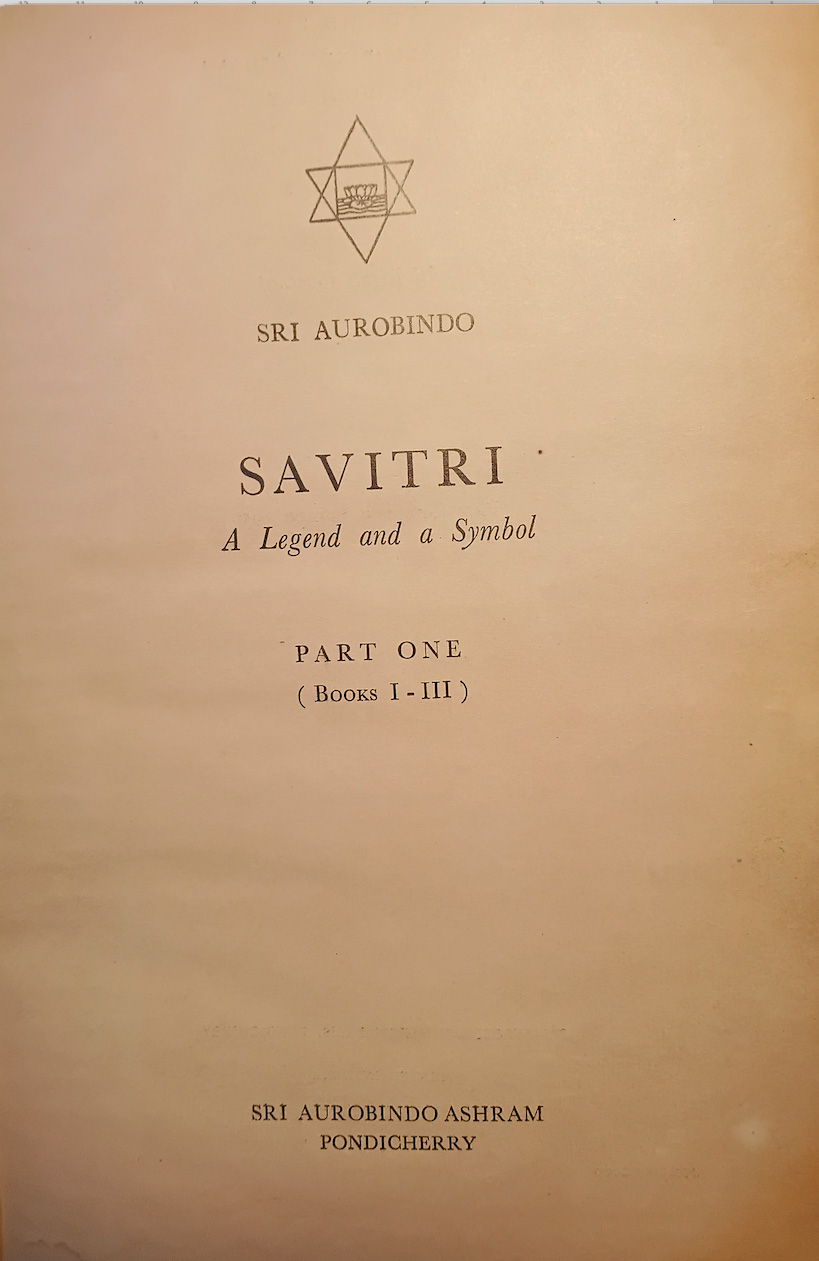
The featured image shows Part One of Savitri, Books I-III, published on 3 September 1950, seen by the Yogi-Poet himself. It has about 12000 lines, 92 Sections, 24 Cantos. Number 24 is significant, corresponding to 24 syllables of the Gayatri metre, also present in the Divine Boon received from the Divine Mother by Yogi Aswapati:
“O strong forerunner, I have heard thy cry. ||91.3||
One shall descend and break the iron Law,
Change Nature’s doom by the lone Spirit’s power. ||91.4||
A limitless Mind that can contain the world,
A sweet and violent heart of ardent calms
Moved by the passions of the gods shall come. ||91.5||
All mights and greatnesses shall join in her;
Beauty shall walk celestial on the earth,
Delight shall sleep in the cloud-net of her hair
And in her body as on his homing tree
Immortal Love shall beat his glorious wings. ||91.6||
A music of griefless things shall weave her charm;
The harps of the Perfect shall attune her voice,
The streams of Heaven shall murmur in her laugh,
Her lips shall be the honeycombs of God,
Her limbs his golden jars of ecstasy,
Her breasts the rapture-flowers of Paradise. ||91.7||
She shall bear Wisdom in her voiceless bosom,
Strength shall be with her like a conqueror’s sword
And from her eyes the Eternal’s bliss shall gaze. ||91.8||
A seed shall be sown in Death’s tremendous hour,
A branch of heaven transplant to human soil;
Nature shall overleap her mortal step;
Fate shall be changed by an unchanging will.” ||91.9||
 The Winds of Wonder
Leave a comment