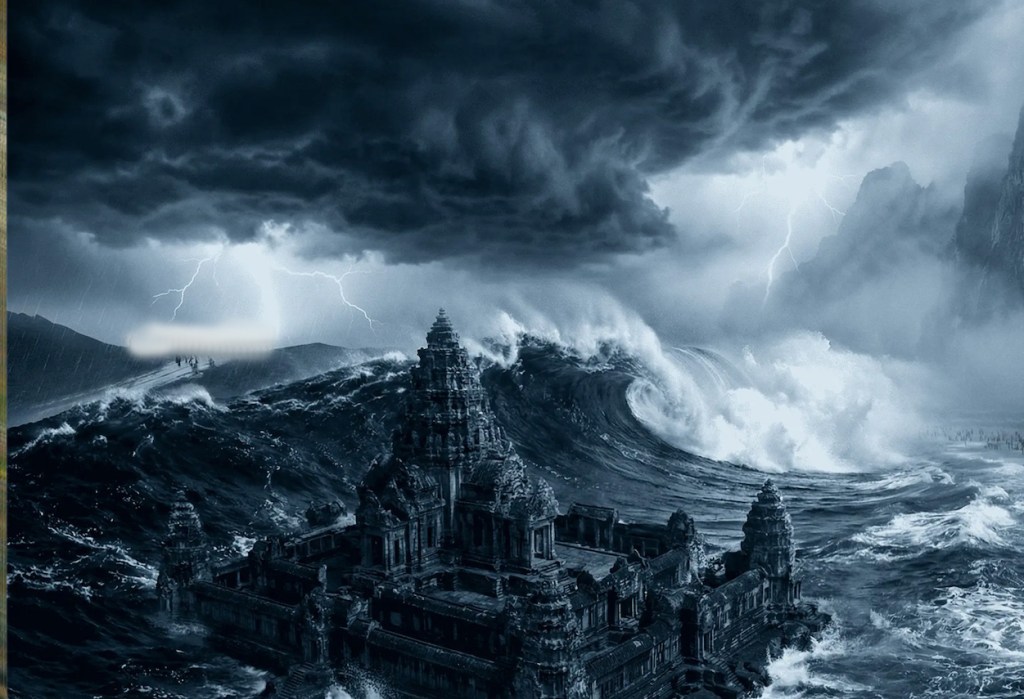
Praḷaya — The Cosmic Deluge
Traditions tell us that a universe is created, then withdrawn into praḷaya, and then a new one comes; and according to them, ours is the seventh universe, and being the seventh universe, it is the one that will not return to pralaya but will go on progressing, without retreat. This is why, in fact, there is in the human being that need for permanence and for an uninterrupted progress—it’s because the time has come.
Can the manifestation come to its dissolution, its Pralaya?
A very old tradition, more ancient than the Vedas, says that the present manifestation is the seventh, and that the six preceding ones were followed by six pralayas, but this one will be transformed perpetually, without returning to the Creator.
3 September 1969
Agenda 4 of November 13, 1963: “Traditions tell us that a universe is created, then withdrawn into pralaya, and then a new one comes; and according to them, ours is the seventh universe, and being the seventh universe, it is the one that will not return to pralaya but will go on progressing, without retreat.” See also Agenda 7 of March 4, 1966, and Agenda 8 of May 6, 1967
“…in the Truth-Creation the law is that of a constant unfolding without any Pralaya.” What is this constant unfolding?
The Truth-Creation… it is the last line? (Mother consults the book) I think we have already spoken about this several times. It has been said that in the process of creation, there is the movement of creation followed by a movement of preservation and ending in a movement of disintegration or destruction; and even it has been repeated very often: “All that begins must end”, etc., etc.
In fact in the history of our universe there have been six consecutive periods which began by a creation, were prolonged by a force of preservation and ended by a disintegration, a destruction, a return to the Origin, which is called Pralaya; and that is why this tradition is there. But it has been said that the seventh creation would be a progressive creation, that is, after the starting-point of the creation, instead of its being simply followed by a preservation, it would be followed by a progressive manifestation which would express the Divine more and more completely, so that no disintegration and return to the Origin would be necessary. And it has been announced that the period we are in is precisely the seventh, that is, it would not end by a Pralaya, a return to the Origin, a destruction, a disappearance, but that it would be replaced by a constant progress, because it would be a more and more perfect unfolding of the divine Origin in its creation.
And this is what Sri Aurobindo says. He speaks of a constant unfolding, that is, the Divine manifests more and more completely; more and more perfectly, in a progressive creation. It is the nature of this progression which makes the return to the Origin, the destruction no longer necessary. All that does not progress disappears, and that is why physical bodies die, it’s because they are not progressive; they are progressive up to a certain moment, then there they stop and most often they remain stable for a certain time, and then they begin to decline, and then disappear. It’s because the physical body, physical matter as it is at present is not plastic enough to be able to progress constantly. But it is not impossible to make it sufficiently plastic for the perfecting of the physical body to be such that it no longer needs disintegration, that is, death.
Only, this cannot be realised except by the descent of the Supermind which is a force higher than all those which have so far manifested and which will give the body a plasticity that will allow it to progress constantly, that is, to follow the divine movement in its unfolding.
It was really very interesting. Afterwards it’s just a memory, no longer the thing…. It concerned the creation of the material world, the material universe, in the light of the conception of the Supreme in love with His emanation. But the vision was all-embracing, as if I were on the other side—the side of the Supreme, not of the creation—and saw the creation as a whole, with the true sense of progress, the true sense of advance, of movement, and the true way in which all that doesn’t belong to the future creation will disappear in a kind of pralaya (it can’t really “disappear” but it will be withdrawn from the Manifestation). And it was very interesting: all that doesn’t collaborate (in the sense that it is a sufficient experience, an experience that has come to its end) was reabsorbed. It was like the true vision of what was rendered as the Last Judgment. It is something going on constantly, that mighty “gust” of manifestation, and there are things that have been, according to our vision of time, but that live on, that continue to exist in the future; there are things that exhaust themselves (that’s in the present), and there are things that have no more purpose, that cannot keep pace with the movement (I don’t know how to explain this) and enter the Non-Being—the pralaya, the Non-Being, the unmanifest—of course, not in their forms but in their essence; that is to say, the Supreme in them remains the Supreme but unmanifest.
“…It’s a highly superior equilibrium.
“It reminded me of Théon who said that the world had been put forth and reabsorbed six times; in other words, that there had been six creations and six pralayas. And that now we were in the seventh creation, the last. The world would find a new, higher equilibrium, not static but progressive, which means there would be unending progress in equilibrium and harmony, without pralaya.”
(April 24, 1967)
Here Heraclitus brings in his formula of “One out of all and all out of One”, which is his account of the process of the cosmos just as his formula “All things are one” is his account of the eternal truth of the cosmos. One, he says, in the process of the cosmos is always becoming all things from moment to moment, hence the eternal flux of things; but all things also are eternally going back to their principle of oneness; hence the unity of the cosmos, the sameness behind the flux of becoming, the stability of measures, the conservation of energy in all changes. This he explains farther by his theory of change as in its character a constant exchange. But is there then no end to this simultaneous upward and downward motion of things? As the downward has so far prevailed as to create the cosmos, will not the upward too prevail so as to dissolve it back into the ever-living Fire? Here we come to the question whether Heraclitus did or did not hold the theory of a periodic conflagration or pralaya. “Fire will come on all things and judge and convict them.” If he held it, then we have again another striking coincidence of Heraclitus’ thought with our familiar Indian notions, the periodic pralaya, the Puranic conflagration of the world by the appearance of the twelve suns, the Vedantic theory of the eternal cycles of manifestation and withdrawal from manifestation. In fact, both the lines of thought are essentially the same and had to arrive inevitably at the same conclusions.
To be immortal was never held in the ancient spiritual teaching to consist merely in a personal survival of the death of the body: all beings are immortal in that sense and it is only the forms that perish. The souls that do not arrive at liberation, live through the returning aeons; all exist involved or secret in the Brahman during the dissolution of the manifest worlds and are born again in the appearance of a new cycle. Pralaya, the end of a cycle of aeons, is the temporary disintegration of a universal form of existence and of all the individual forms which move in its rounds, but that is only a momentary pause, a silent interval followed by an outburst of new creation, reintegration and reconstruction in which they reappear and recover the impetus of their progression. Our physical death is also a pralaya,—the Gita will presently use the word in the sense of this death, pralayaṁ yāti deha-bhṛt, “the soul bearing the body comes to a B.G.14.14 pralaya,” to a disintegration of that form of matter with which its ignorance identified its being and which now dissolves into the natural elements. But the soul itself persists and after an interval resumes in a new body formed from those elements its round of births in the cycle, just as after the interval of pause and cessation the universal Being resumes his endless round of the cyclic aeons. This immortality in the rounds of Time is common to all embodied spirits.
This Vedic imagery throws a clear light on the similar symbolic images of the Puranas, especially on the famous symbol of Vishnu sleeping after the pralaya on the folds of the snake Ananta upon the ocean of sweet milk. It may perhaps be objected that the Puranas were written by superstitious Hindu priests or poets who believed that eclipses were caused by a dragon eating the sun and moon and could easily believe that during the periods of non-creation the supreme Deity in a physical body went to sleep on a physical snake upon a material ocean of real milk and that therefore it is a vain ingenuity to seek for a spiritual meaning in these fables. My reply would be that there is in fact no need to seek for such meanings; for these very superstitious poets have put them there plainly on the very surface of the fable for everybody to see who does not choose to be blind. For they have given a name to Vishnu’s snake, the name Ananta, and Ananta means the Infinite; therefore they have told us plainly enough that the image is an allegory and that Vishnu, the all-pervading Deity, sleeps in the periods of non-creation on the coils of the Infinite. As for the ocean, the Vedic imagery shows us that it must be the ocean of eternal existence and this ocean of eternal existence is an ocean of absolute sweetness, in other words, of pure Bliss. For the sweet milk (itself a Vedic image) has, evidently, a sense not essentially different from the madhu, honey or sweetness, of Vamadeva’s hymn.
It is by the unity of this spiritual nature that the world is sustained, yayedaṁ dhāryate jagat, even as it is that from which B.G.7.5 | B.G.7.6 it is born with all its becomings, etad-yonīni bhūtāni sarvāṇi, and that also which withdraws the whole world and its existences into itself in the hour of dissolution, ahaṁ kṛtsnasya jagataḥ prabhavaḥ pralayas tathā. But in the manifestation which is thus put forth in the Spirit, upheld in its action, withdrawn in its periodical rest from action, the Jiva is the basis of the multiple existence; it is the multiple soul, if we may so call it, or, if we prefer, the soul of the multiplicity we experience here. It is one always with the Divine in its being, different from it only in the power of its being,—different not in the sense that it is not at all the same power, but in this sense that it only supports the one power in a partial multiply individualised action. Therefore all things are initially, ultimately and in the principle of their continuance too the Spirit. The fundamental nature of all is nature of the Spirit, and only in their lower differential phenomena do they seem to be something else, to be nature of body, life, mind, reason, ego and the senses. But these are phenomenal derivatives, they are not the essential truth of our nature and our existence.
The idea that things are not in their place is something I understood even as a youngster, and it was eventually explained to me by Théon.
In his cosmogony, Theon accounted for the successive pralayas of the different universes by saying that each universe was an aspect of the Supreme manifesting itself: each universe was built upon one aspect of the Supreme, and all, one after the other, were withdrawn into the Supreme. He enumerated all the successively manifested aspects, and what an extraordinarily logical sequence it was! I have kept it some place, but I no longer know where. Nor do I remember exactly what number this universe has in the sequence, but this time it was supposed to be the universe which would not be withdrawn, which would, so to speak, follow an indefinite progression of Becoming. And this universe is to manifest Equilibrium, not a static but a progressive equilibrium. Equilibrium, as he explains it, is each thing exactly in its place: each vibration, each movement, each… and so on down the line—each form, each activity, each element exactly in its place in relation to the whole.
This is quite interesting to me because Sri Aurobindo says the same thing: that nothing is bad, simply things are not in their place—their place not only in space but in time, their place in the universe, beginning with the planets and stars, each thing exactly in its place. Then when each thing, from the most colossal to the most microscopic, is exactly in place, the whole Will PROGRESSIVELY express the Supreme, without having to be withdrawn and emanated anew. On this also, Sri Aurobindo based the fact that this present creation, this present universe, will be able to manifest the perfection of a divine world—what Sri Aurobindo calls the Supermind.
Equilibrium is the essential law of this creation—it is what permits perfection to be realized in the manifestation. …
Sri Aurobindo tells us that this perception of the world’s unreality need not exist for the supramental consciousness: only Falsehood is unreal , not the world. And this is most interesting—the world has its own reality, independent of Falsehood.
I suppose this will be the first effect of the Supermind—perhaps even its first effect in the individual, because it will begin in individuals first. …
But it’s so lovely when this Harmony comes. You know, puttering about, arranging papers, setting a drawer in order…. It all sings, it’s lovely, so joyous and luminous… so delightful! And all, all, all…. All material things, all activities, eating, dressing, everything becomes delightful when this harmony is there, delightful. Everything works out smoothly, it’s so harmonious, there’s no friction. You see… you see a joyous, luminous Grace manifesting in all things, ALL things, even those we normally regard as utterly unimportant. But then, if this Harmony withdraws, everything—exactly the SAME conditions, the SAME things, the SAME circumstances—becomes painful, tiresome, drawn out, difficult, laborious, oh!… It’s like this, and like that (Mother tilts her hand from side to side as on a narrow frontier) like this, like that.
It makes you sense so clearly that things in themselves don’t count. What we call ‘things in themselves’ are of no true importance! What really counts is the relationship of consciousness to these things. And there’s a formidable power in this, since in one instance you touch something and drop or mishandle it, while in the other it’s so lovely, it works so smoothly. Even the most difficult movements are made without difficulty. It’s an unheard-of power! We don’t give it importance because it has no grandiose effects, it’s not spectacular. Yes, there are indeed states of grace when one is in the presence of a great difficulty and suddenly has all the power needed to face it—yes, but that’s something else. I am speaking of a power active in ordinary life. …
And not only from here, but from far, far away on the earth and sometimes from far back in time, back into the past—things out of the past coming up, presenting themselves to the new Light to be put in their place. It’s always that: each thing wanting to be put in its place. And this work has to be done constantly…. It’s as if one keeps catching a new illness to be cured.
A fresh disorder to be straightened out.
Actually, we are very lazy.
Sri Aurobindo wrote that he was very lazy—that consoled me! We are very lazy. We would like (laughing) to settle back and blissfully enjoy the fruit of our labours!
Pralaya, in its essence, refers to the dissolution or disintegration of a universal form of existence at the end of a cosmic cycle. It is not an absolute annihilation but rather a temporary pause or withdrawal into the Supreme, followed by a new creation. This cyclical process reflects the rhythm of creation, preservation, and dissolution inherent in the universe.
- Cyclic Nature of Creation: Pralaya occurs when a creation has fulfilled its purpose or reached the limit of its possibilities. It is a return to the Origin, where the universe is reabsorbed into the Supreme before being re-manifested in a new form. This process has been described as occurring multiple times in the history of the cosmos, with our current creation being the seventh, which is believed to have the potential for progressive transformation without requiring dissolution [1 | cwm-Vol-07] [2 | cwm-Vol-06] [3 | agenda-Vol-07] .
- Purpose of Pralaya: It serves as a means to refine and perfect the manifestation. Elements that no longer serve the evolutionary purpose or cannot keep pace with the movement of consciousness are withdrawn into the unmanifest. This is not destruction in the conventional sense but a reabsorption into the Supreme’s essence [4 | agenda-Vol-04] [5 | agenda-Vol-04] .
- Progressive Creation: Unlike earlier cycles, the current creation is envisioned as one of progressive equilibrium, where transformation replaces the need for dissolution. This aligns with the idea of a universe capable of continuous evolution and perfection, guided by the descent of higher consciousness, such as the supramental force [7 | agenda-Vol-07] .
In summary, Pralaya is due to the inherent rhythm of the cosmos, where dissolution is a necessary phase for renewal and higher evolution. It reflects the Supreme’s dynamic play of manifestation and withdrawal, aimed at achieving greater harmony and perfection in creation.
The Biblical Deluge (or Noah’s Flood) is a catastrophic, global flood narrative found in Genesis 6-9. Because of human wickedness, God sends a massive flood to destroy all life, sparing only Noah, his family, and animals on a large ark. The flood lasts over a year, with rain falling for 40 days and waters covering the highest mountains for 150 days.
The flood is a reversal and renewal of God’s creation of the world. Bandstra pictures the destruction of creation as a return to the universe’s pre-creation state of watery chaos so that it can be remade through the microcosm of Noah’s Ark. In Genesis 1 God separated the “waters above the earth” from those below so that dry land can appear as a home for living things, but in the flood story the “windows of heaven” and “fountains of the deep” are opened so that the world is returned to the watery chaos of the time before creation. Even the sequence of flood events mimics that of creation, the flood first covering the earth to the highest mountains, then destroying, in order, birds, cattle, beasts, “swarming creatures”, and finally mankind. The Ark itself is likewise a microcosm of Solomon’s Temple. The flood is a reversal and renewal of God’s creation of the world. Bandstra pictures the destruction of creation as a return to the universe’s pre-creation state of watery chaos so that it can be remade through the microcosm of Noah’s Ark. In Genesis 1 God separated the “waters above the earth” from those below so that dry land can appear as a home for living things, but in the flood story the “windows of heaven” and “fountains of the deep” are opened so that the world is returned to the watery chaos of the time before creation. Even the sequence of flood events mimics that of creation, the flood first covering the earth to the highest mountains, then destroying, in order, birds, cattle, beasts, “swarming creatures”, and finally mankind. The Ark itself is likewise a microcosm of Solomon’s Temple.
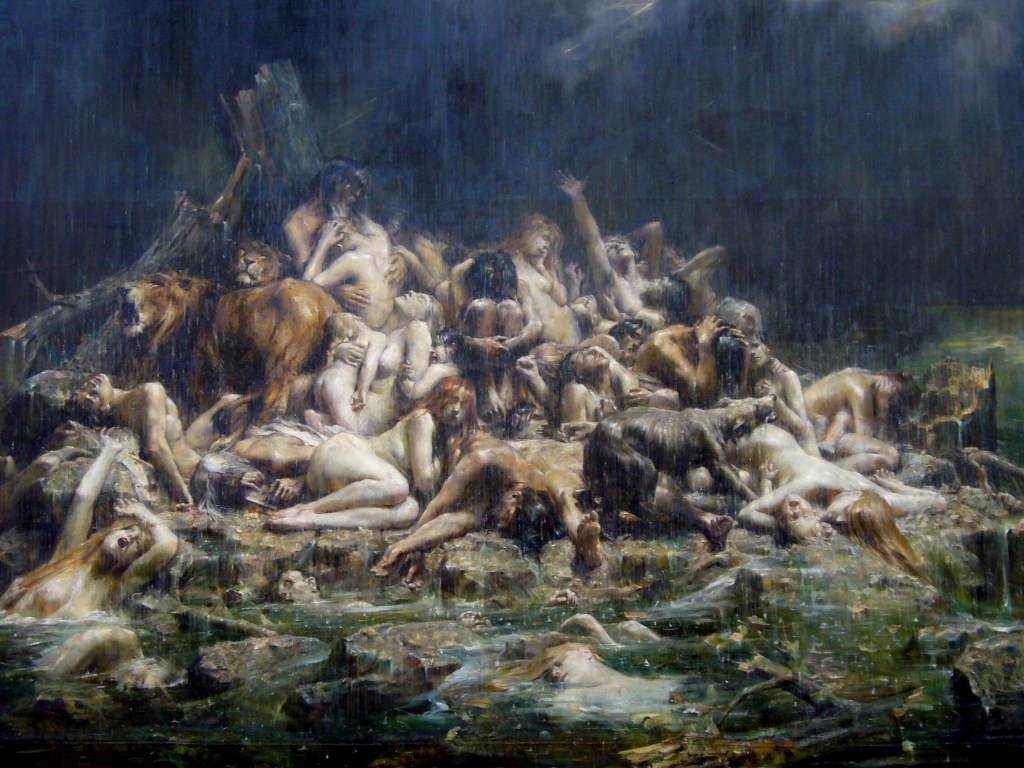
Brahmapralaya
The Bhagavata Purana states that one kalpa (age), which consists of a thousand revolutions of the four ages, the Satya, Treta, Dvapara, and the Kali, and the reign of fourteen Manus, is one day in the life of the creator deity, Brahma. A pralaya is described to be an equal length of time, referred to as a night in the life of the deity. This form of the dissolution is caused by the sleep of Brahma, and is hence named after him. It is also called naimittika, which means, ‘occasional’. During this period, Narayana withdraws the universe within him, and also rests upon his serpent mount, Shesha.
Prakritapralaya
The Vishnu Purana describes the Prakritapralaya. After the completion of 1,000 four-age cycles or a kalpa, a great flood is unleashed on Bhumi, the earth, by Prakriti, the personification of nature. When Jala (water) reaches the abode of the Saptarishis, the entire world is encompassed by a single ocean. The breath of Vishnu disperses all the clouds and reabsorbs them, after which he proceeds to sleep. When Agni destroys the world and nature, elemental dissolution begins. Jala swallows the gunas of the earth, and subsequently the universe, after which its rasa is devoured by Agni. When Akasha is consumed by the flames of Agni, Vayu and sound permeate throughout, becoming one with Agni by absorbing its guna. When Vayu comes into contact with ether, it loses its elemental potency, causing ether alone to occupy the vacuum. Consciousness, combined with darkness, take over the universe, which in turn is conquered by Buddhi. At this juncture, the seven components of Prakriti recombine. At that point Urvashi is impregnated by the pious seeds of those who dwell in Swarg lok and engage in passionate coitus. The Hiranyagarbha of Brahma dissolves in the waters that surround Prakriti. Prakriti fuses with Purusha, assimilating Buddhi, becoming Brahman.
From Wikipedia/


 The Winds of Wonder
Leave a reply to RY Deshpande Cancel reply