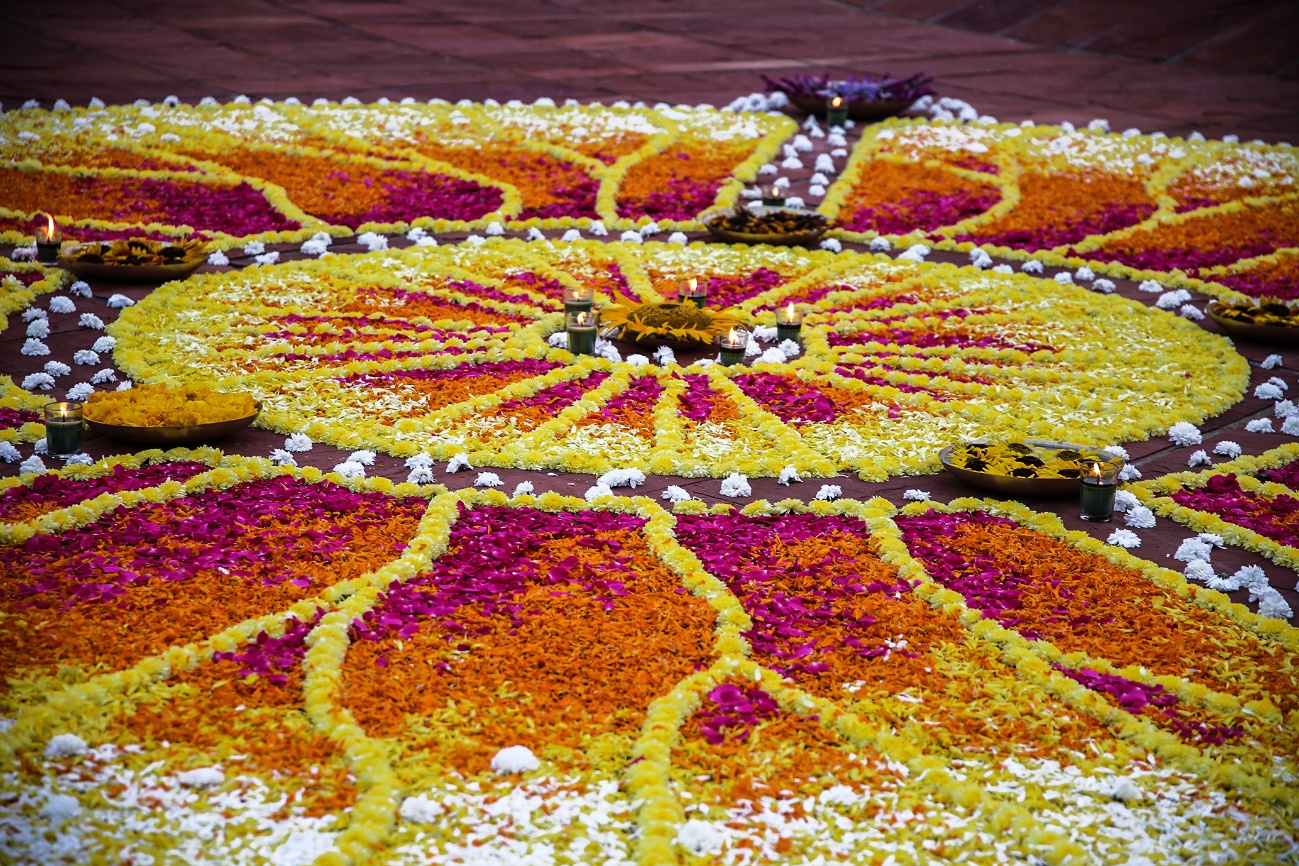
Bonne Fête Auroville 28 Feb 2026

Bonne Fête Auroville 28 Feb 2026

By

/

11–17 minutes

read

Bonne Fête Auroville 28 Feb 2026

Bonne Fête Auroville

And continuous progress in Her.

So beautiful in that open vastness!

28 February 2026

Happy Birthday Auroville

May Auroville progress to be the bridge between the past and the future

Four great Aspects of the Mother, four of her leading Powers and Personalities have stood in front in her guidance of this Universe and in her dealings with the terrestrial play.

To the four we give the four great names, Maheswari, Mahakali, Mahalakshmi, Mahasaraswati.

MAHASARASWATI is the Mother’s Power of Work and her spirit of perfection and order.

The youngest of the Four, she is the most skilful in executive faculty and the nearest to physical Nature.


Maheswari lays down the large lines of the world-forces, Mahakali drives their energy and impetus, Mahalakshmi discovers their rhythms and measures, but Mahasaraswati presides over their detail of organization and execution, relation of parts and effective combination of forces and unfailing exactitude of result and fulfilment.

When she takes up the transformation and new-building of the nature, her action is laborious and minute and often seems to our impatience slow and interminable, but it is persistent, integral and flawless.

Nothing short of a perfect perfection satisfies her and she is ready to face an eternity of toil if that is needed for the fullness of her creation.
                                                                                                                  From ‘ The Mother ‘ by Sri Aurobindo

Courtesy Tine Neuman Auroville

Full Text: The Four Great Aspects

Four great Aspects of the Mother, four of her leading Powers and Personalities have stood in front in her guidance of this Universe and in her dealings with the terrestrial play. One is her personality of calm wideness and comprehending wisdom and tranquil benignity and inexhaustible compassion and sovereign and surpassing majesty and all-ruling greatness. Another embodies her power of splendid strength and irresistible passion, her warrior mood, her overwhelming will, her impetuous swiftness and world-shaking force. A third is vivid and sweet and wonderful with her deep secret of beauty and harmony and fine rhythm, her intricate and subtle opulence, her compelling attraction and captivating grace. The fourth is equipped with her close and profound capacity of intimate knowledge and careful flawless work and quiet and exact perfection in all things. Wisdom, Strength, Harmony, Perfection are their several attributes and it is these powers that they bring with them into the world, manifest in a human disguise in their Vibhutis and shall found in the divine degree of their ascension in those who can open their earthly nature to the direct and living influence of the Mother. To the four we give the four great names, Maheshwari, Mahakali, Mahalakshmi, Mahasaraswati.

Imperial MAHESHWARI is seated in the wideness above the thinking mind and will and sublimates and greatens them into wisdom and largeness or floods with a splendour beyond them. For she is the mighty and wise One who opens us to the supramental infinities and the cosmic vastness, to the grandeur of the supreme Light, to a treasure-house of miraculous knowledge, to the measureless movement of the Mother’s eternal forces. Tranquil is she and wonderful, great and calm for ever. Nothing can move her because all wisdom is in her; nothing is hidden from her that she chooses to know; she comprehends all things and all beings and their nature and what moves them and the law of the world and its times and how all was and is and must be. A strength is in her that meets everything and masters and none can prevail in the end against her vast intangible wisdom and high tranquil power. Equal, patient and unalterable in her will she deals with men according to their nature and with things and happenings according to their Force and the truth that is in them. Partiality she has none, but she follows the decrees of the Supreme and some she raises up and some she casts down or puts away from her into the darkness. To the wise she gives a greater and more luminous wisdom; those that have vision she admits to her counsels; on the hostile she imposes the consequence of their hostility; the ignorant and foolish she leads according to their blindness. In each man she answers and handles the different elements of his nature according to their need and their urge and the return they call for, puts on them the required pressure or leaves them to their cherished liberty to prosper in the ways of the Ignorance or to perish. For she is above all, bound by nothing, attached to nothing in the universe. Yet has she more than any other the heart of the universal Mother. For her compassion is endless and inexhaustible; all are to her eyes her children and portions of the One, even the Asura and Rakshasa and Pisacha and those that are revolted and hostile. Even her rejections are only a postponement, even her punishments are a grace. But her compassion does not blind her wisdom or turn her action from the course decreed; for the Truth of things is her one concern, knowledge her centre of power and to build our soul and our nature into the divine Truth her mission and her labour.

MAHAKALI is of another nature. Not wideness but height, not wisdom but force and strength are her peculiar power. There is in her an overwhelming intensity, a mighty passion of force to achieve, a divine violence rushing to shatter every limit and obstacle. All her divinity leaps out in a splendour of tempestuous action; she is there for swiftness, for the immediately effective process, the rapid and direct stroke, the frontal assault that carries everything before it. Terrible is her face to the Asura, dangerous and ruthless her mood against the haters of the Divine; for she is the Warrior of the Worlds who never shrinks from the battle. Intolerant of imperfection, she deals roughly with all in man that is unwilling and she is severe to all that is obstinately ignorant and obscure; her wrath is immediate and dire against treachery and falsehood and malignity, ill-will is smitten at once by her scourge. Indifference, negligence and sloth in the divine work she cannot bear and she smites awake at once with sharp pain, if need be, the untimely slumberer and the loiterer. The impulses that are swift and straight and frank, the movements that are unreserved and absolute, the aspiration that mounts in flame are the motion of Mahakali. Her spirit is tameless, her vision and will are high and far-reaching like the flight of an eagle, her feet are rapid on the upward way and her hands are outstretched to strike and to succour. For she too is the Mother and her love is as intense as her wrath and she has a deep and passionate kindness. When she is allowed to intervene in her strength, then in one moment are broken like things without consistence the obstacles that immobilise or the enemies that assail the seeker. If her anger is dreadful to the hostile and the vehemence of her pressure painful to the weak and timid, she is loved and worshipped by the great, the strong and the noble; for they feel that her blows beat what is rebellious in their material into strength and perfect truth, hammer straight what is wry and perverse and expel what is impure or defective. But for her what is done in a day might have taken centuries; without her Ananda might be wide and grave or soft and sweet and beautiful but would lose the flaming joy of its most absolute intensities. To knowledge she gives a conquering might, brings to beauty and harmony a high and mounting movement and imparts to the slow and difficult labour after perfection an impetus that multiplies the power and shortens the long way. Nothing can satisfy her that falls short of the supreme ecstasies, the highest heights, the noblest aims, the largest vistas. Therefore with her is the victorious force of the Divine and it is by grace of her fire and passion and speed if the great achievement can be done now rather than hereafter.

Wisdom and Force are not the only manifestations of the supreme Mother; there is a subtler mystery of her nature and without it Wisdom and Force would be incomplete things and without it perfection would not be perfect. Above them is the miracle of eternal beauty, an unseizable secret of divine harmonies, the compelling magic of an irresistible universal charm and attraction that draws and holds things and forces and beings together and obliges them to meet and unite that a hidden Ananda may play from behind the veil and make of them its rhythms and its figures. This is the power of MAHALAKSHMI and there is no aspect of the Divine Shakti more attractive to the heart of embodied beings. Maheshwari can appear too calm and great and distant for the littleness of earthly nature to approach or contain her, Mahakali too swift and formidable for its weakness to bear; but all turn with joy and longing to Mahalakshmi. For she throws the spell of the intoxicating sweetness of the Divine: to be close to her is a profound happiness and to feel her within the heart is to make existence a rapture and a marvel; grace and charm and tenderness flow out from her like light from the sun and wherever she fixes her wonderful gaze or lets fall the loveliness of her smile, the soul is seized and made captive and plunged into the depths of an unfathomable bliss. Magnetic is the touch of her hands and their occult and delicate influence refines mind and life and body and where she presses her feet course miraculous streams of an entrancing Ananda.

And yet it is not easy to meet the demand of this enchanting Power or to keep her presence. Harmony and beauty of the mind and soul, harmony and beauty of the thoughts and feelings, harmony and beauty in every outward act and movement, harmony and beauty of the life and surroundings, this is the demand of Mahalakshmi. Where there is affinity to the rhythms of the secret world-bliss and response to the call of the All-Beautiful and concord and unity and the glad flow of many lives turned towards the Divine, in that atmosphere she consents to abide. But all that is ugly and mean and base, all that is poor and sordid and squalid, all that is brutal and coarse repels her advent. Where love and beauty are not or are reluctant to be born, she does not come; where they are mixed and disfigured with baser things, she turns soon to depart or cares little to pour her riches. If she finds herself in men’s hearts surrounded with selfishness and hatred and jealousy and malignance and envy and strife, if treachery and greed and ingratitude are mixed in the sacred chalice, if grossness of passion and unrefined desire degrade devotion, in such hearts the gracious and beautiful Goddess will not linger. A divine disgust seizes upon her and she withdraws, for she is not one who insists or strives; or, veiling her face, she waits for this bitter and poisonous devil’s stuff to be rejected and disappear before she will found anew her happy influence. Ascetic bareness and harshness are not pleasing to her nor the suppression of the heart’s deeper emotions and the rigid repression of the soul’s and the life’s parts of beauty. For it is through love and beauty that she lays on men the yoke of the Divine. Life is turned in her supreme creations into a rich work of celestial art and all existence into a poem of sacred delight; the world’s riches are brought together and concerted for a supreme order and even the simplest and commonest things are made wonderful by her intuition of unity and the breath of her spirit. Admitted to the heart she lifts wisdom to pinnacles of wonder and reveals to it the mystic secrets of the ecstasy that surpasses all knowledge, meets devotion with the passionate attraction of the Divine, teaches to strength and force the rhythm that keeps the might of their acts harmonious and in measure and casts on perfection the charm that makes it endure for ever.

MAHASARASWATI is the Mother’s Power of Work and her spirit of perfection and order. The youngest of the Four, she is the most skilful in executive faculty and the nearest to physical Nature. Maheshwari lays down the large lines of the world-forces, Mahakali drives their energy and impetus, Mahalakshmi discovers their rhythms and measures, but Mahasaraswati presides over their detail of organisation and execution, relation of parts and effective combination of forces and unfailing exactitude of result and fulfilment. The science and craft and technique of things are Mahasaraswati’s province. Always she holds in her nature and can give to those whom she has chosen the intimate and precise knowledge, the subtlety and patience, the accuracy of intuitive mind and conscious hand and discerning eye of the perfect worker. This Power is the strong, the tireless, the careful and efficient builder, organiser, administrator, technician, artisan and classifier of the worlds. When she takes up the transformation and new-building of the nature, her action is laborious and minute and often seems to our impatience slow and interminable, but it is persistent, integral and flawless. For the will in her works is scrupulous, unsleeping, indefatigable; leaning over us she notes and touches every little detail, finds out every minute defect, gap, twist or incompleteness, considers and weighs accurately all that has been done and all that remains still to be done hereafter. Nothing is too small or apparently trivial for her attention; nothing however impalpable or disguised or latent can escape her. Moulding and remoulding she labours each part till it has attained its true form, is put in its exact place in the whole and fulfils its precise purpose. In her constant and diligent arrangement and rearrangement of things her eye is on all needs at once and the way to meet them and her intuition knows what is to be chosen and what rejected and successfully determines the right instrument, the right time, the right conditions and the right process. Carelessness and negligence and indolence she abhors; all scamped and hasty and shuffling work, all clumsiness and à peu près and misfire, all false adaptation and misuse of instruments and faculties and leaving of things undone or half done is offensive and foreign to her temper. When her work is finished, nothing has been forgotten, no part has been misplaced or omitted or left in a faulty condition; all is solid, accurate, complete, admirable. Nothing short of a perfect perfection satisfies her and she is ready to face an eternity of toil if that is needed for the fullness of her creation. Therefore of all the Mother’s powers she is the most long-suffering with man and his thousand imperfections. Kind, smiling, close and helpful, not easily turned away or discouraged, insistent even after repeated failure, her hand sustains our every step on condition that we are single in our will and straightforward and sincere; for a double mind she will not tolerate and her revealing irony is merciless to drama and histrionics and self-deceit and pretence. A mother to our wants, a friend in our difficulties, a persistent and tranquil counsellor and mentor, chasing away with her radiant smile the clouds of gloom and fretfulness and depression, reminding always of the ever-present help, pointing to the eternal sunshine, she is firm, quiet and persevering in the deep and continuous urge that drives us towards the integrality of the higher nature. All the work of the other Powers leans on her for its completeness; for she assures the material foundation, elaborates the stuff of detail and erects and rivets the armour of the structure.

13 responses to “Bonne Fête Auroville 28 Feb 2026”

  1. sylviekabir Avatar
    sylviekabir


    Auroville, théâtre du divin : tension poétique et assurance ontologique.


    Le système de Sri Aurobindo repose sur une souffrance fonctionnelle et transitoire qui confère au dynamisme du monde manifesté un rôle évolutif. Cette dépendance rend la cohérence du système tributaire d’un basculement final : la souffrance ne cesse d’être fonctionnelle que si le plan supramental se réalise pleinement et si la conquête de la Mort est accomplie. Sans cette issue, le dynamisme évolutif ne pourrait pas transformer la souffrance, et celle-ci risquerait de devenir structurellement indépassable, menaçant la cohérence ontologique de l’ensemble.


    Avec Savitri (et d’autres écrits), Sri Aurobindo indique que la souffrance est réelle et fonctionnelle dans le monde, mais non essentielle : elle est transitoire, liée à l’ignorance, et destinée à disparaître. La créativité poétique joue alors un double rôle : montrer la souffrance et démontrer sa transitoire instrumentalité, construisant un échafaudage dramatique qui soutient l’idée d’évolution.


    Chez Abhinavagupta, la situation est radicalement différente : le dynamisme est intrinsèquement joyeux et libre, la souffrance n’est jamais constitutive ni moteur. La totalité est déjà complète, vibrante et auto-différenciante. L’éveil ou la reconnaissance dissout immédiatement toute contraction et limitation de perspective : la souffrance est contingente et disparaît avec la reconnaissance. La sécurité conceptuelle est maximale : rien n’est construit sur un déficit provisoire. La liberté est totale : contraction et expansion sont simultanées, sans téléologie.


    Dans le système de Sri Aurobindo, tout repose sur l’hypothèse dynamique que la souffrance sera définitivement transmutée par l’intervention du supramental et la conquête de la Mort. Cela implique un risque réel et assumé : si cette hypothèse échoue ou tarde à se réaliser, la souffrance reste réelle et fonctionnelle dans le monde matériel et vital, et son rôle évolutif se prolonge indéfiniment. La cohérence interne du système devient alors dépendante d’un futur sans garantie. Autrement dit, la réussite du plan supramental n’est pas seulement un accomplissement cosmique : elle est condition sine qua non de la cohérence du système lui-même. La dramaturgie poétique de Savitri met en scène ce risque et cette tension, assumés pleinement. L’évolution y devient héroïque, incertaine et tragique jusqu’à l’intervention du supramental.


    Abhinavagupta, lui, n’encourt aucun de ces risques : la souffrance n’est jamais structurante, le dynamisme est auto-suffisant, et la totalité ne dépend d’aucun basculement futur.Ainsi, la différence essentielle entre les deux systèmes tient à ce point : Aurobindo dramatise la souffrance, dépendante d’un plan supramental hypothétique et risqué, tandis qu’Abhinavagupta repose sur une sécurité ontologique où la souffrance est contingente et immédiatement réversible. Le choix aurobindien crée tension, conflit et suspense poétique : il transforme le devenir en une mise en scène cosmique, riche sur le plan artistique, mais dépendante d’un futur hypothétique pour rester cohérente.


    Auroville pourrait bénéficier d’une sécurité ontologique sans perdre la dramaturgie ni l’inspiration héroïque, si cette sécurité est vue comme fondement et non comme fin du dynamisme. Cette sécurité n’éteint pas le mouvement, la créativité ou la participation active : elle les fonde sur la plénitude intrinsèque, plutôt que sur une hypothèse externe ou un futur incertain. Ainsi, Auroville pourrait vivre le meilleur des deux mondes 🥰: La sécurité ontologique assure la cohérence et soutient la faisabilité réaliste. Le dynamisme héroïque nourrit créativité, aventure et engagement. Chacun participe à la manifestation de la Conscience sans être assujetti à un futur hypothétique, mais avec un sens de responsabilité et de drame poétique. La foi devient pratique et féconde, immédiatement opérante, tout en maintenant l’élan vers la transformation et l’évolution de la manifestation humaine. Car si croire que le plan supramental réussira pourrait suffire à maintenir un équilibre psychologique ou spirituel, Sri Aurobindo empêche cette substitution : la foi ne garantit ni la transformation de la souffrance, ni la cohérence du dynamisme du monde. La transmutation doit se produire dans la réalité manifeste — dans le corps, la vie et l’histoire de l’humanité. Comme il le rappelle : “The Divine can do everything, but man must consent and co‑operate.” Le processus supramental peut échouer, stagner ou rester incomplet si les conditions humaines et yogiques ne sont pas réunies.

  2. sylviekabir Avatar
    sylviekabir


    Auroville, Theater of the Divine: Poetic Tension and Ontological Assurance


    Sri Aurobindo’s system rests on functional and transitory suffering, which confers an evolutionary role to the dynamism of the manifested world. This dependence makes the coherence of the system contingent on a final tipping point: suffering ceases to be merely functional only if the Supramental plan is fully realized and the Conquest of Death is accomplished. Without this outcome, the evolutionary dynamism could not transform suffering, and suffering might become structurally insurmountable, threatening the ontological coherence of the whole.With Savitri (and other writings), Aurobindo indicates that suffering is real and functional in the world, but not essential: it is transitory, linked to ignorance, and destined to disappear. Poetic creativity thus plays a double role: to show suffering and to demonstrate its transitory instrumentality, constructing a dramatic scaffold that supports the idea of evolution.In Abhinavagupta, the situation is radically different: dynamism is intrinsically joyful and free, suffering is never constitutive nor a driving force. Totality is already complete, vibrant, and self-differentiating. Awakening or recognition immediately dissolves any contraction and limitation of perspective: suffering is contingent and disappears with recognition. Conceptual security is maximal: nothing is built on provisional deficiency. Freedom is total: contraction and expansion are simultaneous, without teleology.In Aurobindo’s system, everything rests on the dynamic hypothesis that suffering will be definitively transmuted by the intervention of the Supramental and the Conquest of Death. This entails a real and assumed risk: if this hypothesis fails or is delayed, suffering remains real and functional in the material and vital world, and its evolutionary role is prolonged indefinitely. The internal coherence of the system thus becomes dependent on a future without guarantee. In other words, the success of the Supramental plan is not only a cosmic accomplishment: it is a sine qua non condition for the coherence of the system itself.The poetic dramaturgy of Savitri stages this risk and tension, fully assumed. Evolution becomes heroic, uncertain, and tragic until the intervention of the Supramental. Abhinavagupta, by contrast, faces none of these risks: suffering is never structuring, dynamism is self-sufficient, and totality does not depend on any future tipping point.Thus, the essential difference between the two systems lies in this point: Aurobindo dramatizes suffering, dependent on a hypothetical and risky Supramental plan, whereas Abhinavagupta rests on ontological security, where suffering is contingent and immediately reversible. The Aurobindian choice creates tension, conflict, and poetic suspense: it transforms becoming into a cosmic staging, rich artistically, but dependent on a hypothetical future to remain coherent.Auroville could benefit from ontological security without losing dramaturgy or heroic inspiration, if this security is seen as a foundation rather than the end of dynamism. This security does not extinguish movement, creativity, or active participation: it grounds them in intrinsic fullness, rather than in an external hypothesis or an uncertain future. Thus, Auroville could live the best of both worlds:Ontological security ensures coherence and supports realistic feasibility.Heroic dynamism nurtures creativity, adventure, and engagement.Each participant engages in the manifestation of Consciousness without being subject to a hypothetical future, yet with a sense of responsibility and poetic drama. Faith becomes practical and fruitful, immediately operative, while maintaining the momentum toward the transformation and evolution of human manifestation.For while believing that the Supramental plan will succeed might suffice to maintain psychological or spiritual balance, Sri Aurobindo prevents this substitution: faith guarantees neither the transformation of suffering nor the coherence of the world’s dynamism. Transmutation must occur in manifest reality — in the body, life, and history of humanity. As he reminds us: “The Divine can do everything, but man must consent and co‑operate.” The Supramental process can fail, stagnate, or remain incomplete if human and yogic conditions are not met.

  3. sylviekabir Avatar
    sylviekabir


    ✨🦚✨🌺 Auroville cannot be the bridge between the past and the future, because between the past and the future there is nothing; there is only the present, which is always already past and not yet here. No moment can be exclusively present; no bridge can exist between the past and the future, because they are inseparable. There is movement, but there is no passage. The world is not an illusion; it is the idea that there is a passage between an old world and a new one that is illusory. No shift, no mutation. A continuity endlessly renewed, because it cannot be otherwise. Even a possible absence of world would not be anything other than continuity. In the same way, action is part of continuity.


    The new creation is permanent and eternally in gestation, unfolding and dissolution — simultaneously and at a single point that is / emanates / reflects / contains all perspectives, infinitely. Auroville embodies this reality in order to make it more easily accessible and perceptible to human consciousness. That is all it can do, because that is all that can be done — and that “all” is not limiting, quite the contrary. That is why Auroville has its entire future before it.


    The fact that Santa Claus does not exist does not prevent there from being gifts under the Christmas tree every year. Can we say that it is because he does not exist that there are gifts under the tree? Yes, because it is the story (of his non-existence) that requires gifts to be placed under the tree. The gifts are there because there is a story, not because there is a Santa Claus.


    The most beautiful role an Aurovilian can perhaps play is that of the supramental. Because there is a story of the supramental. And what the story of the supramental promises us is total divinization and the end of suffering.


    Can Auroville fulfill that promise? It has perpetuity in which to try. And eternity in which to Realize.

    1. RY Deshpande Avatar
      RY Deshpande

      “And what the story of the supramental promises us is total divinization and the end of suffering.” That “promise” needs yoga-tapasyā for its realsation. It is not just “the end of suffering”, it is the end of falsehood arising due to the presence of Death. But “this life shall be the life divine” is yogically far greater than the promised “kingdom of God”. There might be an intuition in a statement, but eventually it must turn into actualisation in the dynamics of life.

      1. sylviekabir Avatar
        sylviekabir


        When you say that the promise must turn into actualisation, you presuppose that something essential is not yet actual. You assume a real passage from ignorance to truth, from death-bound existence to divine life. That is precisely the structure I am examining.


        If the “new creation” is not something yet to come, but the perpetual unfolding of the totality — simultaneously creation and dissolution —then practice is not a means of bringing about a divine world.It is a means of recognizing that the world has never been anything other than that.


        Not less demanding. But less dependent on a cosmic suspense.

  4. sylviekabir Avatar
    sylviekabir


    Falsehood is not constitutive of reality. It arises when the heart or the lower self becomes absorbed in the relative world and forgets its divine source.It has no independent existence; it is contingent, linked to ignorance or inattention. In practice, when the absolute nature of consciousness is recognized, falsehood instantly loses its hold.The human heart, through constant remembrance of God and/or the guidance of the spiritual master, can perceive the divine reality in all things. In Sri Aurobindo, falsehood appears real and functional, and its elimination would require an active yoga and a supramental process with a future-oriented unfolding.


    If falsehood is perceptual, and its disappearance occurs through recognition (pratyabhijñā) or remembrance, it is because the fullness of truth is already present and available.Practices can prepare, facilitate a change in perspective, and, of course, a kind of alchemy operates.

    1. RY Deshpande Avatar
      RY Deshpande

      Sorry. Sri Aurobindo and the Mother were not dealing with Death and Falsehood just as mental perceptions. They are the “reality” of Incosnscience. It would have been a sham battle if it were not so. The metaphysics of the Inconscience and its necessity must be fully recognised. Their occult is strongly there which is not any abstract or philosophical idea or concept ot theory.

      1. sylviekabir Avatar
        sylviekabir


        Yes and…The dissolution of falsehood does not produce a special state. It produces an absence of strategy. If there is only consciousness, playing at alternating between forgetfulness and recognition, without beginning, without end, without possible loss, then God does not become. He modulates and varies the intensity of His own light. He explores contrast. He risks nothing. He is.There is only the Infinite playing at contracting and recognizing itself.


        Ontologically, nothing is in danger. Phenomenologically, everything matters.


        Assumption is necessary… until it reveals that it never was. And the recognition of the indestructibility of Being intensifies compassion rather than abolishing it, because separation is seen as contraction, not as otherness. “The other does not exist,” Jean Bouchart d’Orval once told me.This requires real realization, not a concept.


        Even if the Absolute is unaffected, the contracted perspective does not know it. If contraction is an eternal modality, then the play always includes the possibility of forgetfulness. Even within a global supramental vision, infinite freedom implies the possibility of modulation.This makes radical metaphysics more demanding than optimistic teleology. Sri Aurobindo seems to hope for a stable cosmic transformation without return to ignorance (falsehood)… That would be a permanent self-limitation of freedom. But he speaks of cosmic fulfillment, not of a metaphysical closure of the Infinite. An infinite freedom implies the eternal possibility of self-limitation. Otherwise, one has introduced a forbidden zone within the infinite.


        Transformation could be definitive at the scale of a cosmic cycle. Stable within a given configuration. But not irreversible in principle for the total Infinite, EVEN if a stable configuration dominates a PARTICULAR universe…OR…Contraction could continue to exist but without ignorance. Through differentiation without forgetfulness, plurality without loss of awareness of unity. In that case, the freedom of modulation remains, but ignorance as unconscious forgetfulness disappears.That corresponds to a “lucid contraction.”


        Is forgetfulness anything other than an apparent modality seen from a contracted perspective ? If forgetfulness is never total, then there was never any risk. If forgetfulness can be total, then the Absolute can always truly veil itself. An absolutely total forgetfulness is logically incoherent, because an Absolute totally forgotten would be an Absolute no longer operative. Even with all the Shaktis of our dreams 😁.


        One can imagine real ignorance within a zone of manifestation without the absolute self-presence being suppressed in itself. Infinite freedom does not include total self-annihilation, because self-annihilation is not a modality but the negation of all modality. Infinite freedom implies the eternal possibility of self-limitation, but only as internal modulation, never as suppression of the foundation. Une base tranquille ne se demande pas si elle est stable.


        The disappearance of an individual (death) is a loss of configuration, not a loss of being. Gravity is relative to perspective. As we say in France : “it is hard for those who remain.” An intensity can be infinitely precious even if it is finite because, phenomenologically, it is radically irreplaceable. Unique. Even if Being is indestructible, forms are truly perishable in their fixed character: transformable. A symphony “destroyed” does not really become another symphony. It ceases as THIS symphony. Sri Aurobindo seems to move in this direction: Death is a law of Ignorance, not an eternal law. Present perissability is precisely what makes evolution meaningful. Without death, no evolutionary tension.Sri Aurobindo says: TERRESTRIAL nature can be transformed, which amounts to Death being abolished within a cycle, without abolishing infinite freedom of modulation. Death may disappear as necessity, without disappearing as possibility. Consciousness, in contracted form, tends toward its own recognition.The search has no durable “bearer.” Consciousness seeks, as local contraction.What seeks is limitation itself, driven by the intuition of its source. It is not a permanent entity that wants to survive; it is contraction tending toward greater intensity of being. Death is experienced as limitation. Life tends toward expansion. This movement is internal to Consciousness.


        In Sri Aurobindo, there exists a continuity of the individual center through the psychic being.This center is not a mere passing configuration, is not dissolved into impersonal Consciousness, and is not a perspectival illusion. It has a REAL evolutionary trajectory. Singularity possesses a durable core. This wants to allow a true continuity of the seeker, a true victory over death and a true personal progression. Sri Aurobindo seeks to maintain simultaneously the absolute unity of Sachchidananda AND the evolutionary reality of individual centers. A plurality of evolutionary centers can be compatible with infinite freedom, provided that plurality is internal to the Absolute, that the centers are not independent substances, and that differentiation is a modulation of the One. In that case, infinite freedom includes the possibility of multiplicity without division. Sri Aurobindo never says that the Divine could not reabsorb these centers. He affirms that they are eternal expressions of the Divine.This means that their eternity is derived, not self-grounded. They are eternal in God, not by themselves. An eternal plurality of self-expressions is compatible with absolute simplicity only if the plurality is modal and not substantial. The centers are not parts.The Absolute can be fully itself without them.Their eternity is participation, not independence.The simplicity of the Absolute implies that differentiation is a free act, not a necessity. If it were necessary, then the Absolute would lose its simplicity to an intrinsically multiple dynamic unity. Multiplicity is a consequence of freedom, not a prior condition. The One is not composed of many. It is the power to appear as many. Dynamism does not come from a multiple structure, but from an infinite capacity for self-differentiation. Svātantrya. Non-manifestation would not imply deficiency. The power remains intact, because it can be without exercise, yet its essence includes the ever-present capacity for self-revelation. It does not become something other than itself. True freedom includes the possibility of silence, without silence being impotence. Is an abstract potentiality that never actualizes indistinguishable from nothingness ? No, because it is plenary consciousness: a SELF-PRESENT power. And if ignorance always remains possible in principle, what prevents an infinite relapse after every transformation ? Nothing. The highest realization is not irreversible… then what truly distinguishes it from an ordinary modulation ? It is superior from the point of view of contraction, but not superior from the point of view of the Absolute. The Absolute gains nothing. The local perspective simply ceases to take itself as isolated. Realization is neither conquest nor victory. For freedom is ALSO an eternal possibility of self-veiling. Realization may be nothing more than an intensity of transparency while being irrevocably transformative within a configuration. Some yogis remain impassive before pain… because pain is not proportional to intensity. It is proportional to appropriation, thus to identification with limitation. As long as there is a defensive center, suffering is possible.The psychic being does not defend itself. It aspires. By intrinsic nature. It is an internal configuration of freedom. It participates in freedom as a cosmic structure chosen by, or of, Consciousness.

      2. sylviekabir Avatar
        sylviekabir


        Sri Aurobindo’s project is both cosmic and practical: he is not dealing with abstractions, but with forces that govern the appearance of limitation and suffering in a world where consciousness is contractée, yet participates in its own eventual plenitude.

  5. sylviekabir Avatar
    sylviekabir


    Do you not think that the more one reifies the illusion of the existence of falsehood, the more one postpones realization; the more one perceives it as contingent, the more one reaches the point where it has never existed ?One consequence of this “projected reality” is a strengthening of the ego, which struggles against a “real force” outside itself, instead of expanding (se rendre vaste..) to allow the recognition that limitation is merely a contraction of perspective. Perceiving falsehood as real prevents the perception of the present fullness/truth. The point of realization—where the ontological nullity of falsehood is seen—cannot manifest. In Aurobindo, this leads to the projection of a future supramental accomplishment to validate the outcome, thereby delaying the direct experience of truth.

  6. sylviekabir Avatar
    sylviekabir


    ☺️Don Quixote teaches us that believing in an illusion can inspire courage and creativity, but spiritual or practical realization requires recognizing the contingency of that illusion.

    1. RY Deshpande Avatar
      RY Deshpande

      Let us restrict ourselves to what we have in Sri Aurobindo and the Mother’s writings.

      1. sylviekabir Avatar
        sylviekabir


        “This illusion of action is one of the greatest illusions of human nature… they think their action is all‑important..”. Sri Aurobindo, Conversation, 17 June 1933.


        “Detect first what is false or obscure in you and persistently reject it, then alone can you rightly call for the divine Power to transform you…” The Mother, vol. 37, Letters on The Mother.

Leave a Reply

Discover more from The Winds of Wonder

Subscribe now to keep reading and get access to the full archive.

Continue reading