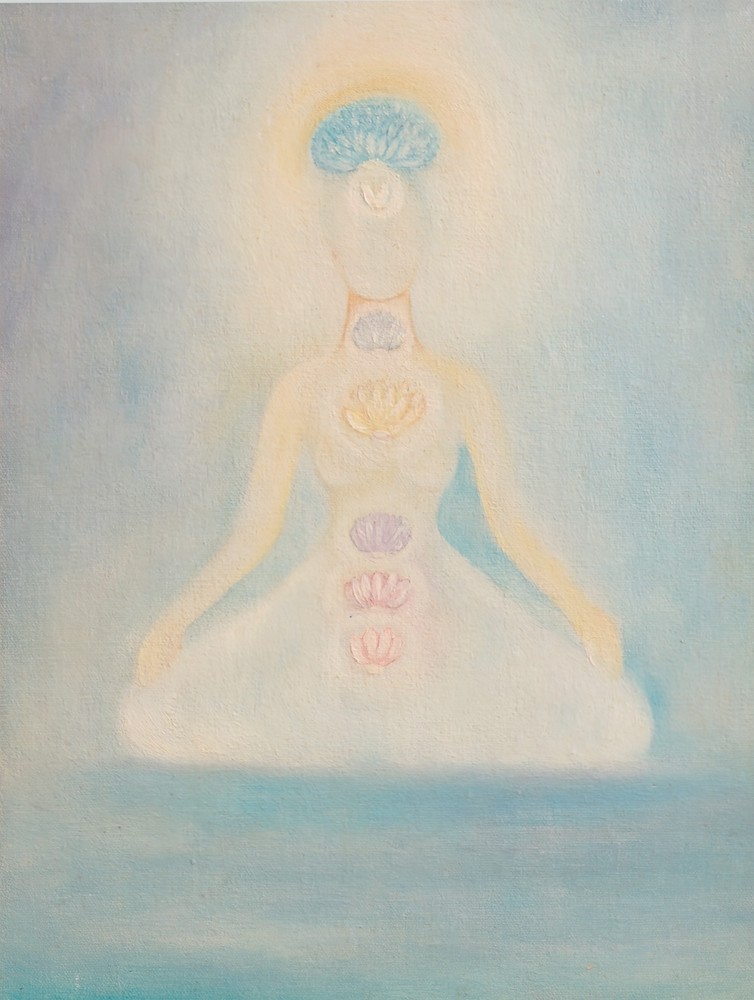
The Descent of Mahākuṇdalinī

The Descent of Mahākuṇdalinī

By

/

3–4 minutes

read

The Descent of Mahākuṇdalinī

Canto Thirty-Eight

Now the way must cut through brahmāndhāra,

And Savitri meet god in a godless form.


By whatever it may be known or perceived


That ceases in the genuine night, the sacred void,

And only remains the will that cancels

The burden of death present in the mortal’s breast.

Above all stood the wonder of the triple sun,


Bliss and consciousness and absolute truth.

Suddenly the cave opened, and she saw

The primal might seated on the topaz rock,


And heard seven great notes; flooded her the sound

Occult, sohaṃ-oṃ-haṃ-yaṃ-raṃ-vaṃ-laṃ.

26 May 2002

Brahmāndhāra: Darkness of Brahma or the Great Night, the Night of God; Dryden’s is genuine night full of idiocy and ignorance.

sohaṃ, oṃ, haṃ, yaṃ, raṃ, vaṃ, laṃ are the seven sounds that come from the seven Chakras, or occult centres of consciousness from above down below, in the subtle-physical. The seven musical notes sā, ré, ga, ma, pa, dha, nī, or do, re, mi, fa, sol, la, si have their origin in these centres rising from below above.

VII:5 The Finding of the Soul

This promise can bear fruit only in the deep soul of Savitri. While nearing the mystic cave she experiences a strange darkness that knows not the Unknown, all her human faculties cease to exist. But there is remembrance and silent she moves on, and all is the spirit’s vastness. Now she is standing in front of a rock-temple with the figures of gods and goddesses carved on its walls. She sees in stone images breathing presences, deathless and divine. They are the supreme aspects climbing to Sachchidānanda. Savitri crosses the tunnel through the last rock and suddenly Soul and Oversoul rush into each other. They become one. The transcendental Mother’s Power, the divine Mahākuṇdalinī, floods her entire being. Lotus after dynamic lotus opens, and the lower Nature becomes an instrument of the higher. There is the greatening of spiritual happiness everywhere. Across death and birth the first stage of perfection is reached in life.

Savitri Book 7 Canto 5 – The Finding of the Soul

All underwent a high celestial change:

Breaking the black Inconscient’s blind mute wall,

Each part of the being trembling with delight

Lay overwhelmed with tides of happiness

In the country of the lotus of the head

In the castle of the lotus twixt the brows

In the passage of the lotus of the throat ||127.11||

In the kingdom of the lotus of the heart ||127.16||

In the navel lotus’ broad imperial range ||127.17||

In the narrow nether centre’s petty parts ||127.18||

In the deep place where once the Serpent slept,

A firm ground was made for Heaven’s descending might. ||127.19||

Break+ing| the black| In+con|+scient’s blind| mute wall,|

Each part| of the be|+ing trem|+bling with| de+light|

Lay o|+ver+whelmed| with tides| of hap|+pi+ness|

In the coun|+try of| the lo|+tus of| the head|

In the cas|+tle of| the lo|+tus twixt| the brows|

In the pas|+sage of| the lo|+tus of| the throat|

In the king|+dom of| the lo|+tus of| the heart|

In the na|+vel lo|+tus’s broad| im+pe|+ri+al range|

In the nar|+row neth|+er cen|+tres’ pet|+ty parts|

In the| deep place| where once| the Ser|+pent slept,|

A firm ground| was made| for Heav|+en’s de+scend|+ing might.|

The featured image is a painting by Huta

3 responses to “The Descent of Mahākuṇdalinī”

  1. RY Deshpande Avatar
    RY Deshpande

    Sri Aurobindo About Kuṇdalinī

    The Functions of the Chakras or Centres

    The centres or Chakras are seven in number—

    (1) The thousand-petalled lotus on the top of the head.

    (2) In the middle of the forehead—the Ajna Chakra—(will, vision, dynamic thought).

    (3) Throat centre—externalising mind.

    (4) Heart-lotus—emotional centre. The psychic is behind it.

    (5) Navel—higher vital (proper).

    (6) Below navel—lower vital.

    (7) Muladhara—physical.

    All these centres are in the middle of the body; they are supposed to be attached to the spinal cord; but in fact all these things are in the subtle body, sūkṣma deha, though one has the feeling of their activities as if in the physical body when the consciousness is awake.

    ***

    Chakras

    The thousand-petalled (head) lotus—Chakra or centre of the higher will and knowledge

    The lotus in the forehead—Will, vision, mental dynamism

    The lotus in the throat—Expression—external mind

    The lotus of the heart—Emotion, dynamic vital feeling (behind the heart is the seat of the psychic being)

    The lotus of the navel—Higher vital

    The lotus of the abdomen—Lower vital

    The lotus at the end of the spine (Muladhara)—Physical consciousness

    ***

    In the process of our Yoga the centres have each a fixed psychological use and general function which base all their special powers and functionings. The mūlādhāra governs the physical down to the subconscient; the abdominal centre—svādhiṣṭhāna—governs the lower vital; the navel centre—nābhipadma or maṇipūra—governs the larger vital; the heart centre—hṛtpadma or anāhata—governs the emotional being; the throat centre—viśuddha—governs the expressive and externalising mind; the centre between the eyebrows—ājñācakra—governs the dynamic mind, will, vision, mental formation; the thousand-petalled lotus—sahasradala—above commands the higher thinking mind, houses the still higher illumined mind and at its highest opens to the intuition through which or else by an overflooding directness the overmind can have with the rest communication or an immediate contact.

    ***

    I never heard of two lotuses in the heart centre; but it is the seat of two powers, in front the higher vital or emotional being, behind and concealed the soul or psychic being.

    The colours of the lotuses and the numbers of petals are respectively, from bottom to top:—(1) the Muladhara or physical consciousness centre, four petals, red; (2) the abdominal centre, six petals, deeper purple red; (3) the navel centre, ten petals, violet; (4) the heart centre, twelve petals, golden pink; (5) the throat centre, sixteen petals, grey; (6) the forehead centre between the eyebrows, two petals, white; (7) the thousand-petalled lotus above the head, blue with gold light around. The functions are, according to our Yoga,—(1) commanding the physical consciousness and the subconscient; (2) commanding the small vital movements, the little greeds, lusts, desires, the small sense-movements; (3) commanding the larger life-forces and the passions and larger desire-movements; (4) commanding the higher emotional being with the psychic deep behind it; (5) commanding expression and all externalisation of the mind movements and mental forces; (6) commanding thought, will, vision; (7) commanding the higher thinking mind and the illumined mind and opening upwards to the intuition and overmind. The seventh is sometimes confused with the brain, but that is an error—the brain is only a channel of communication situated between the thousand-petalled and the forehead centre. The former is sometimes called the void centre, śūnya, either because it is not in the body, but in the apparent void above or because rising above the head one enters first into the silence of the self or spiritual being.

    ***

    There is one centre below the navel (lower vital), another at the navel (central vital), another in the chest (emotional vital, heart centre), another in the throat (physical mind), another above the head (higher consciousness); besides these there is the centre in the forehead (mind, will, vision) and one at the bottom of the spine (muladhara, physical centre). The working in each will be according to the nature of the centre.

    1. In a draft of this letter Sri Aurobindo wrote in the opening paragraph: “I have often written of the centres—but without using the Sanskrit names which are intelligible only to Hindus. They are the same but our interpretation and application is not quite identical. We relate them to the psychological levels or planes.”—Ed. 

    https://incarnateword.in/compilations/chakras-and-kundalini/the-functions-of-the-chakras-or-centres/

    Like

  2. RY Deshpande Avatar
    RY Deshpande
    • Muladhara (Root): 4 petals
    • Svadhisthana (Sacral): 6 petals
    • Manipura (Solar Plexus): 10 petals
    • Anahata (Heart): 12 petals
    • Vishuddha (Throat): 16 petals
    • Ajna (Third Eye): 2 petals (though sometimes described as 96 or 1,000 minor divisions) 
    • Sahasrara Chakra (above the head): 1000 petals

    [From the Internet]

    Like

    1. RY Deshpande Avatar
      RY Deshpande

      It is not clear from the painting whether there are, respectively, as many petals in the various lotuses. And their colours.

      Like

Leave a reply to RY Deshpande Cancel reply