
Apropos of “her unlit temple of eternity”
We are looking into the second sentence of Savitri:
Across the path of the divine Event
The huge foreboding mind of Night, alone
In her unlit temple of eternity,
Lay stretched immobile upon Silence’ marge. ||1.2||
The first feature we immediately notice is the enjambment, the second line striding over into the third. This is a striking example right at the beginning of the poem, as if to illustrate the variation in the poetic art. Here is another appearing much later in the composition:
Then none could answer to her words. Silent
They sat and looked into the eyes of Fate. ||106.201||
About the technique of poetry Sri Aurobindo answered a letter long before the epic started taking final shape, especially during the last eight years, from 1942.
Savitri is built on another plan altogether. It is blank verse without enjambements (except rarely)—each line a thing by itself and arranged in paragraphs of one, two, three, four, five lines (rarely a longer series), in an attempt to catch something of the Upanishadic and Kalidasian movements, so far as that is a possibility in English. You can’t take that as a model—it is too difficult a rhythm-sculpture to be a model. I shall myself know whether it is a success or not, only when I have finished 2 or 3 books. But where is the time now for such a work? When the supramental has finished coming down—then perhaps.
25 December 1932
But he also tells that “sparing use of enjambements” can be a good part of the rhythmic flow.
Another surprise in the sentence is related to the grammar.
Across the path of the divine Event
The huge foreboding mind of Night, alone
In her unlit temple of eternity,
Lay stretched immobile upon Silence’ marge. ||1.2||
In this sentence grammatically “her” in the third line should refer to “mind” in the second. But in the totality of the sense it is going for “Night”. Is it possible? Nuances of grammar allow it.
By the way, the third line does not exist in the earlier draft and therefore this question does not arise there. In that draft it was “spirit” and not “mind”. In it the sentence was:
Across the path of the divine Event
The huge foreboding spirit of Night, alone
Lay stretched immobile upon Silence’ marge. ||1.2||
Technically “mind” by itself should be “it or “he” and never “she”. In Savitri it is generally “it” throughout. From the description it is clear that the “unlit temple” refers to “Night” and not to “mind” who has no temple at all. She is the negative power of Inconscience, power therefore she, without any flame or light present there, nobody has so far lit the lamp in her temple. But it is necessary for the creation that it should be, the unseen lamp in her abysmal bosom must start showing her glories and her beauties, her wonders in the vast creative manifestation in the multiplicity of truth and consciousness and bliss.
This “forbidding mind of Night” is standing across the “path of the divine Event”, not allowing it to proceed further, towards the manifestation of the superior spiritual possibilities. The problem is there in finding a solution to its resolution. That will be done by the incarnate divine Shakti herself, she coming as Savitri in this death-governed world. She will come and change this “mind of Night” into the “mind of Light”, transform it, the physical’s mind receiving the supramental light and force. That is the Avataric issue and realisation.
About the grammatical aspect, however, I had consulted my expert in the field. NG writes the following, a beautiful and satisfying detail. Here it is:
Sri Aurobindo genders “Spirit” as neuter if he intends to refer to its impersonal aspect or its abstract aspect of That and as male if he intends to bring forth the personal of the Lord aspect (to Prakriti) or of the Witness aspect (to Prakriti) but never female. For “Mind” Sri Aurobindo genders it as male when referring to the manomaya purusha and as neuter when referring to it as an instrument but never female. So the fact that Sri Aurobindo changed “Spirit” to “Mind” and still retained the pronoun “her” is itself proof that his reference to “Night” as the pronoun’s referenced entity is intentional, regardless of the syntactical hierarchy.
Grammatically, this is a case of conceptual agreement overriding syntactical agreement.
Technically, the phrase is [The Mind [of Night]].
- Syntactic Subject: The Mind.
- Possessive Modifier: Of Night.
Usually, a pronoun like “her” (in her temple) refers to the subject. But here, the “Temple of Eternity” does not belong to the Mind; it belongs to Night. The Mind is merely the faculty occupying the temple.
Therefore, “In her unlit temple” correctly identifies “Night” as the owner of the temple.
We see this structure in English when the modifier is more potent than the head noun. For example:
- “The wrath of the Goddess consumed her enemies.”
- (We do not say “its” enemies referring to “wrath”; we refer to the Goddess).
So it is grammatically possible because “Night” is the possessor of the “Temple,” not the “Mind” but semantically it is necessary because Mind owning the temple of Eternity doesn’t make sense and only Night can own.
Interestingly Sri Aurobindo went back and forth between “Spirit” and “Mind” six times and also between “the” and “her” in “In her temple of Eternity” four times and in both cases till quite late in the drafts.
There is more to it about which I will write later.
In the meantime the following blog post might interest you:
Featured image is a painting by Huta
Savitri Book 1 Canto 1 – The Symbol Dawn
It was the hour before the Gods awake. ||1.1||
Across the path of the divine Event
The huge foreboding mind of Night, alone
In her unlit temple of eternity,
Lay stretched immobile upon Silence’ marge. ||1.2||
Almost one felt, opaque, impenetrable,
In the sombre symbol of her eyeless muse
The abysm of the unbodied Infinite;
A fathomless zero occupied the world. ||1.3||
Let us scan these lines:
It was| the hour| be+fore| the Gods| a+wake.|
A+cross| the path| of the| di+vine| E+vent|
The huge| fore+bod|+ing mind| of Night,| a+lone|
In her| un+lit| tem+ple| of e+ter|+ni+ty,|
Lay stretched| im+mo|+bile u|+pon Si|+lence’ marge.|
Al+most| one felt,| o+paque,| im+pen+e+|tra+ble,|
In the som|+bre sym|+bol of| her eye|+less muse|
The a+bysm| of the| un+bod|+ied In|+fi+nite;|
A fath|+om+less ze|+ro oc|+cu+pied| the world.|
A pow+er| of fall|+en bound|+less self| a+wake|
Be+tween| the first| and the| last Noth|+ing+ness,|
Re+call+ing| the ten|+e+brous womb| from which| it came,|
Turned from| the in+sol|+u+ble mys|+ter+y| of birth|
And the tar|+dy pro|+cess of mor|+tal|+i+ty|
And longed| to reach| its end| in va|+cant Nought.|
Wonder at this prosodic beauty with foot-variation in the passage! In it the monotony of ti-tum ti-tum iambic composition is completely overcome, at times unstressed syllable acquiring weight due to its position, the enunciation providing it, as in the first foot itself. The second foot could be amphibrach, short-long-short, but it flows better as an iamb. That is the supreme mastery over the poetic art in Savitri, present in one way or the other throughout.
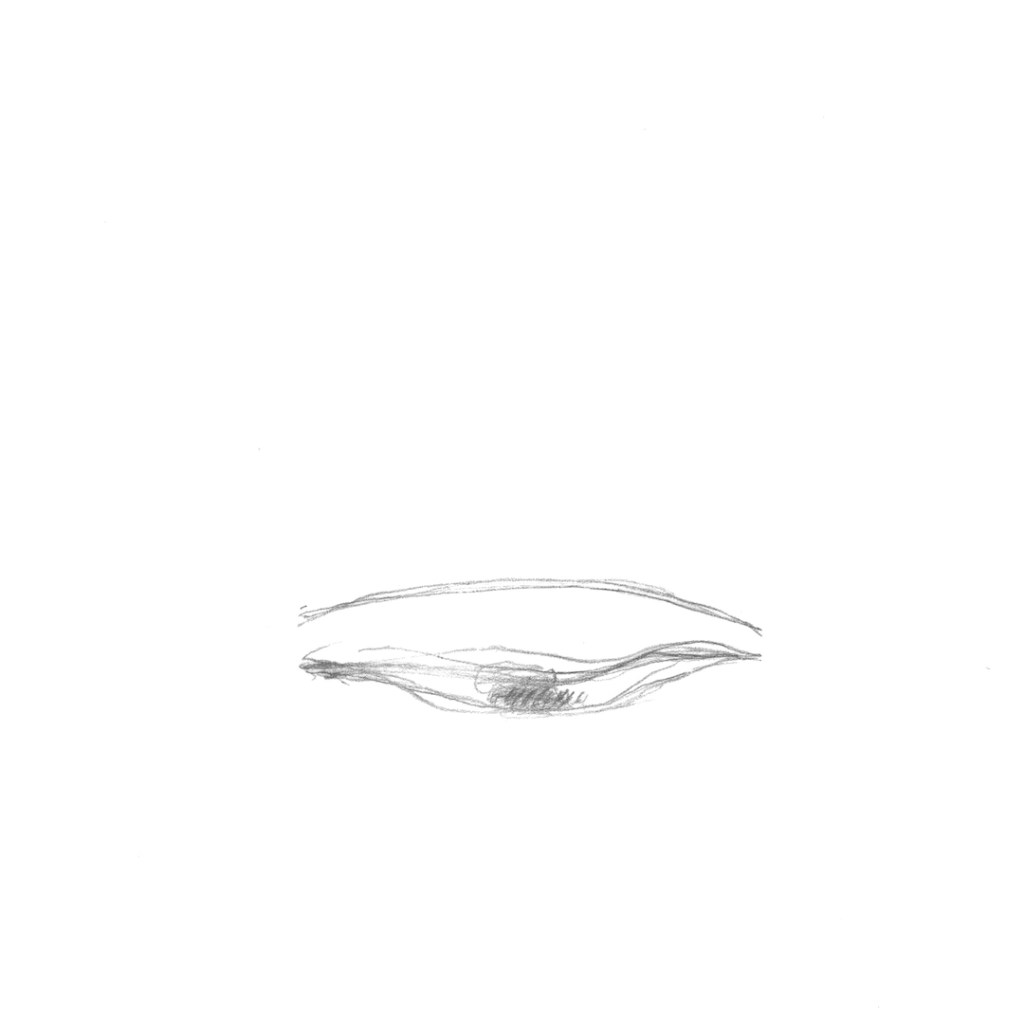
Sketch by the Mother:
Reference may be made to the following:


 The Winds of Wonder
Leave a reply to Conceptual-Syntactical Agreement in the Grammar of Savitri — Some Examples presented by NG – The Winds of Wonder Cancel reply