Aswapati introduces Savitri to Narad — A Comment about a Painting by Huta

Aswapati introduces Savitri to Narad — A Comment about a Painting by Huta

By

/

5–7 minutes

read

Aswapati introduces Savitri to Narad — A Comment about a Painting by Huta

Princess Savitri has grown up into full maidenhood and is bidden by her revered Yogi-father King Aswapati to find a mate for herself. This was because no warrior-prince of merit and will had come forward to claim her hand in marriage. Immediately she sets herself on the long fateful quest and eventually one excellent morning meets Satyavan in the far Shalwa Woods. They by the awakened power of love at once recognise each other’s ancient identity, of ages, and pledge to be together. With all the happiness in her triumphant heart she returns to the Palace to share her discovery of love with her royal parents.

But in the calm luxurious Palace Hall she already finds her parents in the august company of the heavenly Sage Narad. From his home in Paradise he, crossing the silent bounds bordering the mortal’s plane, has rushed to meet them with a tremendously specific charged purpose, making an extremely significant special visit to them, arriving at the Palace an hour before Savitri’s return. In the meanwhile he sings to the royal hosts the song of the lotus-heart of love with a thousand luminous buds of truth.

And steps in joyous Savitri.

The father introduces his daughter to the visiting Sage:

Behold her, singer with the prescient gaze,

And let thy blessing chant that this fair child

Shall pour the nectar of a sorrowless life

Around her from her lucid heart of love,

Heal with her bliss the tired breast of earth

And cast like a happy snare felicity. ||106.55||

As grows the great and golden bounteous tree

Flowering by Alacananda’s murmuring waves,

Where with enamoured speed the waters run

Lisping and babbling to the splendour of morn

And cling with lyric laughter round the knees

Of heaven’s daughters dripping magic rain

Pearl-bright from moon-gold limbs and cloudy hair,

So are her dawns like jewelled leaves of light. ||106.56||

So casts she her felicity on men. ||106.57||

A flame of radiant happiness she was born,

And surely will that flame set earth alight:

Doom surely will see her pass and say no word,

But too often here the careless Mother leaves

Her chosen in the envious hands of Fate:

The harp of God falls mute, its call to bliss

Discouraged fails mid earth’s unhappy sounds;

The strings of the siren Ecstasy cry not here

Or sooner silenced in the human heart. ||106.58||

The reference to the speeding enthusiastic Alacananda River with murmuring waves could be taken as a pregnant suggestion for all the hurrying eagerness that is present not only in the King’s Palace in Madra located on its banks but also meaningfully to the entire yearning creation. The River joins Mandakini the Ganges in the lower Himalayas at Devaprayāga.

Let us scan that sentence:

As grows| the great| and gold|+en boun|+te+ous tree|

Flow+er+ing| by A+la|ca+nan+|da’s mur|+mur+ing waves,|

Where with| e+na+|moured speed| the wa+|ters run|

Lisp+ing| and bab|+bling to| the splen+dour| of morn|

And cling| with lyr|+ic laugh|+ter round| the knees|

Of heav|+en’s daugh|+ters drip|+ping mag|+ic rain|

Pearl-bright| from moon|-gold limbs| and cloud|+y hair,|

So are| her dawns| like jew|+elled leaves| of light.| 106.56

The second line opens with dactyl-amphibrach, ending with an ænapest, carrying the murmur of love over long distances where death stands transformatively defeated. The “great and golden bounteous tree” is life itself getting ready for the riches to make it truly and greatly rich in deathlessness. The “envious hands of Fate” are a decisive part of that secret dreadfulness which must be met with and their workings in the present “mortal life” undone.

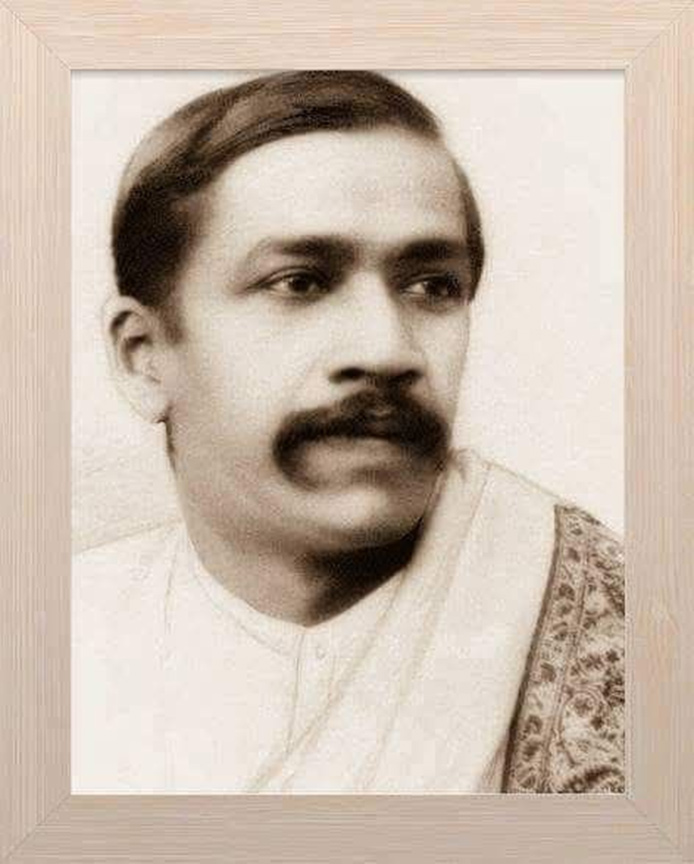
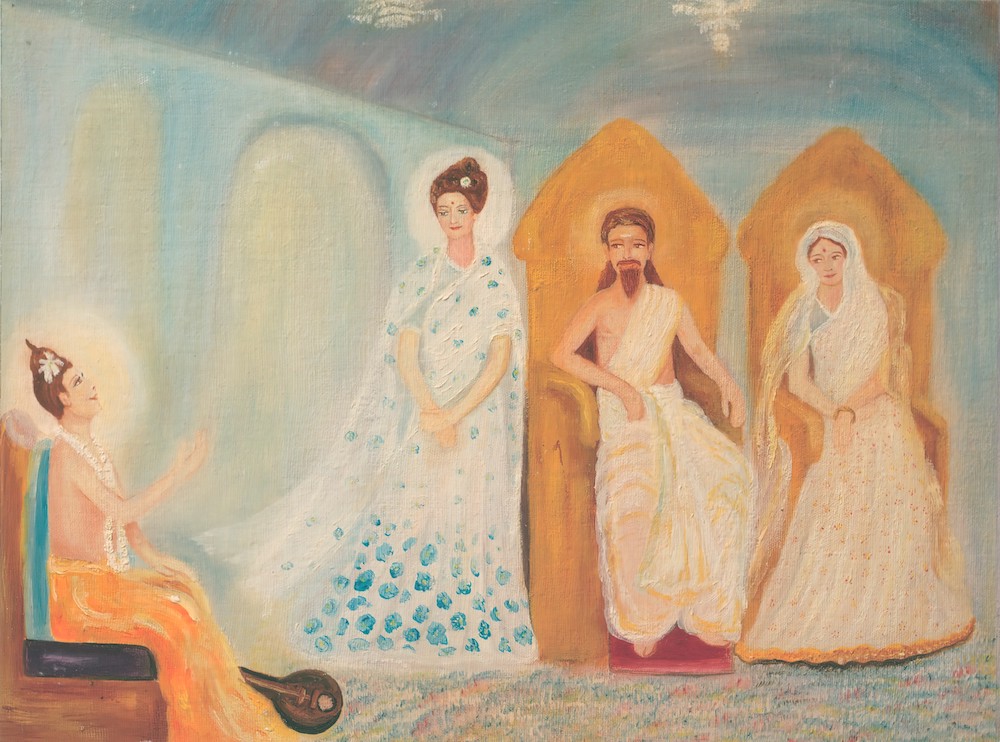
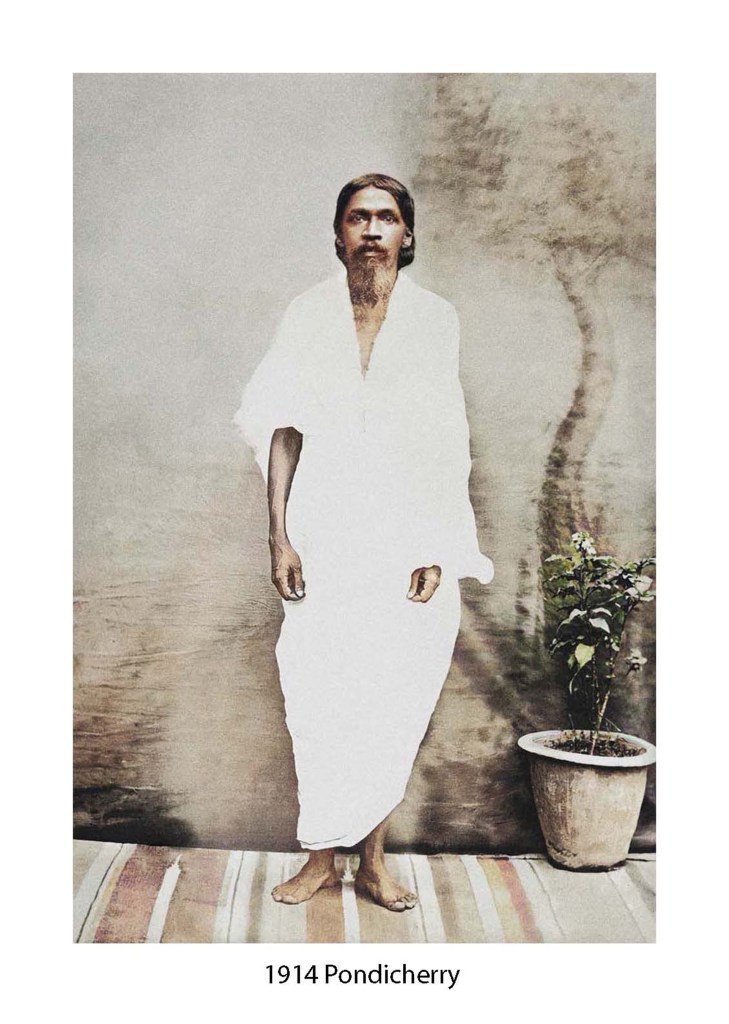
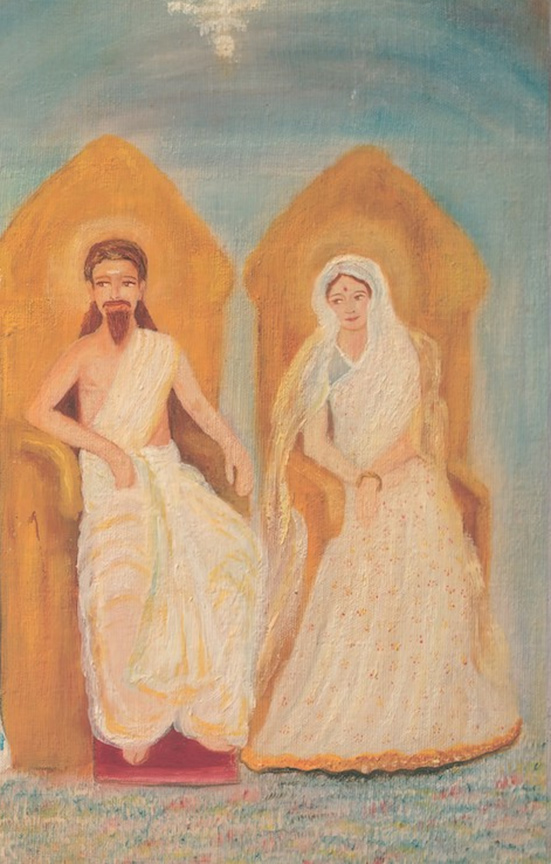
The featured image at the beginning is a wonderful painting by Huta, Book Six Canto One, # 5, very inspired. It is reminiscent of the Photo of Sri Aurobindo taken in 1914 in the Guest House, 41 Rue François Martin Pondicherry. But in the context of the “vast business of created things” these two, we may say with some trepidation, do not quite go together:

The eternal seeker in the aeonic field

Besieged by the intolerant press of hours

Again was strong for great swift-footed deeds. ||92.12||

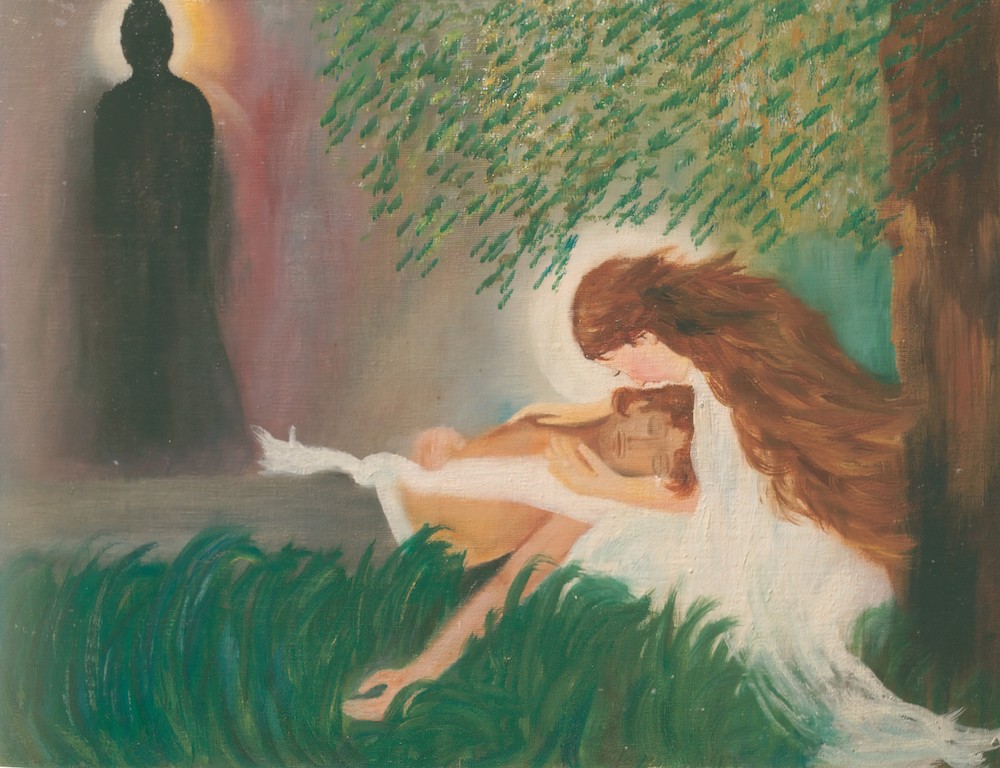
This bust of the busy Aswapati in a dhoti with one end around the shoulders does not have that suggestion of “intolerant press of hours and of the great swift-footed deeds”. It is so not only here but also at a few more subsequent places. Nor does the dress of the Queen go with it. The text has a different atmosphere. But we have most appealing pictures of Narad and Savitri. En passant we may also say that the paintings of Satyavan going to the forest just in jeans, his torso bare, for his hectic work, or when he is dead under the majestic “kingly tree” seem to be out of tune with the classical ambiance of the marvellous Epic, Vyasa’s as well as Sri Aurobindo’s, somewhat unrelated and incongruent.

Can we say that this was approved by the Mother? No doubt, the entire inspiration for the painter comes from her, she at times making sketches herself; but nowhere we have such a Satyavan sketched by the Mother. The Mother has given full freedom to the painter to be prompted by her æsthetic discernment and sensitivity; she would not intervene in it. Sorry Huta-ben if this comment of mine is going to appear not only hasty or perceptive but also atrocious. Satyavan or this Aswapati or the Queen take us a bit away from Savitri of the Master-Creator with a luminous command and restraint.

Sri Aurobindo in 1914
Madra on the Banks of Alacananda, modern Devaprayāga

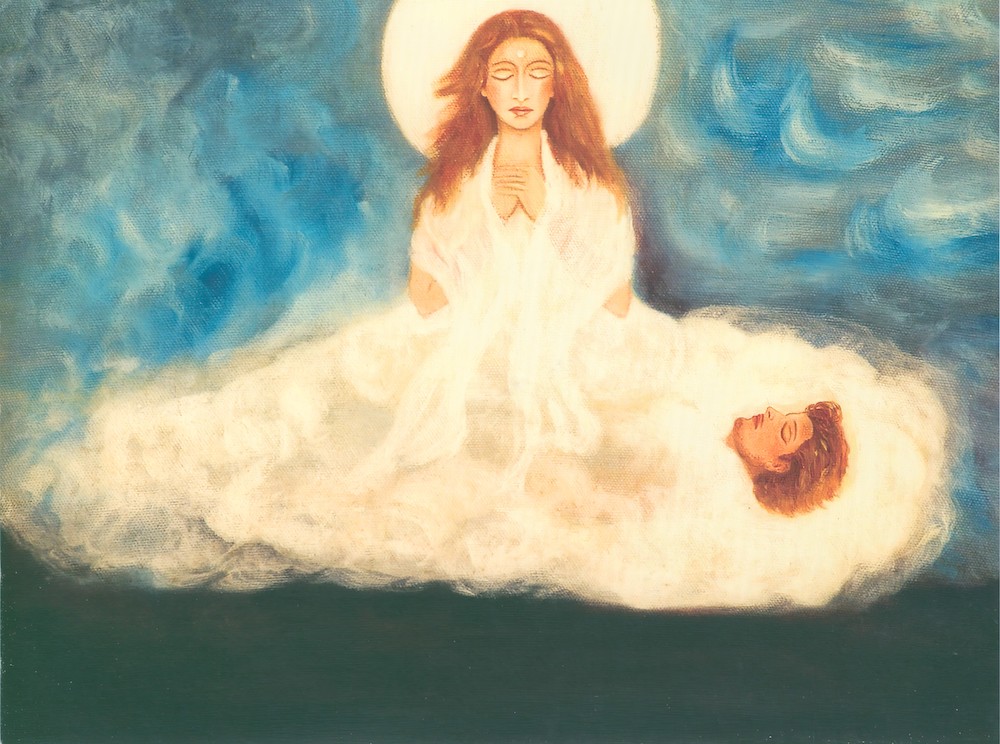
Apropos of the death of Satyavan Huta has done two paintings, the first related to the last line of the Symbol Dawn Book One Canto One and the second the death in the Forest Book Eight. There is a very perceptive difference between the two. I like and prefer the Symbol Dawn painting which has a deep spiritual-occult luminosity and suggestiveness, that Death has certainly been conquered, the entire impetus and momentum of the Epic.

The Symbol Dawn
Death in the Forest
Here are the Royal Parents
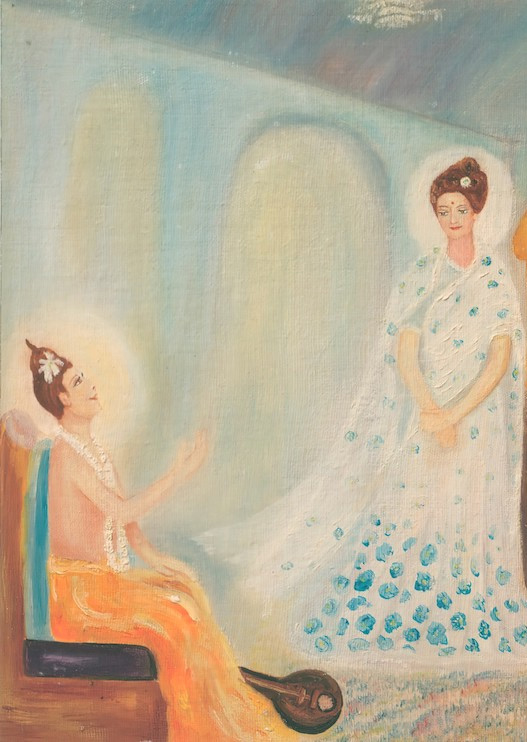
And here is Narad casting his gaze on Savitri
10 responses to “Aswapati introduces Savitri to Narad — A Comment about a Painting by Huta”

  1. luminouspleasantly6d32587376 Avatar
    luminouspleasantly6d32587376

    My words fail to explain the deeper mystic vision of Huta. In fact, it nudges me to rise yogically.

    Like

    1. RY Deshpande Avatar
      RY Deshpande

      “mystic vision of Huta” — absolutely correct, and indisputable. But its relationship with the original text it is attempting to present — how about that?

      Like

      1. claudechamberland Avatar
        claudechamberland

        Dear Brother,

        Let me try to understand your point of view, because I am not sure and my limited understanding of the English language can play tricks on me : Are you arguing that, because of a context where

        “The eternal seeker in the aeonic field
        Besieged by the intolerant press of hours
        Again was strong for great swift-footed deeds.”

        , the image of happy attentiveness depicted by Huta, the serene and smiling face of Aswapati , his posture and clothing during his daughter’s presentations to the wise Narad when she just arrived, full of love, from her meeting with her beloved Satyavan, does not show enough seriousness, or even a worried and thoughtful expression and that Aswapati’s face should have been painted with austere and grim traits?

        I should mention in passing that the challenge of evoking Sri Aurobindo’s features onto the king’s face is enormous. But Huta’s capability to take on this kind of challenge is clear, as demonstrated by Mother’s confidence in her and the results we can see.

        But why should the king wear a dark face, even when “besieged by the intolerant press of hours”? Isn’t Aswapati, in this very moment, obligated to honour the laws of hospitality for his distinguished guest? Was not his heart full of delight after hearing the veena recital of the celestial musician? Finally, is it appropriate to transpose what humanly would have
        been the expected traits of a king-yogi who certainly mastered for long the siddhi of “égalité d’âme”?

        Certainly that the great painter, under Mother’s direct guidance, choose then to portray Sri Aurobindo/Aswapati under the traits evoking the famous photography of which you were talking (the photo of Sri Aurobindo taken in 1914 in the Guest House, 41 Rue François Martin Pondicherry), but with a notable clothing adaptation: The king of Huta’s painting is wearing
        more of a dhoti like the one worn by Sri Aurobindo in these equally famous photos taken by Henri Cartier-Bresson at the Ashram in Pondicherry on April 25, 1950. The pose of the arm, also, is similar.

        In doing so, the artist suggests a certain postural similarity with the situation of our Master in April1950, while taking place a lot of collapses in the state of the world, for example: the first Soviet bomb (29th August 1949) the beginning of the Korean war (25th June 1950), the first invasion of Tibet by China (7th October 1950), thus corresponding also with the words
        you were quoting:

        “The eternal seeker in the aeonic field
        Besieged by the intolerant press of hours
        Again was strong for great swift-footed deeds.”

        From my point of view, the passage that Huta wanted to highlight is the moment in the story where the king and the queen are still under the happy enchantment of Narad’s celestial music, illustrated by this passage:

        “Behold her, singer with the prescient gaze,
        And let thy blessing chant that this fair child
        Shall pour the nectar of a sorrowless life
        Around her from her lucid heart of love,
        Heal with her bliss the tired breast of earth
        And cast like a happy snare felicity.”

        In the painting, one can notice Savitri, dressed in a white sari adorned with blue patterns, embodying purity, light, and divine mission. Her serene expression and reverent posture reflect her role as a bearer of bliss and transformation. The king presents her to the sage with poetic verses highlighting her luminous nature and exceptional destiny. He therefore
        cannot at that moment display a troubled facial expression or gesture, even from a purely human point of view. Since the dramatic revelation of the celestial traveler has not yet occurred, it is natural that Huta’s canvas depicts a joyful atmosphere, heightened by Savitri’s arrival and the joy of her rediscovered love.

        In conclusion, Sri Aurobindo always said that « his life has not been on the surface for men to see” (On Himself). I personally consider that the huge challenge of depicting on a canvass what the “surface” can convey to an observing eye is brilliantly met by the equally huge talent and inspiration of Huta under the Divine inspiration of Mother.

        Like

  2. luminouspleasantly6d32587376 Avatar
    luminouspleasantly6d32587376

    The last last line of the canto ‘This was the day when Satyavan must die’ speaks of the necessity of Satyavan’s death. In the epic ‘SAVITRI’, Savitri appears to have supramentalised the subtler mystic planes within the Cosmic Creation, the planes where Satyavan’s soul has to go to after his death so that all the layers of his subtle being could be supramentalised in view of the fitness of his subtle being for such supramentalisation. In the phenomenon Savitri’s supervention is required. In the first picture drawn by Huta in which Savitri has closed her eyes, I find a yogic aura around her closed eyes which speak of her guardian role in the supramentalisation of the subtler layers of the subtle being of Satyavan.

    I beg your forgiveness for my silly comment. In fact, I always need your guidance.

    Nikhil Kumar

    Liked by 1 person

    1. RY Deshpande Avatar
      RY Deshpande

      Well-said. But “Savitri appears to have supramentalised the subtler mystic planes within the Cosmic Creation” needs to be seen again. This can happen only when Death is fully universally conquered and transfigured. This has to precede supramentalisation. The Mother is categorical, that as long as Death is present Falsehood will exist, that Death is the cause of Falsehood and not the other way round. In the cosmic creation this can happen only when it is realised on earth, this mortal world, mrityuloka, this “significant centre”.

      Like

    2. RY Deshpande Avatar
      RY Deshpande

      “Savitri, Savitri, O Savitri,

      Lean down, my soul, and kiss me while I die.” ||133.34||

      This is what we have in Book Eight. Satyavan has finally succumbed to death. This has to happen and it has happened, he has consented to die; without that consent Death cannot take away the soul. But there is the power of Death that he removes the veil and makes visible the “luminous Satyavan” kept hidden here by Nature, Prakriti.

      The dim and awful godhead rose erect

      From his brief stooping to his touch on earth,

      And like a dream that wakes out of a dream,

      Forsaking the poor mould of that dead clay,

      Another luminous Satyavan arose,

      Starting upright from the recumbent earth

      As if someone over viewless borders stepped

      Emerging on the edge of unseen worlds. ||135.25||

      Liked by 1 person

  3. RY Deshpande Avatar
    RY Deshpande

    Dear Claude

    Your comment is very perceptive and persuasive, winnable. I certainly like it, very thoughtful, an accomplished avocat presenting a case. It must be taken seriously, serious as the issues are. But we should also recognise that there are plenty of details which are not present in the Savitri-text, these left for the reader to provide for himself. Surely, there will arise divergences of view-points and understanding. I believe that Narad is not going to descend — materialise — directly in the Palace-Hall where the royal hosts are already present; there will be some protocol as a matter of regular procedure, as we have in the Ramayana when Rama is going to meet Rishi Agastya in his Ashram. But before we proceed further let me wait for other responses also. In the meanwhile, I will hold on to what I have said.

    Deshpande

    Liked by 1 person

  4. The Divine Yajña Celebrating the Death of Satyavan – The Winds of Wonder Avatar
    The Divine Yajña Celebrating the Death of Satyavan – The Winds of Wonder

    […] Aswapati introduces Savitri to Narad — A Comment about a Painting by Huta Behold this image cast by light and love […]

    Like

  5. RY Deshpande Avatar
    RY Deshpande
  6. damahapatra Avatar
    damahapatra

    Thank you, Shri Deshpande ji, for inviting me to comment on the post. As I read and re-read the post and the comments, I am in a dilemma as to what exactly should I write, mainly owing to my limitations both ways – I am not a skilled evaluator of paintings, nor I am an ‘expert’ on Savitri. I am a learner or rather I myself am evolving as I read the epic poem.

    Hence, my comments will perhaps – I am afraid – be more of general nature, which may not appear meaningful to you. I hope I do not disappoint you.

    To me, Huta-ben would be the ideal one to respond to your perspective on her paintings. In my case, following the spirit of Anekantavada – that Truth has many truths, or Truth has many sides to it – I would say you both are right in your own ways. Can one provide the whole, integral, picture? I doubt. Huta-ben as you wrote in your response to a comment that it was indisputable that she had a mystic vision – which might have its intricacies which we are not aware of – that propelled her to make these paintings.

    Personally, I like those paintings. In my view, and perhaps you will agree with me, Aswapati was Rajarshi, and wearing clothes like the one worn by Sri Aurobindo does not sound offensive to the Maharishi. I had earlier come across such comparisons (not remembering exactly where) where parallels were made between Sri Aurobindo and Aswapati, but I do not have a deeper knowledge of it. I also find it interesting and intriguing when you wrote, “The Mother has given full freedom to the painter,” then what are the points of contention? You were also candid when you wrote, “sorry Huta-ben…”

    We all know language has its own limitations. Not everything is captured by language, perhaps also by painting. I wish I knew Huta-ben’s inner mind to make an insightful comment.

    Also the idea of protocol – when a Rishi meets a king or vice versa – sounded to me a little, for the lack of a better word, prosaic or formal. In a spiritual world, I am not sure if protocols like royal protocol, or in modern terms diplomatic protocol, bear much value. Also, as Sri Aurobindo himself used these words ‘a legend and a symbol’ for the book’s subtitle, how can we judge a symbol as powerful as Savitri from a purely intellectual/protocol point of view? Or, as he wrote in the author’s note, the characters are “incarnations or emanations of living and consciousness Forces with whom we can enter into….” Perhaps you will agree with me that it would depend on one’s plane of consciousness to interpret the epic poem as well as the paintings made by Huta-ben. Perhaps Huta-ben had her vision which was reflected in her paintings. I know I am using ‘perhaps’ too much in my comment, but this reflects my own puzzlement while writing this comment.

    A story told by Sri Ramakrishna comes to mind. A mother prepares different types of food for children. For the sick one, she makes khichdi, and for the one who likes green vegetables she prepares that and so on (paraphrasing the story as I do not have the exact food examples Sri Ramakrishna used), but the mother’s love was equal for all her children. I am alluding to this story to make a case that as a child of the Divine Mother, Huta-ben had her inspiration to draw these paintings, and as an equally-loved child of the Divine Mother, you are most welcome to disagree as in your vision you see discrepancies. And to me, you both are right in your own ways.

    Can we say that it is always welcome to have coexistence of perspectives, even if conflicting? Difference is not discord. There are multiple ways to express our love for the Divine Mother and Sri Aurobindo, and following that spirit, I appreciate the questions you raised. 

    Debidatta Aurobinda Mahapatra

    Like

Leave a comment