The Mother about Paul Richard — One
…I have done my best, all these years, to try to keep him at a distance. He has a power—a terrible asuric power. Between you and me, I saw him like that from the start—that’s why I became involved with him. I never intended to marry him (his family affairs made it necessary), but when we met, I recognized him as an incarnation of the ‘Lord of Falsehood’—that is his ‘origin’ (what he called the ‘Lord of Nations’); and in fact, this being has directed the whole course of world events during the last few centuries. As for Theon, he was….
It was not by choice that I met all the four Asuras—it was a decision of the Supreme. The first one, whom religions call Satan, the Asura of Consciousness, was converted and is still at work. The second [the Asura of Suffering] annulled himself in the Supreme. The third was the Lord of Death (that was Théon). And the fourth, the Master of the world, was the Lord of Falsehood; Richard was an emanation, a vibhuti, as they say in India, of this Asura.
Théon was the vibhuti of the Lord of Death. …
At any rate, you understand that I’m not very keen on having Richard introduced into the book—the simple fact of mentioning him attracts him.
He was a pastor at Lille, in France, for perhaps ten years; he was quite a practicing Christian, but he dropped it all as soon as he began to study occultism. He had first specialized in theological philosophy in order to pass the pastoral examinations, studying all the modem philosophy of Europe (he had a rather remarkable metaphysical brain). Then I met him in connection with Theon and the Cosmic Review, and I led him into occult knowledge. Afterwards, there were all sorts of uninteresting stories…. He became a lawyer during the early period of our relationship and I learned Law along with him—I could even have passed the exam! Then the divorce stories began: he divorced his wife; they had three children and he wanted to keep them, but to do so he had to be legally married, so he asked me to marry him—and I said yes. I have always been totally indifferent to these things. Anyway, when I met him I knew who he was and I decided to convert him—the whole story revolves around that.
As a matter of fact, the books he wrote (especially the first one, The Living Ether) were based on my knowledge; he put my knowledge into French—and beautiful French, I must say! I would tell him my experiences and he would write them down. Later he wrote The Gods (it was incomplete, one-sided). Then he became a lawyer and entered politics (he was a first-class orator and fired his audiences with enthusiasm) and was sent to Pondicherry to help a certain candidate who couldn’t manage his election campaign single-handed. And since Richard was interested in occultism and spirituality, he took this opportunity to seek a ‘Master,’ a yogi. When he arrived, instead of involving himself in politics, the first thing he did was announce, ‘I am seeking a yogi.’ Someone said to him, ‘You’re incredibly lucky! The yogi has just arrived.’ It was Sri Aurobindo, who was told, ‘There’s a Frenchman asking to see you….’ Sri Aurobindo wasn’t particularly pleased but he found the coincidence rather interesting and received him. This was in 1910.
When Richard had finished his work, he returned to France with a poor photograph of Sri Aurobindo and a completely superficial impression of him, yet with the feeling that Sri Aurobindo KNEW (he hadn’t at all understood the man that Sri Aurobindo was, he hadn’t felt the presence of an Avatar, but he had sensed that he had knowledge). Moreover, I think he always held this opinion, because he used to say that Sri Aurobindo was a unique intellectual giant… without many spiritual realizations! (The same type of stupidity as Romain Rolland’s.) Well, my relationship with Richard was on an occult plane, you see, and it’s difficult to touch upon. What happened was far more exciting than any novel imaginable.
But he was a man who….
He isn’t dead and he’s still terribly dangerous because of what’s behind him [the Lord of Falsehood].
Ah, no! It must all be erased. Simply put a note in your book: ‘Paul Richard, who met Sri Aurobindo for the first time in 1910….’ And you can mention that he was a theological writer or something of the sort to explain how he prompted Sri Aurobindo to write.
When he returned, he told me he would take me there as soon as he could.
5 November 1961
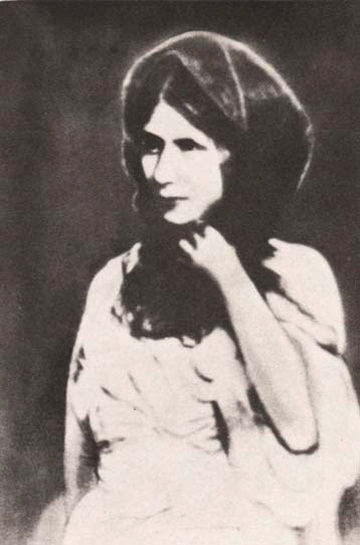
The Mother met Max Théon and later his wife Madame Théon, Alma, two of Her teachers in occultism. The Mother noticed the resemblance he had with the figure
Featured Photo: The Mother in Algeria
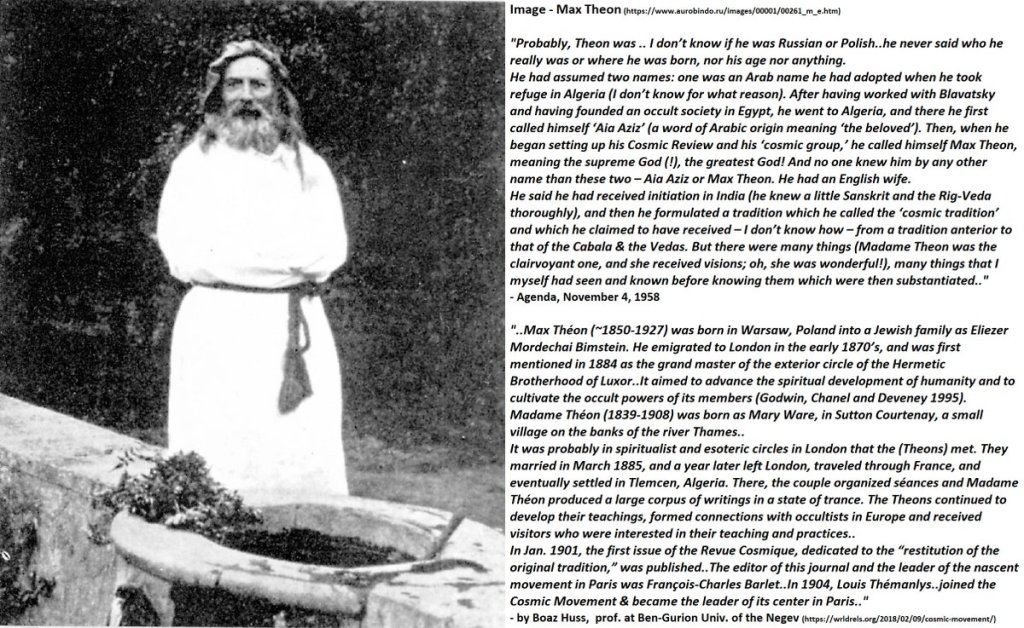
Max Théon
There is the whole Chaldean tradition, and there is also the Vedic tradition, and there was very certainly a tradition anterior to both that split into two branches. Well, all these occult experiences have been the same. Only the description differs depending upon the country and the language. The story of creation is not told from a metaphysical or psychological point of view, but from an objective point of view, and this story is as real as our stories of historical periods. Of course, it’s not the only way of seeing, but it is just as legitimate a way as the others, and in any event, it recognizes the concrete reality of all these divine beings. Even now, the experiences of Western occultists and those of Eastern occultists exhibit great similarities. The only difference is in the way they are expressed, but the manipulation of the forces is the same.
I learned all this through Theon. Probably, he was … I don’t know if he was Russian or Polish (a Russian or Polish Jew), he never said who he really was or where he was born, nor his age nor anything.
He had assumed two names: one was an Arab name he had adopted when he took refuge in Algeria (I don’t know for what reason). After having worked with Blavatsky and having founded an occult society in Egypt, he went to Algeria, and there he first called himself ‘Aïa Aziz’ (a word of Arabic origin meaning ‘the beloved’). Then, when he began setting up his Cosmic Review and his ‘cosmic group,’ he called himself Max Theon, meaning the supreme God (!), the greatest God! And no one knew him by any other name than these two—Aïa Aziz or Max Theon.
He had an English wife.
He said he had received initiation in India (he knew a little Sanskrit and the Rig-Veda thoroughly), and then he formulated a tradition which he called the ‘cosmic tradition’ and which he claimed to have received—I don’t know how—from a tradition anterior to that of the Cabala and the Vedas. But there were many things (Madame Theon was the clairvoyant one, and she received visions; oh, she was wonderful!), many things that I myself had seen and known before knowing them which were then substantiated.
So personally, I am convinced that there was indeed a tradition anterior to both these traditions containing a knowledge very close to an integral knowledge. Certainly, there is a similarity in the experiences. When I came here and told Sri Aurobindo certain things I knew from the occult standpoint, he always said that it conformed to the Vedic tradition. And as for certain occult practices, he told me that they were entirely tantric—and I knew nothing at that time, absolutely nothing, neither the Vedas nor the Tantras.
So very probably there was a tradition anterior to both. I have recollections (for me, these are always things I have LIVED), very clear, very distinct recollections of a time that was certainly VERY anterior to the Vedic times and to the Cabala, to the Chaldean tradition.
But now, there is only a very small number of people in the West who know that it isn’t merely subjective or imaginative (the result of a more or less unbridled imagination), and that it corresponds to a universal truth.
All these regions, all these realms are filled with beings who exist separately in their own realms, and if you are awake and conscious on a given plane—for example, if while going out of a more material body you awaken on some higher plane—you can have the same relationship with the things and people of that plane as with the things and people of the material world. In other words, there exists an entirely objective relationship that has nothing to do with your own idea of things. Naturally, the resemblance becomes greater and greater as you draw nearer the physical world, the material world, and there is even a moment when one region can act directly upon the other. In any case, in what Sri Aurobindo calls the ‘kingdoms of the overmind,’ you find a concrete reality entirely independent of your personal experience; whenever you come back to it, you again find the same things, with some differences that may have occurred DURING YOUR ABSENCE. And your relationships with the beings there are identical to those you have with physical beings, except that they are more flexible, more supple and more direct (for example, there is a capacity to change the outer form, the visible form, according to your inner state), but you can make an appointment with someone, come to the meeting and again find the same being, with only certain differences that may have occurred during your absence—but it is absolutely concrete, with absolutely concrete results.
However, you must have at least a little experience of these things to understand them. Otherwise, if you are convinced that all this is just human fancy or mental formations, if you believe that these gods have such and such a form because men have imagined them to be like that, or that they have such and such defects or qualities because men have envisioned it that way—as with all those who say God is created in the image of man and exists only in human thought—all such people won’t understand, it will seem absolutely ridiculous to them, a kind of madness. You must live a little, touch the subject a little to know how concrete it is.

 The Winds of Wonder
Leave a reply to luminouspleasantly6d32587376 Cancel reply