A possible Sentence without a Verb in Savitri
We are looking into the following from original Savitri Book IV Canto iii:
O Spirit, traveller of eternity,
Who camest from the immortal spaces here
Armed for the splendid hazard of thy life
To set thy conquering foot on Chance and Time,
The moon shut in her halo dreams like thee. ||98.44||
A mighty Presence still defends thy frame. ||98.45||
Perhaps the heavens guard thee for some great soul,
Thy fate, thy work are kept somewhere afar,
Thy spirit came not down a star alone. ||98.46||
In the Revised Edition of 1993 there is a slight alteration without the primary textual contents undergoing any change:
O spirit, traveller of eternity,
Who cam’st from the immortal spaces here
Armed for the splendid hazard of thy life
To set thy conquering foot on Chance and Time,
The moon shut in her halo dreams like thee.
A mighty Presence still defends thy frame.
Perhaps the heavens guard thee for some great soul,
Thy fate, thy work are kept somewhere afar.
Thy spirit came not down a star alone.
But in both the editions what is to be seen is that the first sentence is without the main verb:
O Spirit, traveller of eternity, …
The moon shut in her halo dreams like thee.
If read this way “shut”, that is, “closed”, could stand for the principal intransitive verb. But it can get disconnected from the subject “Spirit, traveller” by the subclause “who camest”. This scans as below, possibly in this way with an accidental rhyme at the end:
O Spir|+it, trav|+el+ler| of e+ter|+ni+ty,|
The moon| shut in| her ha|+lo dreams| like thee.|
iamb-iamb-pyrrhic-anapæst-pyrrhic
iamb-trochee-iamb-iamb-iamb
The context is Aswapati addressing his daughter Savitri who has come of age to get married, a certain parental responsibility of the father. She is so dazzling and commanding that no hero-prince had come forward to claim her hand. Aswapati gets concerned about it. He sees in her Nature’s self-revealing sign deathless meaning filling her limbs. Though a Yogi par excellence, he comes out of the spell of daily use to be uneasy about the issue. In that disquiet a deeper sight from within jumps up, that knowing not its far-reaching implications. He might not grasp or comprehend something of it, its significance, he might say that which could appear to be just a passing phrase, a casual-looking phrase that has the power to change the entire course of life and destiny. Some hidden prompter whose words have the extraordinary merit, that they can shape Fate in their splendour and efficacy, is going to utter the Mantra, a Mantra when it would sink in the Yoga’s ear giving birth to the silent incredible greatness of hers.
To tell all this the supreme Poet-Artist simply says “O Spirit, traveller of eternity”. All the immensity of action, of its implied consequences, and all that miraculous birth of the recipient, all that is dynamically present in it, without any need for an explicit or nominal verb, that which obviously is understood. Oh the poetry of enchantment and wonder. Simply magical, a silver moon in the tranquil glistening sky.
Savitri Book 4 Canto 3 – The Call to the Quest
The Voice| withdrew| into| its hid|den skies.| ||98.28||
But| like a shin|ing an|swer from| the gods|
Approached| through sun|-bright spa|ces Sa|vitri.| ||98.29||
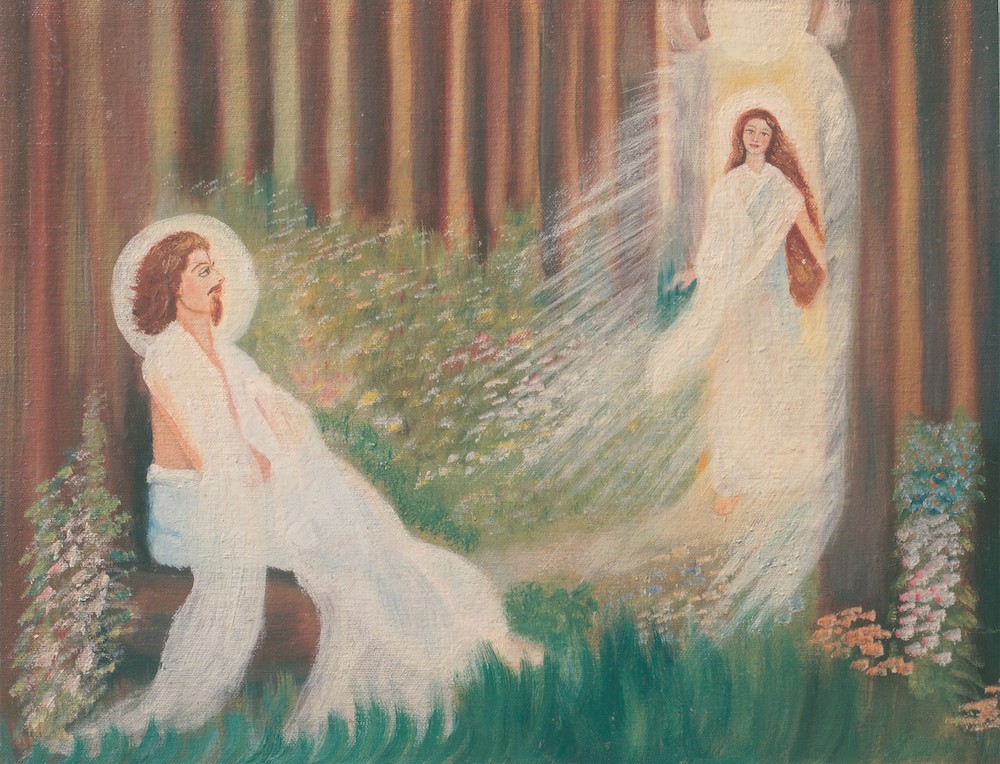
The featured image is a painting by Huta.

 The Winds of Wonder
Leave a comment