
Two sheets from the Savitri Manuscripts
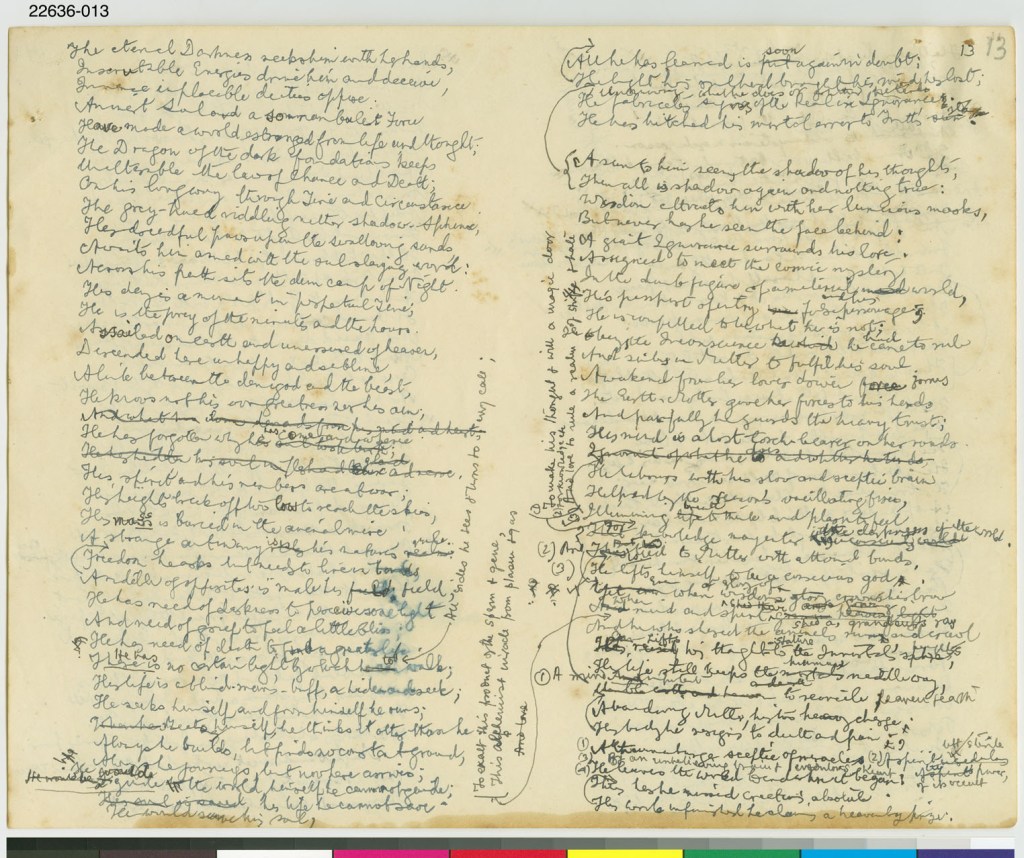
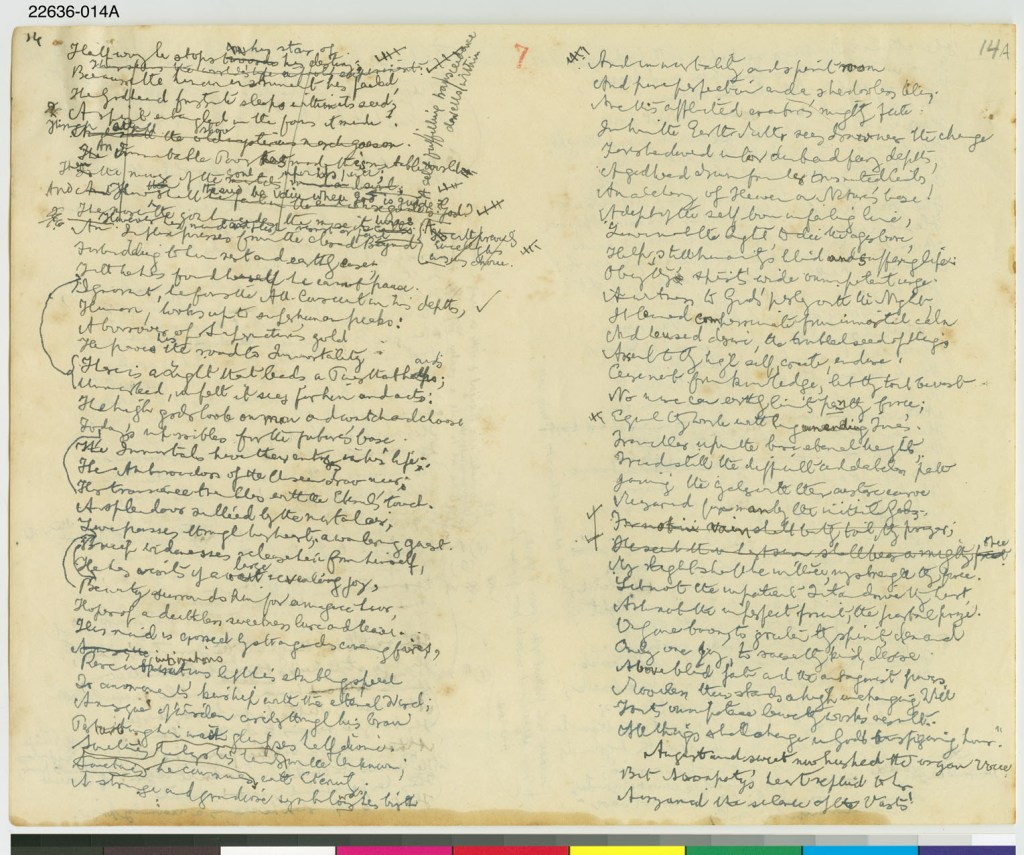
Savitri Book Three Canto Four in Double-Column Manuscript 1944
Images III:iv A: Eternal darkness & B: Halfway he stops
The Final Text
Around him hungers the unpitying Void,
The eternal Darkness seeks him with her hands,
Inscrutable Energies drive him and deceive,
Immense implacable deities oppose. ||89.28||
An inert Soul and a somnambulist Force
Have made a world estranged from life and thought;
The Dragon of the dark foundations keeps
Unalterable the law of Chance and Death;
On his long way through Time and Circumstance
The grey-hued riddling nether shadow-Sphinx,
Her dreadful paws upon the swallowing sands,
Awaits him armed with the soul-slaying word:
Across his path sits the dim camp of Night. ||89.29||
His day is a moment in perpetual Time;
He is the prey of the minutes and the hours. ||89.30||
Assailed on earth and unassured of heaven,
Descended here unhappy and sublime,
A link between the demigod and the beast,
He knows not his own greatness nor his aim;
He has forgotten why he has come and whence;
His spirit and his members are at war;
His heights break off too low to reach the skies,
His mass is buried in the animal mire. ||89.31||
A strange antinomy is his nature’s rule. ||89.32||
A riddle of opposites is made his field:
Freedom he asks but needs to live in bonds,
He has need of darkness to perceive some light
And need of grief to feel a little bliss;
He has need of death to find a greater life. ||89.33||
All sides he sees and turns to every call;
He has no certain light by which to walk;
His life is a blind-man’s-buff, a hide and seek;
He seeks himself and from himself he runs;
Meeting himself, he thinks it other than he. ||89.34||
Always he builds, but finds no constant ground,
Always he journeys, but nowhere arrives;
He would guide the world, himself he cannot guide;
He would save his soul, his life he cannot save. ||89.35||
The light his soul has brought his mind has lost;
All he has learned is soon again in doubt;
A sun to him seems the shadow of his thoughts,
Then all is shadow again and nothing is true:
Unknowing what he does or whither he tends
He fabricates signs of the Real in Ignorance. ||89.36||
He has hitched his mortal error to Truth’s star. ||89.37||
Wisdom attracts him with her luminous masks,
But never has he seen the face behind:
A giant Ignorance surrounds his lore. ||89.38||
Assigned to meet the cosmic mystery
In the dumb figure of a material world,
His passport of entry false and his personage,
He is compelled to be what he is not;
He obeys the Inconscience he has come to rule
And sinks in Matter to fulfil his soul. ||89.39||
Awakened from her lower driven forms
The Earth-Mother gave her forces to his hands
And painfully he guards the heavy trust;
His mind is a lost torch-bearer on her roads. ||89.40||
Illumining breath to think and plasm to feel,
He labours with his slow and sceptic brain
Helped by the reason’s vacillating fires,
To make his thought and will a magic door
For knowledge to enter the darkness of the world
And love to rule a realm of strife and hate. ||89.41||
A mind impotent to reconcile heaven and earth
And tied to Matter with a thousand bonds,
He lifts himself to be a conscious god. ||89.42||
Even when a glory of wisdom crowns his brow,
When mind and spirit shed a grandiose ray
To exalt this product of the sperm and gene,
This alchemist’s miracle from plasm and gas,
And he who shared the animal’s run and crawl,
Lifts his thought-stature to the Immortal’s heights,
His life still keeps the human middle way;
His body he resigns to death and pain,
Abandoning Matter, his too heavy charge. ||89.43||
A thaumaturge sceptic of miracles,
A spirit left sterile of its occult power
By an unbelieving brain and credulous heart
He leaves the world to end where it began:
His work unfinished he claims a heavenly prize. ||89.44||
Thus has he missed creation’s absolute. ||89.45||
Halfway he stops his star of destiny:
A vast and vain long-tried experiment,
An ill-served high conception doubtfully done,
The world’s life falters on not seeing its goal,—
A zigzag towards unknown dangerous ground
Ever repeating its habitual walk,
Ever retreating after marches long
And hardiest victories without sure result,
Drawn endlessly an inconclusive game. ||89.46||
In an ill-fitting and voluminous robe
A radiant purpose still conceals its face,
A mighty blindness stumbles hoping on
Feeding its strength on gifts of luminous Chance. ||89.47||
Because the human instrument has failed,
The Godhead frustrate sleeps within its seed,
A spirit entangled in the forms it made. ||89.48||
His failure is not failure whom God leads;
Through all the slow mysterious march goes on:
An immutable Power has made this mutable world;
A self-fulfilling transcendence treads man’s road;
The driver of the soul upon its path,
It knows its steps, its way is inevitable
And how shall the end be vain when God is guide? ||89.49||
However man’s mind may tire or fail his flesh,
A will prevails cancelling his conscious choice:
The goal recedes, a bourneless vastness calls
Retreating into an immense Unknown;
There is no end to the world’s stupendous march,
There is no rest for the embodied soul. ||89.50||
It must live on, describe all Time’s huge curve. ||89.51||
An Influx presses from the closed Beyond
Forbidding to him rest and earthly ease,
Till he has found himself he cannot pause. ||89.52||
A Light there is that leads, a Power that aids;
Unmarked, unfelt it sees in him and acts:
Ignorant, he forms the All-conscient in his depths,
Human, looks up to superhuman peaks:
A borrower of Supernature’s gold,
He paves his road to Immortality. ||89.53||
The high gods look on man and watch and choose
Today’s impossibles for the future’s base. ||89.54||
His transience trembles with the Eternal’s touch,
His barriers cede beneath the Infinite’s tread;
The Immortals have their entries in his life:
The Ambassadors of the Unseen draw near;
A Splendour sullied by the mortal air,
Love passes through his heart, a wandering guest,
Beauty surrounds him for a magic hour,
He has visits of a large revealing joy,
Brief widenesses release him from himself,
Enticing towards a glory ever in front
Hopes of a deathless sweetness lure and leave. ||89.55||
His mind is crossed by strange discovering fires,
Rare intimations lift his stumbling speech
To a moment’s kinship with the eternal Word;
A masque of wisdom circles through his brain
Perturbing him with glimpses half-divine. ||89.56||
He lays his hands sometimes on the Unknown;
He communes sometimes with Eternity. ||89.57||
A strange and grandiose symbol was his birth
And immortality and spirit-room
And pure perfection and a shadowless bliss
Are this afflicted creature’s mighty fate. ||89.58||
In him the Earth-Mother sees draw near the change
Foreshadowed in her dumb and fiery depths,
A godhead drawn from her transmuted limbs,
An alchemy of Heaven on Nature’s base. ||89.59||
Adept of the self-born unfailing line,
Leave not the light to die the ages bore,
Help still humanity’s blind and suffering life:
Obey thy spirit’s wide omnipotent urge. ||89.60||
A witness to God’s parley with the Night
It leaned compassionate from immortal calm
And housed desire, the troubled seed of things. ||89.61||
Assent to thy high self, create, endure. ||89.62||
Cease not from knowledge, let thy toil be vast,
No more in earthly limits pen thy force;
Equal thy work with long unending Time’s. ||89.63||
Traveller upon the bare eternal heights,
Tread still the difficult and dateless path
Joining the cycles with its austere curve
Measured for man by the initiate Gods. ||89.64||
My light shall be in thee, my strength thy force. ||89.65||
Let not the impatient Titan drive thy heart,
Ask not the imperfect fruit, the partial prize. ||89.66||
Only one boon, to greaten thy spirit, demand;
Only one joy, to raise thy kind, desire. ||89.67||
Above blind fate and the antagonist powers
Moveless there stands a high unchanging Will;
To its omnipotence leave thy work’s result. ||89.68||
All things shall change in God’s transfiguring hour.” ||89.69||
III:iv Section 2 (90)
August and sweet sank hushed that mighty Voice. ||90.1||
Nothing now moved in the vast brooding space:
A stillness came upon the listening world,
A mute immensity of the Eternal’s peace. ||90.2||
But Aswapathy’s heart replied to her,
A cry amid the silence of the Vasts:
Here is a note from the Ashram Archives giving some details about the Composition:
The Two-column Manuscripts
The manuscripts belonging to the early part of 1944 can easily be distinguished by their physical appearance. In the previous two years, Sri Aurobindo had used thick notebooks for much of his work on the epic. In each of the two most important notebooks of that period, he wrote out a complete version of what later became Part One—in 1942 it was the first book and the next year it was divided into three books. But in the first half of 1944, he was writing Savitri in two columns on large loose sheets of paper.
It is in this form that we find the last complete version of Part One written by Sri Aurobindo in his own hand. A close look at it reveals that there has been a dramatic expansion since the previous year, bringing the first three books much closer to their final proportions.
Nevertheless, this will turn out to be far from the end of Sri Aurobindo’s work on the first part of the poem. His handwritten recasts of existing passages and drafts of new ones continue in small note-pads until about 1946, becoming less and less legible due to his failing eyesight. Meanwhile the dictated revision begins. But all this belongs to the last phase of the composition of Savitri, the period from 1945 to 1950. We are concerned now with the manuscripts of 1944.
At least two versions of most cantos of the first three books are found among the two-column manuscripts. There are often several drafts of the same passage in this form. The last such manuscript encompasses the whole of Part One. It is dated at the end: “May 7, 1944”.
This manuscript represents the culmination of the second and longest phase in the composition of Savitri, the period from the late 1920s to the mid-1940s when what absorbed Sri Aurobindo’s attention was not primarily the story of Savitri and Satyavan, but the Yoga of Aswapati. The manuscript has a length of 105 pages. Since there are two columns per page and usually more than 40 lines in each column, the number of lines may be estimated as between eight and nine thousand. Another three thousand lines or so would be added by 1950, when Part One was published.
The manuscript begins with a detailed contents page for the first three books. A glance at it shows that when Sri Aurobindo began this version, he was still dividing the books of Savitri into “sections”, not yet into cantos. Book One still had only three sections. But when he revised the manuscript in his own hand, Sri Aurobindo broke the long third section, “The Yoga of the King”, into Cantos Three to Five with their present titles. The conversion of the other numbered sections into cantos was implied by this change, though in most cases it was not marked on the manuscript itself.
When we speak of versions of Savitri after 1944, the word “section” remains useful for referring to paragraphs separated by blank spaces within a canto.
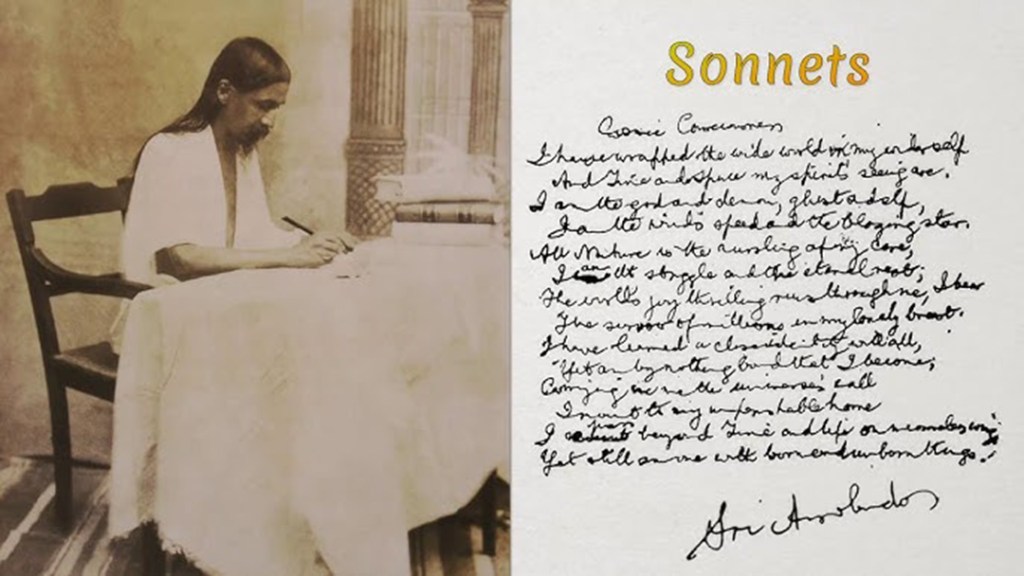
Manuscript of a Sonnet

 The Winds of Wonder
Leave a reply to RY Deshpande Cancel reply