07: Notes — The Queen’s wrong Question
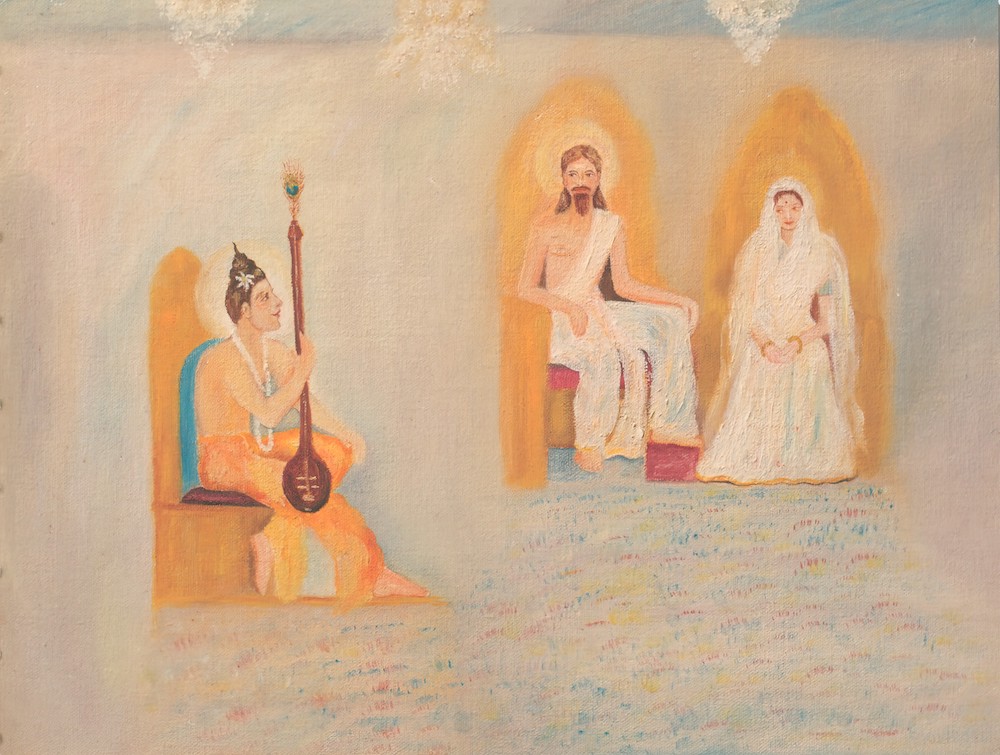
In the Mahabharata narrative of the Savitri-tale Narad makes a very special purposeful visit to king Aswapati in Madra. In the palace hall as they are engaged in an intimate conversation returns Savitri after meeting Satyavan in the Shalwa hermitage. Apparently the heavenly sage from Paradise is here specifically to make them know about the decreed unavoidable death of Satyavan exactly one year after their marriage. Savitri’s human mother Malawi is not present:
अथ मद्राधिपो राजा नारदेन समागतः |
उपविष्टः सभामध्ये कथायोगेन भारत ||१||
ततोभिगम्य तीर्थानि सर्वाण्येवाश्रमांस्तथा |
आजगाम पितुर्वेश्म सावित्री सह मन्त्रिभिः ||२||
नारदेन सहासीनं सा दृष्ट्वा पितरं शुभा |
उभयोरेव शिरस चक्रे पादाभिवादनम् ||३||
O Yudhishthira, on one particular occasion, after¬wards, the King, the ruler of the Madra country, was in the company of Narad; seated in the royal Hall, he was engaged in conversation with him. [1]
Then, about the same time Savitri, after visiting all the holy places and the cloistered ashramas, returned along with the ministers back to her father’s house. [2]
Seeing there her father seated in the company of Narad she, the bright and graceful one, went around and bowed respectfully at the feet of both of them. [3]
In Sri Aurobindo’s Savitri we have the Queen as an additional character, introduced by him much later after the first Arya draft of 1916-18. This draft has only the following:
There welcomed by the strong and thoughtful king
Who ceased from common life and care and sat
Inclining to the high and rhythmic voice,
Seated on sacred grass the heavenly seer
Spoke of the toils of men and what the gods
Strive for on earth, and joy that throbs behind
The marvel and the mystery of pain.
He sang to him of the lotus heart of love
With all its thousand luminous buds of truth
That quivering sleeps veiled by apparent things.
“He sang to him” of this became later “He sang to them”. The classical tradition of patriarchal society dominated by male characters in all important matters of life has been kept aside here, with liberal attitude of participation of both the sexes with a fulfilling measure of importance.
It is an excellent artistic creative device, necessary also, to meet the crucial occasion in the episode. Narad has made known to them the death of Satyavan and the Queen is distraught. Hers is a voice that questioned changeless destiny:
A mother’s heart had heard the fateful speech
That rang like a sanction to the call of death
And came like a chill close to life and hope. ||107.3||
Yet hope sank down like an extinguished fire. ||107.4||
She felt the leaden inevitable hand
Invade the secrecy of her guarded soul
And smite with sudden pain its still content
And the empire of her hard-won quietude. ||107.5||
Awhile she fell to the level of human mind,
A field of mortal grief and Nature’s law
She shared, she bore the common lot of men
And felt what common hearts endure in Time. ||107.6||
She is “beautiful, passionate, wise” but what comes now is her passion. She bluntly asks Narad: “Is this thy God who made this cruel law?” Certainly, this would not have been asked by the Yogi, Aswapati, ever calm and poised, seeing always a greater gain in the immediate calamity. She is extremely fond of her daughter and asks that question, and demands an answer. She was of course asking a wrong question. She should have rather asked him: How is that in God’s world such a cruel law should have appeared? That is what Narad sets to tell. He first unravels the mystery of this creation, resolves the Riddle of this World.
Savitri Book 6 Canto 1 – The Word of Fate
There welcomed him the sage and thoughtful king,
At his side a creature beautiful, passionate, wise,
Aspiring like a sacrificial flame,
Skyward from its earth-seat through luminous air,
Queen-browed, the human mother of Savitri. ||106.15||
There wel|+comed him| the sage| and thought|+ful king,|
At his side| a crea|+ture beau|+ti+ful, pas|+sion+ate, wise,|
As+pir|+ing like| a sac|+ri+fi|+cial flame,|
Sky+ward| from its earth|-seat through| lu+mi|+nous air,|
Queen-browed,| the hu|+man moth|+er of Sa|+vi+tri.| 106.15

 The Winds of Wonder
Leave a reply to Dilip Kumar Roy Cancel reply