02: A Blue-throated Ascetic
A matted forest-head invaded heaven
As if a blue-throated ascetic peered
From the stone fastness of his mountain cell
Regarding the brief gladness of the days;
His vast extended spirit couched behind. ||101.18||
A mighty murmur of immense retreat
Besieged the ear, a sad and limitless call
As of a soul retiring from the world. ||101.19||
Let us scan these lines:
A mat|+ted for|+est-head| in+vad|+ed heav+en|
As if| a blue-|throat+ed| as+cet|+ic peered|
From the| stone fast|+ness of| his moun|+tain cell|
Re+gard|+ing the| brief glad|+ness of| the days;|
His vast| ex+tend|+ed spir|+it couched| be+hind.| 101.18
A might|+y mur|+mur of| im+mense| re+treat|
Be+sieged| the ear,| a sad| and lim|+it+less call|
As of| a soul| re+tir|+ing from| the world.| 101.19
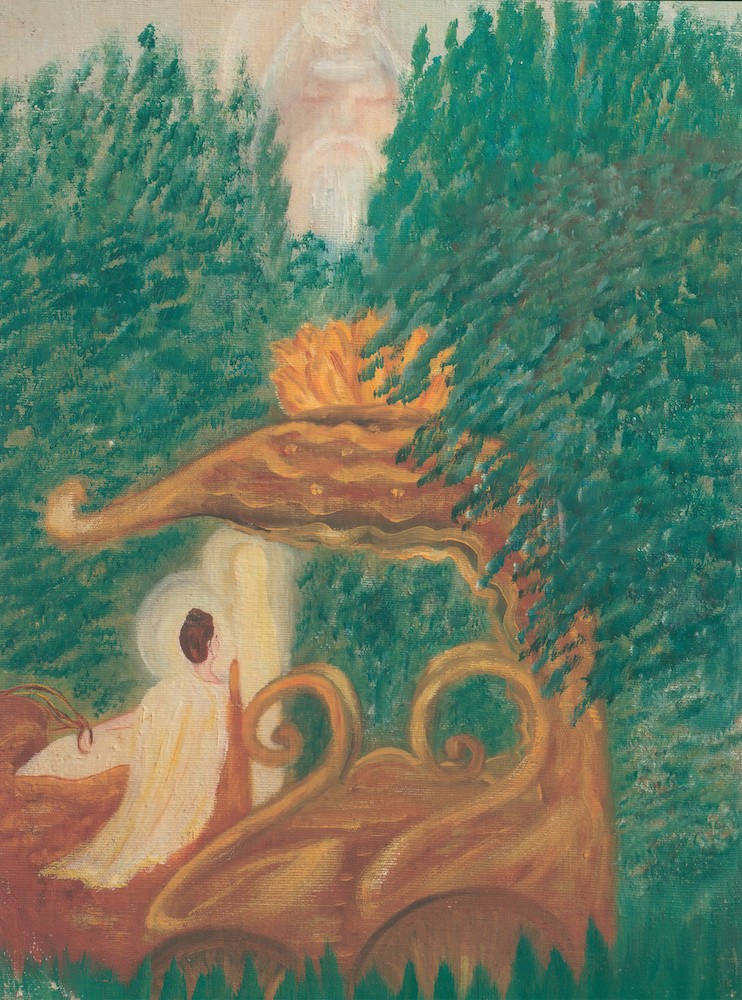
The featured image is a painting by Huta.
But let us be concerned about the Pauranic mythology related to this Blue-Throated Ascetic.
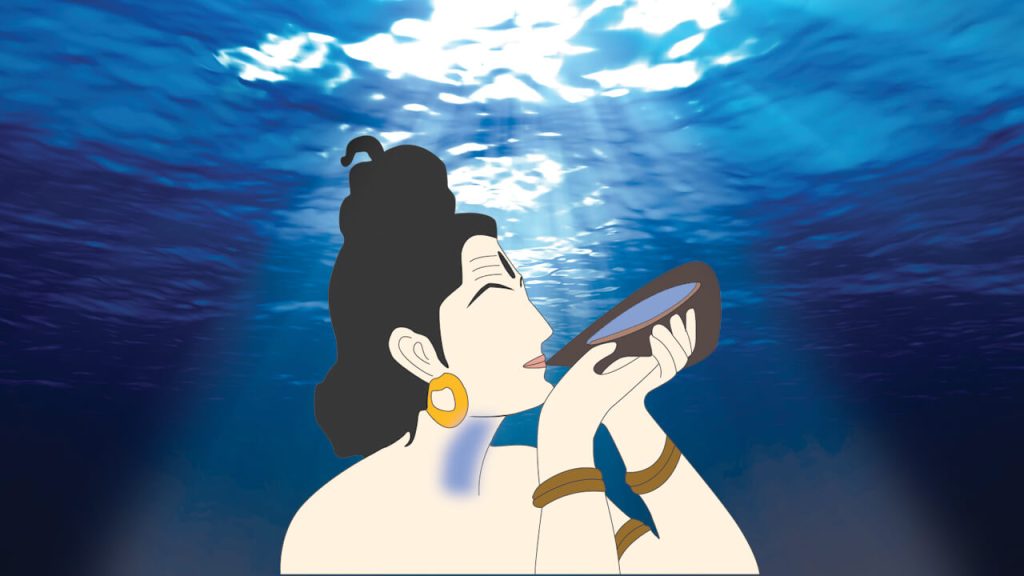
Due to the curse of Rishi Durwāsa the Devas, the cosmic Gods, had become weak and in the battle were defeated by the Asuras, the Demons. Vishnu advised them to treat the conquerors with diplomacy. A proposal was made to churn the Ocean of Milk, Kshirasāgar, together to receive the gifts, Jewels, Ratnas, from it. An elaborate cosmic process was set up and from this churning of the Ocean, Samudra Manthan, appeared fourteen gifts with Amrita, the Nectar of immortality. The Devas held the tail of Vāsuki the Serpent, the churning Rope, while the Asuras held the head. The first to come out of the churning was the Poison, Halāhala. It was Shiva who drank it and became the Blue-Throated, Nīḷakanṭha. This great act of Shiva eventually ended in the Devas obtaining Amrita. The story symbolises the spiritual transformation.
There are also allusions to Shiva’s Bow in Savitri.
In hands sustained by a transfiguring Might
He caught up lightly like a giant’s bow
Left slumbering in a sealed and secret cave
The powers that sleep unused in man within. ||6.4||
As knowledge grows Light flames up from within:
It is a shining warrior in the mind,
An eagle of dreams in the divining heart,
An armour in the fight, a bow of God. ||141.55||
Internet has the following: “The Pinaka (Sanskrit: पिनाक, pināka) is the celestial bow of the Hindu deity, Shiva. In popular legend, he is believed to have employed this bow in his avatar as Tripurantaka to annihilate the three cities of Mayasura, known as Tripura.[1] The weapon is the origin of one of Shiva’s epithets, Pinākapāṇi, literally meaning, ‘The Wielder of The Pināka’.[2] According to Valmiki Ramayana, Lord Shiva gifted the Pinaka bow to Devatas after the destruction of Daksha’s Yajna. Later the Devatas passed the Pinaka bow to the King Devarata Janaka of Mithila Kingdom for its safe-keeping. It was kept safe till the regime of the King Shreedhwaja Janaka.” https://en.wikipedia.org/wiki/Pinaka_(Hinduism)
This giant’s bow could also be Odysseus’s Bow: “Only Odysseus could string and shoot it, highlighting his unique strength and rightful claim as king.”
Here is Shiva in Savitri:
A huge inertness is the world’s defence,
Even in change is treasured changelessness;
Into inertia revolution sinks,
In a new dress the old resumes its role;
The Energy acts, the stable is its seal:
On Shiva’s breast is stayed the enormous dance. ||68.14||
A giant dance of Shiva tore the past,
There was a thunder as of worlds that fall;
Earth was o’errun with fire and the roar of Death
Clamouring to slay a world his hunger had made;
There was a clangour of Destruction’s wings:
The Titan’s battle-cry was in my ears,
Alarm and rumour shook the armoured Night. ||90.27||
A sealed identity within her woke;
She knew herself the Beloved of the Supreme:
These Gods and Goddesses were he and she:
The Mother was she of Beauty and Delight,
The Word in Brahma’s vast creating clasp,
The World-Puissance on almighty Shiva’s lap,—
The Master and the Mother of all lives
Watching the worlds their twin regard had made,
And Krishna and Radha for ever entwined in bliss,
The Adorer and Adored self-lost and one. ||125.35||
Shiva in Sri Aurobindo
1:
All are deceived, do what the One Power dictates,
Yet each thinks his own will his nature moves;
The hater knows not ‘tis himself he hates,
The lover knows not ‘tis himself he loves.
In all is one being many bodies bear;
Here Krishna flutes upon the forest road,
Here Shiva sits ash-smeared, with matted hair.
But Shiva and Krishna are the single God.
In us too Krishna seeks for love and joy,
In us too Shiva struggles with the world’s grief.
One Self in all of us endures annoy,
Cries in his pain and asks his fate’s relief.
My rival’s downfall is my own disgrace:
I look on my enemy and see Krishna’s face.
2:
Immortal, moveless, calm, alone, august,
A silence throned, to just and to unjust
One Lord of still unutterable love,
I saw Him, Shiva, like a brooding dove
Closewinged upon her nest.
He feels the joy of the immortal play;
He has the silence and the unflinching force,
He knows the oneness and the eternal course.
He too is Rudra and thunder and the Fire,
He Shiva and the white Light no shadows tire,
The Strength that rides abroad on Time’s wide wings,
The Calm in the heart of all immortal things.
3:
The One is Four for ever in his supramental quaternary of Being, Consciousness, Force and Ananda. Brahma, Vishnu, Shiva, Krishna, these are the eternal Four, the quadruple Infinite.
Vishnu is the Eternal’s Personality of Consciousness; in him all is supported, in his wideness, in his stability, in his substance. Shiva is the Eternal’s Personality of Force; through him all is created, through his passion, through his rhythm, through his concentration.
Krishna is the Eternal’s Personality of Ananda; because [of] him all creation is possible, because of his play, because of his delight, because of his sweetness. Brahma is Immortality, Vishnu is Eternity, Shiva is Infinity; Krishna is the Supreme’s eternal, infinite, immortal self-possession, self-issuing, self-manifestation, self-finding. As earth when it becomes pot, floor or oven, never ceases to be earth, so the Being even though it becomes all things and persons, is ever and immutably the same.
4:
I am, says the Godhead, Vishnu among the Adityas, Shiva among the Rudras, Indra among the gods, Prahlada among the Titans, Brihaspati the chief of the high !
5:
Pure Spirit who wast before creation woke,
Calm violence, destroyer, gulf of Soul,
One, though divided in thy own conceit,
Brahma we see thee here, who from thy deeps
Of memory rescuest forgotten Time.
We see thee, Yogin, on the solemn snows,
Shiva, withdrawing into thy hush the Word
Which sang the fiat of the speeding stars.
6:
The vani strongly anandamaya, first of the vijnanamaya ananda, then of the others, reappears full of the Vishnu or Pradyumna personality, taking into it Rudra (Balarama), Shiva (Mahavira) and Aniruddha (Kama). The definite personality of the Master in his personal relations to this Yoga and the Jiva in the Yoga has to develop out of the laya.
7:
On Himâloy ‘s grandiose summits upright in his cirque of stones
Shiva sits in breathless air,
Where the outcast seeks his refuge, where the demon army moans,
Ganges erring through his hair.
Shiva in the Mother
1:
A radiant glance from the eye of Shiva; but behind him is the divine gaze from which he came and Shiva himself and Brahma and Vishnu and OM all-exceeding.
2:
Oh yes, the story begins like this: one of the three—I believe it was Shiva’s consort, Parvati (she was the worst one, by the way!)—was doing her puja. Shiva was in meditation, and she began doing her puja in front of him; she was using an oil lamp for the puja, and the lamp fell down and burned her foot.
She cried out because she had burned her foot. So Shiva at once came out of his meditation and said to her, ‘What is it, Devi?’
3:
There’s a ledge above the pillars there, where all the gods used to sit—Shiva, Krishna, Lakshmi, the Trimurti, all of them—the little ones, the big ones, they all used to come regularly, every day, to attend these meditations.
It was a descent of the Supreme, from… some time back, now consenting to participate in the new manifestation.
Shiva refused. ‘No,I will come only when you have finished your work. He looked at me, smiled and said, Not yet. And the effect vanished. But Shiva had indeed given me what I wanted!
Not yet, Sri Aurobindo said.
4:
You see, to use the Indian names known in India, well, I think they are Avatars of Vishnu who come rather to prove that the Divine can come upon earth; whereas each time Shiva has manifested he has always manifested like this, in beings who have tried to fight against an illusion and demolish what is there.
To speak more accurately, he manifested something of the power of Shiva: it was the same compassion, the same understanding of all the misery, and the same power which destroys—obviously with the intention of transforming, but destroys rather than constructs.
5:
It is said, for instance, that Vivekananda was an incarnation (a vibhuti) of Shiva’s; but Shiva himself… I have had a very close relationship with him and he clearly expressed the will to come down on earth only with the supramental world.
6:
You understand, when I was giving meditations in the hall downstairs, they were all there: Shiva, Krishna, all the gods of the Indian pantheon were there, seated like this (gesture in a circle) to follow the meditation.
Nīḷakanṭha

Mt Kailash — Digital

Kedarnath — Digital


 The Winds of Wonder
Leave a reply to claudechamberland Cancel reply