
01: Fate a transaction between Nature and Soul
O King, thy fate is a transaction done
At every hour between Nature and thy soul
With God for its foreseeing arbiter. ||112.25||
Fate is a balance drawn in Destiny’s book. ||112.26||
Man can accept his fate, he can refuse. ||112.27||
Even if the One maintains the unseen decree
He writes thy refusal in thy credit page:
For doom is not a close, a mystic seal. ||112.28||
The heavenly sage Narad visits Aswapati in the context of Savitri having chosen in the Shalwa Woods Satyavan for her lover and husband. The sage makes a prophetic proclamation that exactly one year after the marriage Satyavan will die. Savitri yet remains steadfast in her resolve. The power of love that got awakened in her soul holds that she would know how to deal with the eventuality. It is as if to firm it up functionally had the sage uttered the Word of Fate. But human nature is totally unable to see the far prosperous implications of the death in life. Savitri’s human mother Malawi even questions if it was Narad’s God who made this cruel law. [107.11] She was asking a wrong question. She should have rather asked how in God’s world entered fate and pain and suffering and death and ignorance. This is exactly an occasion for Narad to fully expatiate about the human riddle regarding this creation.
Aswapati raises a point, whether it is the outward world that rules the spirit. If so can there be any remedy within? Is not fate but the spirit’s will in long time fulfilled by cosmic Force? His apparent dilemma is, how could his daughter who had come with a mighty Power be subject to Fate. Should not that Power subjugate all the workings of dubious universal Nature?
I deemed a mighty Power had come with her;
Is not that Power the high compeer of Fate? ||112.4||
Narad promptly answers that his fate is a transaction done, transaction between Nature and his soul. But Aswapati’s soul is already released from Ignorance, [Book I Canto 3] and his spirit is free from the workings of Nature [Book I Canto 5]. Is not then Narad’s answer, directly addressed to Aswapati, “O King, …”, incongruent with his yogic realisations and attainments?
But the answer is not for Aswapati; it is for man yet under the sway of Nature and universal forces. By asking the question he is rather making definite that the sage’s divine Word brings the higher occult efficacy into the operational dynamics.
Savitri Book 6 Canto 2 – The Way of Fate and the Problem of Pain
Then Aswapathy answered to the seer: … ||112.1||
I deemed a mighty Power had come with her;
Is not that Power the high compeer of Fate? ||112.4||
But Narad answered covering truth with truth: … ||112.5||
A day may come when she must stand unhelped
On a dangerous brink of the world’s doom and hers ||112.50||
Carrying the world’s future on her lonely breast,
Carrying the human hope in a heart left sole
To conquer or fail on a last desperate verge ||112.51||
Let us scan these lines:
Then As|wapathy| an+swered| to the| se+er:|
I deemed| a might|+y Pow|+er had come| with her;|
Is not| that Pow+er| the high| com+peer| of Fate?|
But Na|+rad an|+swered cov|+er+ing truth| with truth:|
A day| may come| when she| must stand| un+helped|
On a dan|+ger+ous brink| of the| world’s doom| and hers.|
Car+ry+ing| the world’s| fu+ture| on her lone|+ly breast,|
Car+ry+ing| the hu|+man hope| in a heart| left sole|
To con+quer| or fail| on a| last des|+per+ate verge |
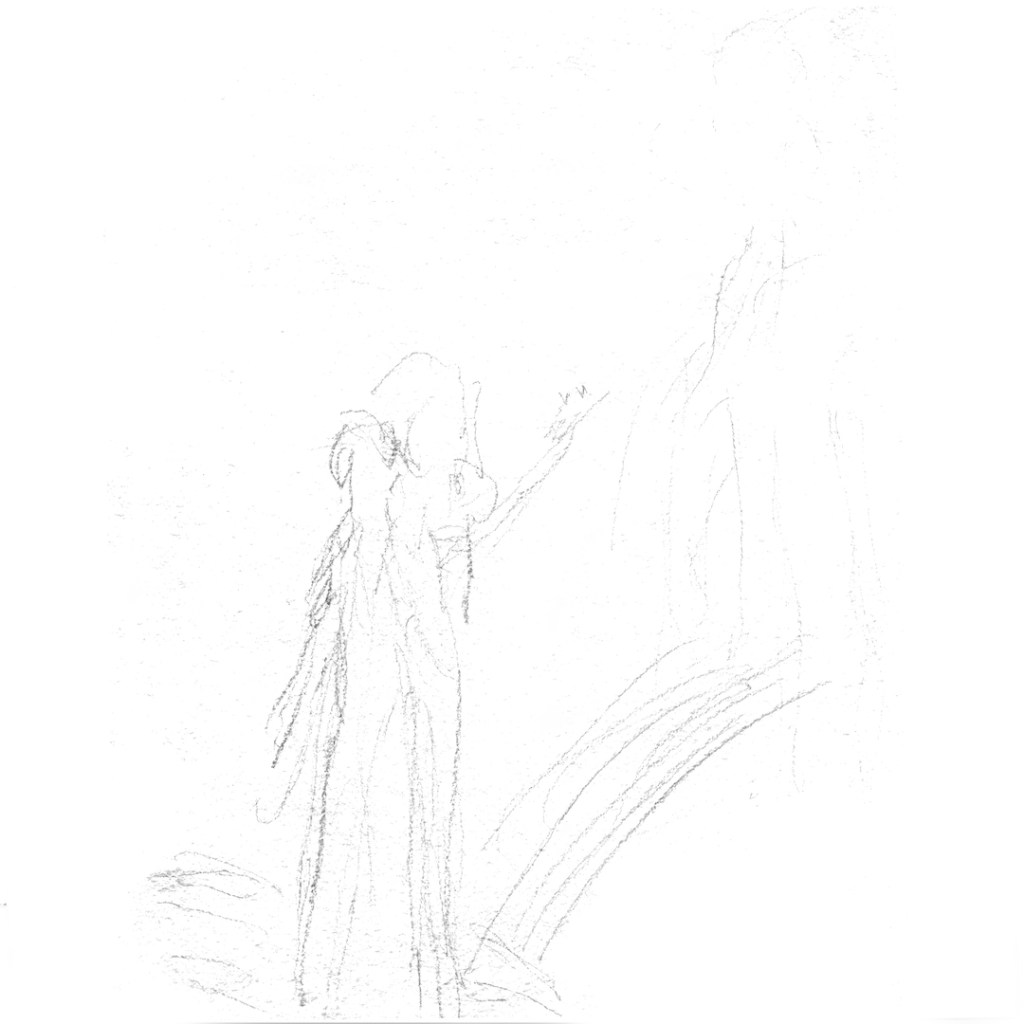
The featured image is a painting by Huta. Here is the sketch drawn by the Mother:

 The Winds of Wonder
Leave a reply to justynjedraszewski Cancel reply