आनंदाचा सोहळा
आर वाय देशपांडे
१७ एप्रिल २०२५
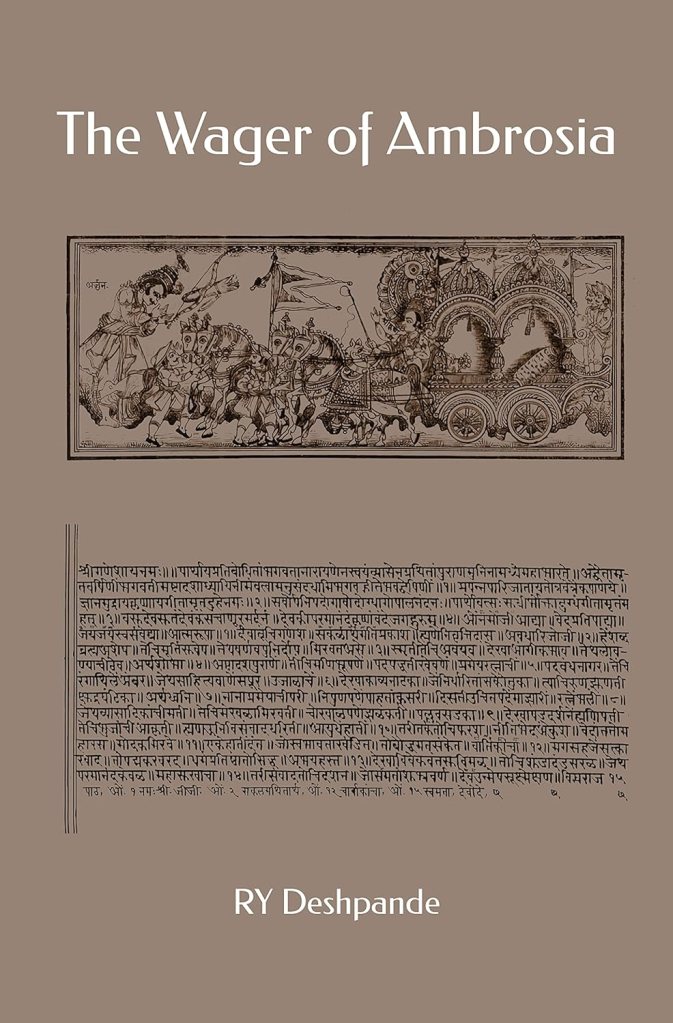
Front Cover: The Wager of Ambrosia, a work in English related to Jñāneshwari.
dp/B09CKFNPCT on amazon.com
आनंदाचा सोहळा
आर वाय देशपांडे
१७ एप्रिल २०२५
Front Cover: The Wager of Ambrosia, a work in English related to Jñāneshwari.
dp/B09CKFNPCT on amazon.com

It is true that I have not written in Marathi anything during the active decades of my writings which are essentially in English, with half a dozen of books in poetry in that language. But that does not mean that I do not know Marathi or that I cannot think in Marathi. I had a library of more than 500 books in Marathi itself, that which I have donated to a holy Maṭh in Pune. In fact, I have a fairly thick book on Jñāneshwari in English, running into some 600 pages, it presenting the majestic opus seen from various perspectives. The book is entitled The Wager of Ambrosia and is available at amazon.com/ :
But what is happening now is something different though I do not know how it will continue. I will only say, let us have faith in the creative goddess of poetry and of being faithful to her.
LikeLike
My general impression about poetry in Marathi is that while it is rich in devotional religious metaphysical and discursive heroic folk and secular aspects with the tradition having a strong grip, there is a certain want as far as experienced mysticism is concerned, deep mystic poetry of the spiritual kind with profound occult contents, गूढ in that sense. It has its own symbolism and imagery and music of the inner mental with the overhead entering in. It will be wonderful, very desirable I suppose, if it can start happening. Will it accept it?
LikeLike
Let me quote as an illustration a poem by Sri Aurobindo. “This sonnet was written about an experience Sri Aurobindo had while walking on the TakhtiSulaiman (“Seat of Solomon”), near Srinagar, Kashmir, in 1903.”
The Hill-Top Temple
After unnumbered steps of a hill-stair
I saw upon earth’s head brilliant with sun
The immobile Goddess in her house of stone
In a loneliness of meditating air.
Wise were the human hands that set her there
Above the world and Time’s dominion;
The Soul of all that lives, calm, pure, alone,
Revealed its boundless self mystic and bare.
Our body is an epitome of some Vast
That masks its presence by our humanness.
In us the secret Spirit can indite
A page and summary of the Infinite,
A nodus of Eternity expressed
Live in an image and a sculptured face.
21 October 1939
https://incarnateword.in/sabcl/5/the-hill-top-temple
LikeLike
But there is also the following note:
The Hill-top Temple. 21 October 1939. Three handwritten manuscripts, the first two entitled “The Temple on the Hill-Top”. This sonnet is about an experience Sri Aurobindo had at a shrine in the temple-complex on Parvati Hill, near Poona, probably in 1902.
https://incarnateword.in/cwsa/02/part-seven-pondicherry-circa-1927-1947
LikeLike
His previous sonnet Adwaita is about the seat of Solomon. “Adwaita. 19 October 1939. Three handwritten manuscripts. This son-net was written about an experience Sri Aurobindo had while walking on the Takht-i-Sulaiman (“Seat of Solomon”), near Srinagar, Kashmir, in 1903.” The Hill-top sonnet is about Parwati Hill in Pune.
LikeLike

The idea of compiling these poems, some of which you have been regularly sharing with us, is fantastic. These poems are beautiful and convey the message they are intended to in relatively simple words. The rural Maharashtrian origins of the metaphors used in some of the poems are nostalgic for me since they remind me of the stories my grandmother used to narrate about her childhood.
 The Winds of Wonder
Leave a comment