Science and Spirituality
Chairman Mao coined the slogan “Science is simply acting daringly.” He purged trained scientists in the 1950s and encouraged Party zealots to embark on crazy experiments, inspired by the equally zany theories of Stalin’s pseudoscientist T.D. Lysenko. “There is nothing special,” Mao said, “about making nuclear reactors, cyclotrons or rockets…. You need to have spirit to feel superior to everyone, as if there was no one beside you.” All the sense of envious inferiority that Mao and his fellow Party provincials felt toward people of higher education is contained in these words. Instinct, spirit, daring… In 1942, a Japanese professor at Tokyo University argued that a Japanese victory over Anglo-American materialism was assured because the former embodied the “spiritual culture” of the East.
[From an old blog, now defunct, November-December 2006]
At this point I will just give a quotation from The Synthesis of Yoga:
The telescope, the microscope, the scalpel, the retort and alembic cannot go beyond the physical, although they may arrive at subtler and subtler truths about the physical. If then we confine ourselves to what the senses and their physical aids reveal to us and refuse from the beginning to admit any other reality or any other means of knowledge, we are obliged to conclude that nothing is real except the physical and that there is no Self in us or in the universe, no God within and without, no ourselves even except this aggregate of brain, nerves and body. But this we are only obliged to conclude because we have assumed it firmly from the beginning and therefore cannot but circle round to our original assumption.
I take the tools mentioned in the Synthesis-passage are just indicative-suggestive of the scientific methodology of investigating the physical world. Our telescope is too small to see the universe in its dimensions of infinity; our microscope is too large to see the finer than the fine—to use the Upanishadic phrase; our instruments of studying life have no sensitivity to sense and detect the process of decay-disintegration-death of life-in-matter. Howsoever refined our tools might become and whatever subtler truths about the physical we might reach, all these still remain too gross. Knowledge based on such investigations does carry a certain kind of value, but carrying it beyond its domain could amount to making an impossible leap. The journey of the evolution of consciousness is made not at all only by reason; there are other known and unknown travellers also.
The scientist once used the retort and the alembic, the best he had, but now the dna and the nano-molecular machines, which cannot go beyond the physical, can never go, are quite surprisingly revealing the subtler truths about the physical. It is those truths which are now accelerating us toward what was perhaps their original assumption, one of “completed nihilism” (as the passage in the Synthesis suggests) and this certainly has consequences. The journey of the evolution of consciousness and the ideals of Human Unity have reached a depth which is bordering on the occult.
But aren’t there too many unknowns even in our familiar knowns to make any search frustrating? If we can think of the knowable unknown—not resting in the domain of metaphysics—then there could be a possibility of developing instrumentation for its investigation or for its study. But can reason posit anything about this kind of “knowable unknown”, posit to pursue our inquiry in order to open out new lines of exploration? One wonders. Of course it is futile to talk about unknowable of any kind—known or unknown. If we have to extend the list of tools given in the Synthesis-passage we should also include in it the Mind-sense, Manas, used by reason. And then to quote a passage from the Letters: “Science itself has come to the conclusion that it cannot, as it once hoped, determine what is the truth of the things or their real nature, or what is behind physical phenomena; it can only deal with the process of physical things and how they come about or on what lines men can deal with and make use of them.” Though written about 100 years ago, it is valid even today.
And about Manas: “Manas, say our philosophers, is the sixth sense. But we may even say that it is the only sense and that the others, vision, hearing, touch, smell, taste are merely specialisations of the sense-mind which, although it normally uses the sense-organs for the basis of its experience, yet exceeds them and is capable of a direct experience proper to its own inherent action.”
A Comment
“As I see it, RYD’s quote from Sri Aurobindo points to a reduction of the domain of reality to an engagement between the human reason and matter. In terms of evolution, this may imply enhancements of the physical basis of consciousness, but whether it implies a change in consciousness is debatable. One may easily conceive a bionic or nano-genetic internalization of machinery which humankind is already using — a race of super-humans with telescopes or microscopes (or both) for eyes but that is just an intimate internalization and individualization of dualistic instrumentations, an enhancement of operation but is it a change of consciousness? One of the problems here is that we can know only what we experience — once again, as in our earlier formulation, epistemology follows ontology. The Buddha, for example, is depicted with a ‘super-brain’, ushnisha, which he is supposed to have been born with, and which gives him access to an experience of being different from those who do not have such an organ. If we ‘knew’ the consciousness that can express itself through the physical organization of an ushnisha, and the dynamics of such an expression, we could attempt the mutation, but without the experience of alternate ontologies, how could we even begin to guess what mutations will take us there? If however, what you mean is that tampering with our physical organization to the degree of enhancing our present dualistic operation may result in undreamed-of changes in consciousness, this of course is possible (though I don’t know how probable) — but then we are invoking exactly those ‘other (known and unknown) travellers’ that RYD is talking about.”
Let us go to the description of samjñana in The Synthesis of Yoga (pp. 863-65):
“…a fourth action of the supramental consciousness completes the various possibilities of the supramental knowledge. This still farther accentuates the objectivity of the thing known, puts it away from the station of experiencing consciousness and again brings it to nearness by a uniting contact effected either in a direct nearness, touch, union or less closely across the bridge or through the connecting stream of consciousness of which there has already been mention. It is a contacting of existence, presences, things, forms, forces, activities, but a contacting of them in the stuff of the supramental being and energy, not in the divisions of matter and through the physical instruments, that creates the supramental sense, samjñana. It is a little difficult to make the nature of the supramental sense understood to a mentality not yet familiar with it by enlarged experience, because our idea of sense action is governed by the limiting experience of the physical mind and we suppose that the fundamental thing in it is the impression made by an external object on the physical organ of sight, hearing, smell, touch, taste, and that the business of the mind, the present central organ of our consciousness, is only to receive the physical impression and its nervous translation and so become intelligently conscious of the object. In order to understand the supramental change we have to realise first that the mind is the only real sense even in the physical process: its dependence on the physical impressions is the result of the conditions of the material evolution, but not a thing fundamental and indispensable. Mind is capable of a sight that is independent of the physical eye, a hearing that is independent of the physical ear, and so with the action of all the other senses. It is capable too of an awareness, operating by what appears to us as mental impressions, of things not conveyed or even suggested by the agency of the physical organs,—an opening to relations, happenings, forms even and the action of forces to which the physical organs could not have borne evidence. Then, becoming aware of these rarer powers, we speak of the mind as a sixth sense; but in fact it is the only true sense organ and the rest are no more than its outer conveniences and secondary instruments, although by its dependence on them they have become its limitations and its too imperative and exclusive conveyors. Again we have to realise—and this is more difficult to admit for our normal ideas in the matter—that the mind itself is only the characteristic instrument of sense, but the thing itself, sense in its purity, samjñana, exists behind and beyond the mind it uses and is a movement of the self, a direct and original activity of the infinite power of its consciousness. The pure action of sense is a spiritual action and pure sense is itself a power of the spirit.”
Aren’t our senses miles and miles away from this true sense which alone can bring proper knowledge about the physical world to us?
The dharma of science, thought and philosophy is to seek the truth by the intellect, seek dispassionately, without prepossession and prejudgment, with no other first propositions than the law of thought and observation itself imposes. Science and philosophy are not bound to square their observations and conclusions with any current ideas of religious dogma or ethical rule or aesthetic prejudices. In the end if left free in their action, they will find the unity of Truth with Good and Beauty and give these a greater meaning than any dogmatic religion or any formal ethics or narrower aesthetic idea can give us. (Sri Aurobindo: The Human Cycle, p. 214)
Consciousness itself by its mutation will necessitate and operate whatever mutation is needed for the body. It has to be noted that the human mind has already shown the capacity to aid nature in the evolution of new types of plant and animal; it has created new forms of its environment, developed by knowledge and disciplined considerable changes in its own mentality. It is not an impossibility that “man should aid nature consciously also in his own spiritual and physical evolution and transformation”. The urge to do it is already there and partly effective though still incompletely understood and accepted by the surface mentality; but one day it may understand go deeper within itself and discover the means, the secret energy, the intended operation of Consciousness-Force within which is the hidden reality we call Nature. (Sri Aurobindo: The Life Divine, 1949, pp. 843-44)
—
Let us not mix up science and spirituality, nor or they dichotomous. Science is science and spirituality is spirituality. One may enter into the occult without knowing it, unconsciously; the other may throw a different light which cannot be visible to the material-physical instruments. One is rational-empirical, the other intuitive-revelatory. One has the mathematical imagination of a God-particle without it being a God-particle; the other sees tangibly and dynamically the electron as a flaming chariot for Shiva to ride but with no details of the role it plays in the chemistry of the compounds, the valence binding the elements. Science is for the process, spirituality for the principles, the fundamentals. Will they come together? Yes, they will but in a different way.
The juxtapositioning of science and spirituality is a child-thought. We could as well have poetry and spirituality, arts and spirituality, æsthetics and spirituality, speechmaking and spirituality, cookery and spirituality, gymnastics and spirituality, science and society, and so on. But the idea of beauty, for instance, for a theoretical physicist has a different sense and a different joy than for a spiritual person who can see beauty even in the utter formless. Their interrelationship, of these pairs, acquires a complementary significance when all life becomes Yoga; but that is altogether at a different high level.

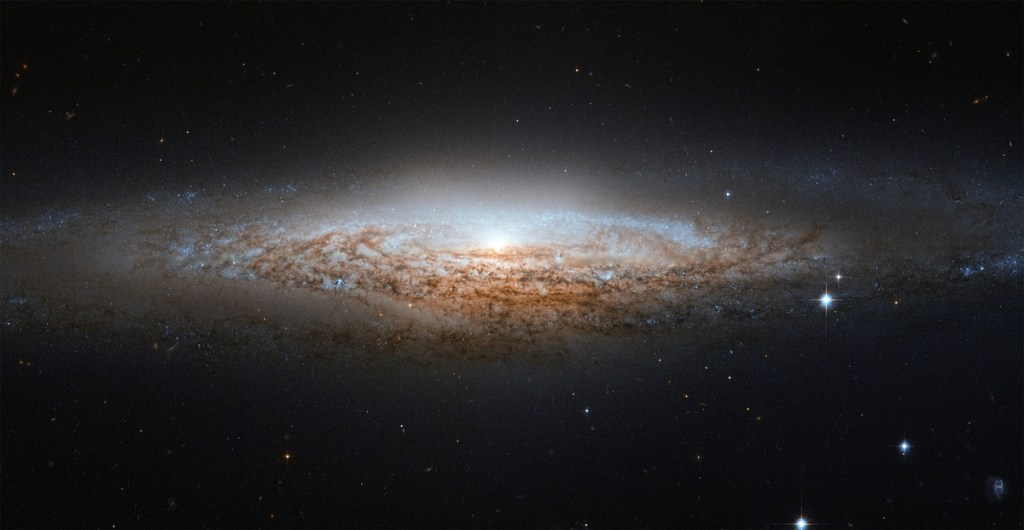
And here is the NASA/ESA Hubble Space Telescope image showing the spiral galaxy NGC 4845, located over 65 million light-years away in the constellation of Virgo (The Virgin). The galaxy’s orientation clearly reveals the galaxy’s striking spiral structure: a flat and dust-mottled disk surrounding a bright galactic bulge. Its glowing center hosts a gigantic version of a black hole, known as a supermassive black hole. The presence of a black hole in a distant galaxy like NGC 4845 can be inferred from its effect on the galaxy’s innermost stars; these stars experience a strong gravitational pull from the black hole and whizz around the galaxy’s center much faster than otherwise. [Internet]
All that is excellent, beautiful, even meritorious; but there is nothing in it which can be called spiritual. Similarly, there is nothing of science in, say St John’s, “In the beginning was the Word, and the Word was with God, and the Word was God.”
And witness these beautiful corals, sheer poetry, that should thrill not only the scientist but also the mystic.



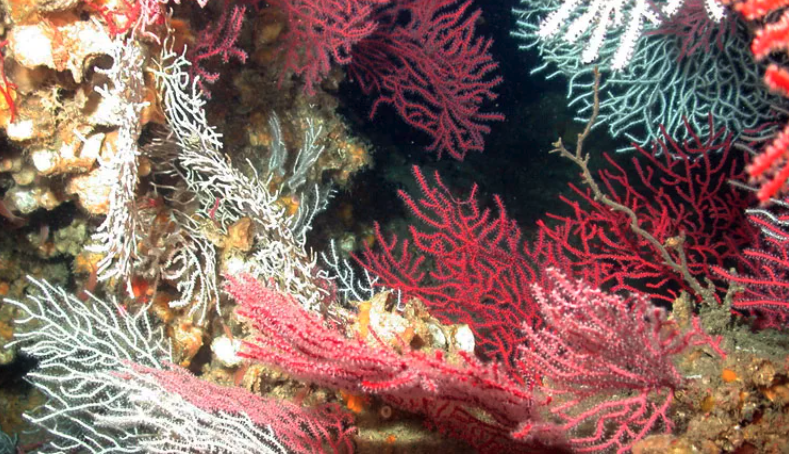
A thing of beauty is a joy for ever.

 The Winds of Wonder
Leave a comment