Inspiration and Revealing Transcription vis-à-vis Savitri
In his Twelve Years with Sri Aurobindo Nirodbaran writes about the composition of Savitri, personally as he was the scribe to have taken dictation as it went through several stages, particularly the second half of the Epic. That is the first-hand about it.
“We can at last see how from among scattered seeds a single huge banyan tree has grown and spread itself to the transcendent and the cosmic infinite and excites our perpetual wonder. I wish I could provide a more faithful and vivid picture of its daily growth, a branch here, an offshoot there, trimming the old twigs, reviving the dying ones, discarding the outworn crowding branches till there soared up into the sky a majestic vision under whose perennial shade the world can repose awhile, in its long journey to the Eternal. … I asked him in my foolish way, why, himself being the master of inspiration and having all higher planes at his command, sending inspiration to others, should he still have to work so hard? With his consciousness entirely silent, he had only to hitch to the right source and words, images, ideas would tumble down in a Brahmaputra of inspiration! To which he answered in his habitual indulgent tone, perhaps a bit piqued by my facile observation: ‘The highest planes are not so accommodating as all that.’ Then, with regard to hard labour on Savitri, he wrote: ‘I used Savitri as a means of ascension.’ “
All this was in 1936. But the final Savitri that came out during 1942-50 has a different splendour and significance when the Mind of Light had started working in his physical, the Physical’s Mind opening to the supramental Light and Force. Sri Aurobindo reveals it in his sonnet The Golden Light, dated 8 August 1938. About the final draft of Savitri Nirodbaran writes:s:
“The revision of Savitri was going on apace with regular unabated vigour. Book after Book was getting done and fascicules of them released for publication. Some 400-500 lines of The Book of Everlasting Day were dictated… . I marvelled at the smooth spontaneous flow of verse after verse of remarkable beauty. Once I had complained to him in my correspondence why, having all the planes of inspiration at his command, should he still labour like us mortals at his Savitri. Why should not the inspiration burst out like the ‘champagne bottle’? Now I witnessed that miracle … when we came to a mighty confrontation with the two big Cantos of The Book of Fate. Revision after revision, addition of lines, even punctuations changed so many times! It seemed like a veritable ‘God’s labour’ against a rock of resistance.”
Nirodbaran’s puzzle was, Sri Aurobindo being the master of inspiration and having all higher planes at his command, should he still have to work so hard. When some 400-500 lines of The Book of Everlasting Day, Book Eleven, were dictated he marvelled at the smooth spontaneous flow of verse after verse of remarkable beauty, inspiration bursting out like the champagne bottle. In The Book of Fate, Book Six, revision after revision was made till the last moment, until three weeks before his withdrawal from the “earthly scene”, on 5 December 1950. It was a veritable “God’s labour”.
Sri Aurobindo’s earlier answer to Nirodbaran’s conundrum was: “I used Savitri as a means of ascension.” This was in 1936, and much had happened during the 1940s when the final Savitri was being given by the Yogi-Poet. Earlier statements were for the earlier tentative drafts.
And importantly: “Inspiration is always a very uncertain thing; it comes when it chooses, stops suddenly before it has finished its work, refuses to descend when it is called.”
Nirodbaran: Inspiration leaves one sometimes and one goes on beating and beating, hammering and hammering, but it comes not! Inspiration failing to descend, perhaps.
Sri Aurobindo: Exactly. When any real effect is produced, it is not because of the beating and the hammering, but because an inspiration slips down between the raising of the hammer and the falling and gets in under cover of the beastly noise. It is when there is no need of effort that the best comes. Effort is all right, but only as an excuse for inducing the Inspiration to come. If it wants to come, it comes—if it doesn’t, it doesn’t and one is obliged to give up after producing nothing or an inferior mind-made something. I have had that experience often enough myself. I have also seen Amal after producing something good but not perfect, beating the air and hammering it with proposed versions each as bad as the other,—for it is only a new inspiration that can really improve a defect in the transcription of the first one. Still one makes efforts, but it is not the effort that produces the result, but the inspiration that comes in answer to it. You knock at the door to make the fellow inside answer. He may or he mayn’t—if he lies mum, you have only to walk off swearing. That’s effort and inspiration.
Nirodbaran: You proclaim the force and inspiration from the house-top, but fail to see that one has to work hour after hour to get it. What would you call this labour?
Sri Aurobindo: Hammering, making a beastly noise so that Inspiration may get excited and exasperated and fling something through the window, muttering “I hope that will keep this insufferable tinsmith quiet.”
6 March 1936
Bearing this in our perspective let us look into the following, Savitri: X:1 Section 2 (139), by way of an example, about working of the Inspiration and the wonder of revelealing Transcription.
There is a morning twilight of the gods;
Miraculous from sleep their forms arise
And God’s long nights are justified by dawn. ||139.1||
There breaks a passion and splendour of new birth
And hue-winged visions stray across the lids,
The dreaming deities look beyond the seen
And fashion in their thoughts the ideal worlds
Sprung from a limitless moment of desire
That once had lodged in some abysmal heart. ||139.2||
…
A ripple of gleaming wings crossed the far sky;
Birds like pale-bosomed imaginations flew
With low disturbing voices of desire,
And half-heard lowings drew the listening ear,
As if the Sun-god’s brilliant kine were there
Hidden in mist and passing towards the sun. ||139.6||
…
One touched incessantly things never seized,
A skirt of worlds invisibly divine. ||139.10||
As if a trail of disappearing stars
There showered upon the floating atmosphere
Colours and lights and evanescent gleams
That called to follow into magic heaven,
And in each cry that fainted on the ear
There was the voice of an unrealised bliss. ||139.11||
An adoration reigned in the yearning heart,
A spirit of purity, an elusive presence
Of faery beauty and ungrasped delight
Whose momentary and escaping thrill,
However unsubstantial to our flesh,
And brief even in imperishableness,
Much sweeter seemed than any rapture known
Earth or all-conquering heaven can ever give. ||139.12||
Heaven ever young and earth too firm and old
Delay the heart by immobility:
Their raptures of creation last too long,
Their bold formations are too absolute;
Carved by an anguish of divine endeavour
They stand up sculptured on the eternal hills,
Or quarried from the living rocks of God
Win immortality by perfect form. ||139.13||
They are too intimate with eternal things:
Vessels of infinite significances,
They are too clear, too great, too meaningful;
No mist or shadow soothes the vanquished sight,
No soft penumbra of incertitude. ||139.14||
…
All in this world was shadowed forth, not limned,
Like faces leaping on a fan of fire
Or shapes of wonder in a tinted blur,
Like fugitive landscapes painting silver mists. ||139.17||
Here vision fled back from the sight alarmed,
And sound sought refuge from the ear’s surprise,
And all experience was a hasty joy. ||139.18||
The joys here snatched were half-forbidden things,
Timorous soul-bridals delicately veiled
As when a goddess’ bosom dimly moves
To first desire and her white soul transfigured,
A glimmering Eden crossed by fairy gleams,
Trembles to expectation’s fiery wand,
But nothing is familiar yet with bliss. ||139.19||
All things in this fair realm were heavenly strange
In a fleeting gladness of untired delight,
In an insistency of magic change. ||139.20||
…
The sombre Shadow sullen, implacable
Made beauty and laughter more imperative;
Enhanced by his grey, joy grew more bright and dear;
His dark contrast edging ideal sight
Deepened unuttered meanings to the heart;
Pain grew a trembling undertone of bliss
And transience immortality’s floating hem,
A moment’s robe in which she looked more fair,
Its antithesis sharpening her divinity. ||139.26||
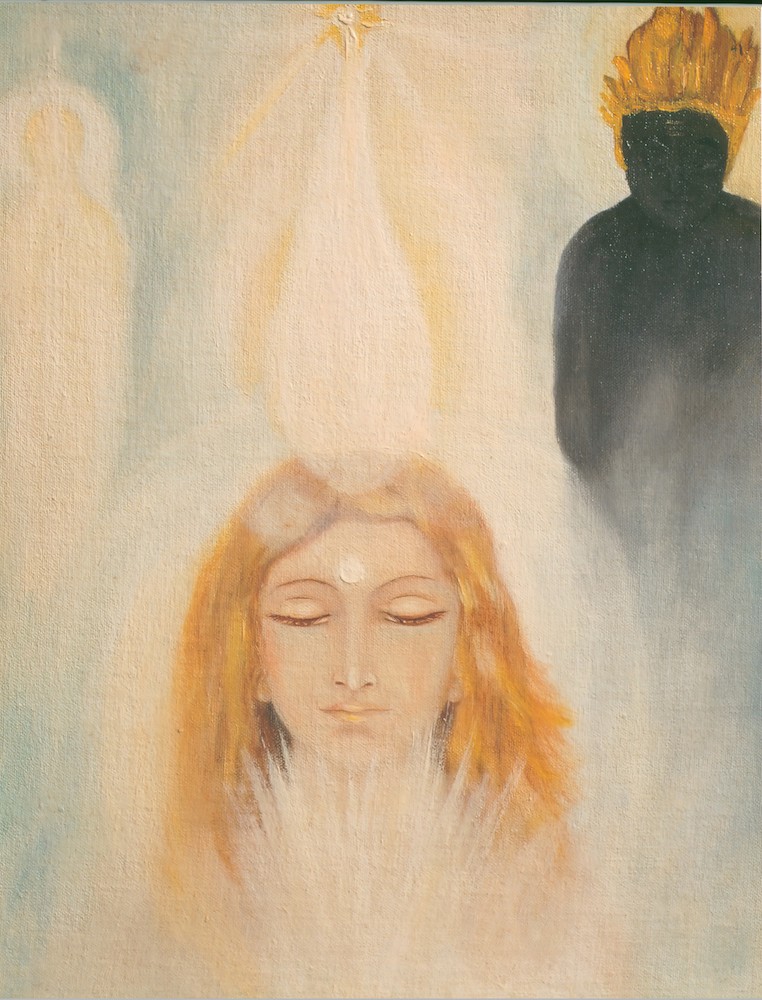
We may have a look at the painting pertaining to this passage, a painting by Huta X:I # 4
Above, her spirit in its mighty trance
Saw all, but lived for its transcendent task,
Immutable like a fixed eternal star. ||139.28||
Savitri Book 10 Canto 1 – The Dream Twilight of the Ideal
Let us see Savitri as a Truth-Beauty-Ānanda transcription.
This is a narrative born of intimacy and oneness of the Poet with the subject-matter, with a living dynamic identity of sense and sound and sight. It is not a thoughted-out stuff, absolutely nothing mentally constructed-manufactured, there is no striving here, no effort even, it is not something that is received or reached. It is not even coming from inspiration or intuition; it is not still what may be called a spontaneous overflow of the artistic impulse or urge. It is simply there, always. Its ceaseless music carries the creative hush in which sound generates sound, sounds bearing colours and scents and flavours. Take these randomly picked up lines:
Birds like pale-bosomed imaginations flew
With low disturbing voices of desire …
There was the voice of an unrealised bliss …
Win immortality by perfect form …
Here vision fled back from the sight alarmed,
And sound sought refuge from the ear’s surprise,
And all experience was a hasty joy …
The sombre Shadow sullen, implacable
Made beauty and laughter more imperative …
Pain grew a trembling undertone of bliss
And transience immortality’s floating hem …
This is sheer poetry, epically romantic, mystically detailed out, spiritually revealing, occultly charged with the power of realisation, prosodically grand and rhythmic and perfect, ushering in divine experience, every word in its place, every vowel with the burden of seizing sound, every idea spawning-spreading ideas and ideas, every small or large image bringing the unseen, — even the unseeable, — to seeing sight. But, most paradoxically, most surprisingly, this is not poetry that climbs up, that soars up; it is that which is coming down, descending, flooding with beauty and truth and delight, Ānanda itself, Ānanda far beyond ecstasy or joy or exultation-rapture; it simply is a transcription of what the Yogi-Poet has in his possession, a part of himself, inseparably always.
If for the Poet Savitri in the 1930s was a “means of ascension”, in the next decade for the Yogi-Poet it was significantly and necessarily a luminously and intensely willed and desirable means of triumphant affirmation, of declaration; it is an announcement, of establishing the divinity of the original Word in the preparing and prepared terrestrial consciousness, of bringing down the powers of the manifesting Spirit in the earthly dynamism. In that sense, to call Savitri a Mantra also becomes too mental a description. It is a Truth-Transcription in the Truth-Mode for the manifestive dimensions and possibilities of the Spirit entering into the mortal creation, for this earthly life to become the life divine, for a divine life in a divine body, a thing which only a supreme Yogi who can decree and realise.
It is a process of materialisation of the spiritual promoting the material to be more and more spiritual, the higher descending into the lower to raise it to its truth-possibilities.


 The Winds of Wonder
Leave a reply to RY Deshpande Cancel reply