“It was the hour before the Gods awake.”

“It was the hour before the Gods awake.”

By

/

2–3 minutes

read

An Exchange of Emails

Pravir Malik

When I read the line “It was the hour before the Gods awake.”, I interpret it in the context of “This was the day when Satyavan must die.”  

My reasoning is the following:

  • Satyavan’s ‘death’ means he is now reborn in some higher consciousness (is this The Flame-Child, or not quite yet?)
  • Being reborn in a higher consciousness (even if not as a flame-being) means that now the Gods can awake (because they can descend into more advanced earthly beings, and ‘awake’ to another way of being?)

Thanks for your comments.

RY Deshpande

This is an excellent way of looking at the text with which Savitri is opening. 

The third Canto begins with the line “A world’s desire compelled her mortal birth.” The “world’s desire” is carried by the supreme Yogi Aswapati himself, the Incarnate, he himself the “World’s Desire” embodying the aspiring Urge.

The insistence is for the Divine Mother to carry out the transformative mission by entering into the mortal birth. It is her work in removing the obstacle standing across the path of the divine Event, the obstacle that is Death, the Mind of Night; it is the Mind of Matter, Matter’s Mind, the physical’s Mind which is under the sway of Inconscience, total unawareness of the Divine.

Eventually In the long occult-spiritual sequel will Satyavan be born as the flame-child, Satyavan who will be no longer in the grip of strong formidable Death, the Supreme himself having put on that functionally necessary mask. Since the beginning of the evolutionary manifestation upon earth Satyavan is the evolutionary Incarnation of the Supreme. His release from the grip of Death ushers in the divine life in a divine body, as a new race in this mortal world. Mortality will then have the sense of the change of form not through death but upon the needs of Consciousness.

The first two Cantos in the swiftness of the epic narrative present these entire operative details, the why and the how of this mortal creation. The transcendental Gods may well now participate in this glory and in this triumphant creative joy. The whole issue is at once brought into focus, the raison d’être of Savitri. It is the Prolegomena of a mighty and majestic theme. It could perhaps be seen as a flashback very creatively used by the Poet, but the Book of Beginnings begins with the beginning. And this what a profound beginning!

Pravir Malik

Thanks.  Have begun listening to your Savitri talks.  Will take me a while get through them.  

So the flame child is not yet, but is yet to come, and the transcendental Gods have yet to begin to participate?

RY Deshpande

This has already been done in the occult, the Mother’s Essential Agenda is that miraculous work done. She sees, it is the psychic being who will materialise and become the supramental being, psychic being the immortal in the mortal of the Rig Veda.

The psychic being materialising is the flame-child.

RY Deshpande

Have a look at this:

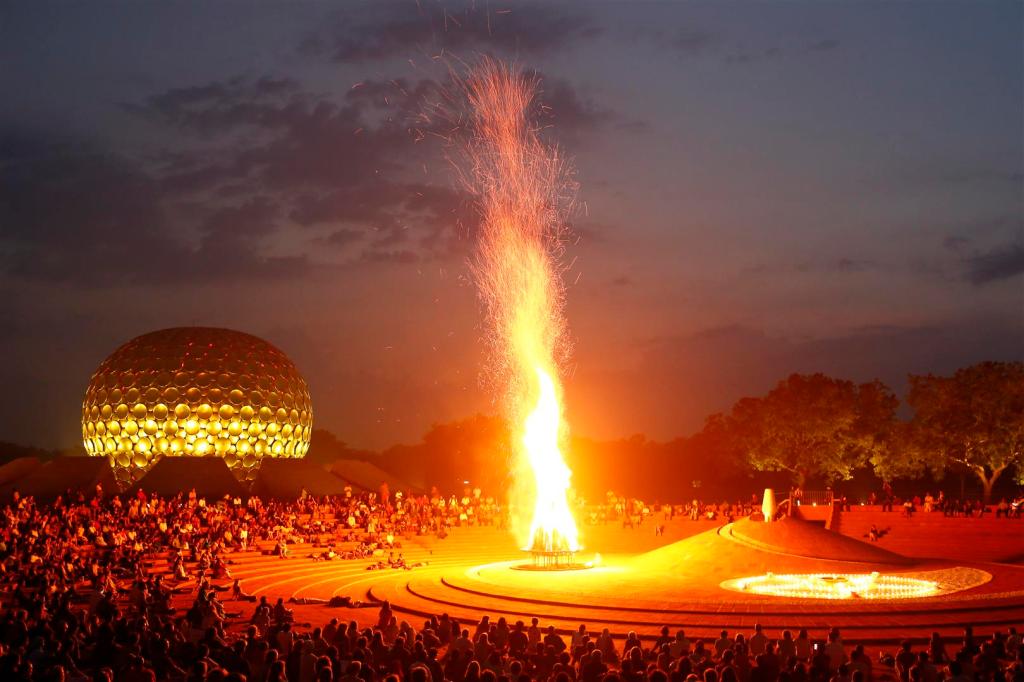
The featured image is the Dawn Fire at Auroville, an invocation to the Flame-Child.

[Dr Pravir Malik lives in Berkeley Calif USA]

Painting by Huta
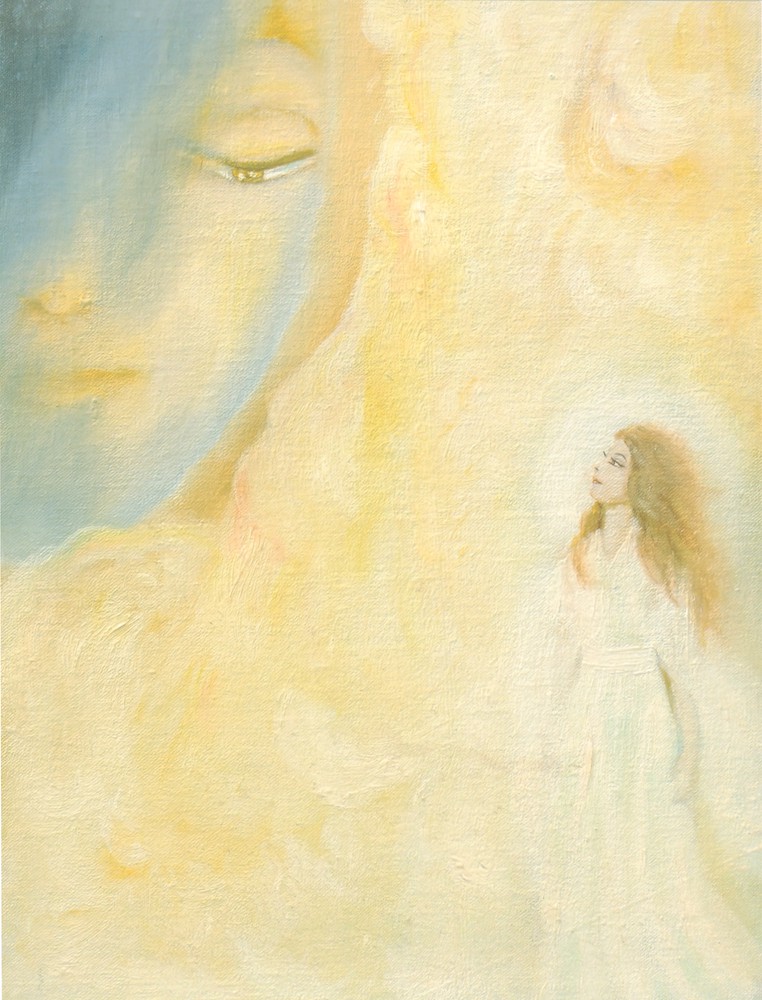

Night the dim mask had grown a wonderful face. Savitri Book XI

28 responses to ““It was the hour before the Gods awake.””

  1. RY Deshpande Avatar
    RY Deshpande

    The first line of Savitri, “It was the hour before the Gods awake”, is after several earlier drafts by the Poet. Previously it was “before the gods awake”, later changed to “before the Gods awake”. This capitalisation of “Gods” is significant, indicating the participation of the transcendental Gods who have not yet entered into universal and evolutionary manifestation.

    Liked by 1 person

  2. RY Deshpande Avatar
    RY Deshpande

    Shiva used to visit the Mother often. Once she asked him to take birth on earth. He declined, and told her he will do so only after the descent of the Supermind. That is the participation of the transcendental Gods.

    Liked by 1 person

    1. sriaurobindocenterla Avatar
      sriaurobindocenterla

      Yes, and Swami Vivekananda too expressed his desire to come down with the Supramental world.

      Like

      1. RY Deshpande Avatar
        RY Deshpande

        This is what Sri Aurobindo writes, inter alia, about Vivekananda:

        Vivekananda was a soul of puissance if ever there was one, a very lion among men, but the definite work he has left behind is quite incommensurate with our impression of his creative might and energy. We perceive his influence still working gigantically, we know not well how, we know not well where, in something that is not yet formed, something leonine, grand, intuitive, upheaving that has entered the soul of India and we say, “Behold, Vivekananda still lives in the soul of his Mother and in the souls of her children.” So it is with all. Not only are the men greater than their definite works, but their influence is so wide and formless that it has little relation to any formal work that they have left behind them.

        https://incarnateword.in/sabcl/17/dayananda

        Like

      2. RY Deshpande Avatar
        RY Deshpande

        Sunrise at Kanyakumari

        First sunrise of Uttarāyana, Sun’s transit to the North, 14 January 2025

        Like

  3. Rima Ghosh Avatar
    Rima Ghosh

    Thank you for this enriching reading.

    Like

  4. RY Deshpande Avatar
    RY Deshpande

    Vikas from EWCC L A writes

    I suppose I have to open an account to comment; but let me say quickly, I am leaning more towards your comment which is closer to Her reading of the line. You imply that these Gods were there but She writes they were “born”. This is your comment:”This capitalisation of “Gods” is significant, indicating the participation of the transcendental Gods who have not yet entered into universal and evolutionary manifestation”.This is more or less in line with the Mother’s explanation below which is unambiguous and consistent with Her statements elsewhere.”There is an ancient tradition which describes the creation as done by some first emanations of the Supreme Mother, who were four emanations. In the sense and the feeling of their supreme Power, they cut connection with their Origin and became independent. And then, these emanations, being separated from their Origin, entered into darkness.The first was Consciousness, Consciousness in Light, and by cutting Himself from His Origin He went down and down towards Unconsciousness.The second was Bliss and turned into Suffering.The third was Truth and turned into Falsehood.The fourth one was Life and turned into Death.This happened after they came down into the vital level. When this was seen, it was decided that some second emanations would be made to repair the mistake of the first; and the second emanations were the Gods.This first line refers to the condition of the world before the Gods were born.Sri Aurobindo says, ‘It was the hour before the Gods awake.’”.The Night referred to is obviously the Night of Inconscient. The earth, the terrestrial world is surely the result of the descent of the spark of Divine Love into this Inconscient. Imaginatively one might say that the gods were also created subsequent to this fall but naturally this time the Mother kept them in contact with Her that there be no possibility of separation. These gods were consequently function bound along with being Mother-bound. These are the intermediate worlds. At the same time there was a direct descent of Love into this Night without passing through these worlds. It is the beginning of evolution. I remember She wrote somewhere that She was commissioned to do this. Let me quickly add I am not implying that this is the beginning of creation (“As in a dark beginning of all things”) but one crucial dawn in the successive dawns of which the Vedic Rishis speak. The darkness (“when darkness was blind and engulfed within darkness”) was black, and veiled the Divine/Light and cast a shadow of the earth (“a shadow spinning through a soulless void”).I will be emailing you the Manvantaras/Kalpas and evolution points. This is written in a hurry so that I could get it off to you. So excuse the typos.Vikas

    Like

  5. supriyafdce46d60a8ae Avatar
    supriyafdce46d60a8ae

    I will try to explain my understanding from the story of Mahabharat.

    Dhrishtadyumna son of King Drupada, had appeared from the sacred fire of yajna.

    Metaphorically, Dhrishtadyumna means, calm inner light of Divine perception. The awakening intuition of devotee. This inner awakening has to take place with tapas, so the devotee can perceive Divine presence.

    the material details of the two stories may be different, but the process of enlightenment should be similar.

    We are talking about man to rise to Divinity or other way for Divinity to come down in man. That birth of ‘Fire born child’ is an uncompromising necessity.

    Avidya is darkness and enlightenment is removal of that avidya.

    I haven’t studied ‘Savitri’, but RYD sir is explaining philosophy of Savitri very nicely.

    That tall fire column at Auroville is really impressive, like reaching for heavens.

    Like

    1. RY Deshpande Avatar
      RY Deshpande

      Just a quick response. The original story of Savitri as we have in the Mahabharata is present in the following:

      https://savitri.in/library/sri-aurobindo/vyasas-savitri

      I have made an attempt to translate verse-by verse the Sanskrit Savitri-text into English, in prose; there is also, in Part II, a discussion about that composition.

      Maybe you would like to look into it, after which we can exchange notes about various specificities.

      Like

    2. RY Deshpande Avatar
      RY Deshpande

      Your mention of Drishtadymna is meaningful. But his birth was an aspect of some revenge-story, lacking any fundamental issue of this creation. It cannot be universalised. Aswapati’s Savitri-Yajña in the Mahabharata was in the context of perpetuation of the dhārmic order. He sets himself to do putra-kāmeshthi tapas, desire for the birth of a son, for 18 years. The Divine Savitri grants him instead the boon of a radiant daughter, kanyā tejasvīni, and tells him this is the sanction from the supreme Lord himself, Grand Sire, Pitāmaha, and he should not have any reservation or qualms in accepting it. That is the birth of Savitri.

      In Sri Aurobindo’s Savitri the necessity, the compulsion of the birth of Savitri, the Divine Puissance, the Death-conquering Power, is in the context of taking the spiritual evolution on earth forward, beyond Man, for a divine life in a divine and deathless body upon earth, in this mortal world, Mṛtyu Loka. In the esoteric-spiritual sense this has already been done and it is only in the process of the unfolding time that it has to manifest, though in the meanwhile “belief shall be not till the work is done”, done on the material plane.

      Like

  6. pravirmalik Avatar
    pravirmalik

    At the end of Book Eleven, when Savitri is returning to Earth, from where (what plane) are the Krishna and Kali that are returning with Her? What is their purpose? And on Siddhi day when Krishna descends into the body of The Lord, from where does He come? Aren’t these beings still different from the Gods in the prophecy – “It was the hour before the Gods awake.”? And what is their purpose?

    Like

    1. RY Deshpande Avatar
      RY Deshpande

      The mask of Death the Supreme had put on is gone and from him Savitri receives the Word:

      Nature shall live to manifest secret God,

      The Spirit shall take up the human play,

      This earthly life become the life divine. ||155.71||

      She is now coming back to Earth, carrying like a bird close to her bosom the soul of Satyavan. Even as she is descending follow her Krishna and Kali:

      Pursuing her in her fall, implacably sweet,

      A face was over her which seemed a youth’s,

      Symbol of all the beauty eyes see not,

      Crowned as with peacock plumes of gorgeous hue

      Framing a sapphire, whose heart-disturbing smile

      Insatiably attracted to delight,

      Voluptuous to the embraces of her soul. ||156.6||

      Changed in its shape, yet rapturously the same,

      It grew a woman’s dark and beautiful

      Like a mooned night with drifting star-gemmed clouds,

      A shadowy glory and a stormy depth,

      Turbulent in will and terrible in love. ||156.7|

      This is the most significant most magnificent Boon Savitri is getting. It is the entry of Ānadamaya Purusha Krishna and the divine Dynamic Creative-Executive Power Kāli for the manifestation of the divine life in a divine body. A new world is born in the joy of the endless possibilities of the Spirit manifesting in the evolutionary sequel.

      The prophet moment covered limitless space

      And cast into the heart of hurrying Time

      A diamond light of the Eternal’s peace,

      A crimson seed of God’s felicity;

      A glance from the gaze fell of undying Love. ||156.14||

      The reign of God’s felicity and undying Love begins, these founded on the Eternal’s peace. To participate in it, the transcendental Gods who are already present may opt to come down here; possibly also altogether new Gods may be born. The new creative dynamics of the Power that has leaned down is for the brooding earth’s infinite Bliss.

      Liked by 2 people

    2. RY Deshpande Avatar
      RY Deshpande

      The Mother was asked What is the difference between pleasure, joy, happiness, ecstasy and Ananda? Can we find one in the other? She replies:

      Ananda belongs to the Supreme Lord.

      Ecstasy belongs to the perfected yogi.

      Joy belongs to the desireless man.

      Pleasure is within the reach of all living beings, but with its inevitable accompaniment of suffering.

      Liked by 2 people

  7. RY Deshpande Avatar
    RY Deshpande

    “It was the hour before the Gods awake” is the opening line of Savitri. The Mother tells to Huta: “This first line refers to the condition of the world before the Gods were born.”

    We should note that “before the Gods awake” and “before the Gods were born” refer to two different events.

    Liked by 2 people

    1. divinepilgrim Avatar
      divinepilgrim

      Yes, that is fairly clear, and as stated earlier, this dawn is one in a succession of dawns. What makes it clear is the line “As in a dark beginning of all things”.
      It is not the beginning of the universal manifestation that is being referred to.

      Like

      1. RY Deshpande Avatar
        RY Deshpande

        “… this dawn is one in a succession of dawns.” Yes, still this is a totally different dawn which ushers in the Everlasting Day. I will not put it as one more dawn in the succession of dawns. Previous dawns were in Ignorance; now is the beginning of Knowledge.

        Like

  8. divinepilgrim Avatar
    divinepilgrim

    Previous dawn were in Ignorance. But so is this one in the sense that the earth is besieged by and under the sway of the Inconscience and Ignorance. If it were not, the whole import of Savitri would be lost. Yes, this Dawn is different as it would usher in the Knowledge. But the beginning of knowledge itself implies Greater Splendours; the Divine is no fixed paradise.

    This dawn is the symbol of the Supramental Godhead entry into the consciousness of earth , an invasion of the Inconscient which is symbolized by the Night. This dawn is from the Transcendental unlike the previous Dawns. The Mother was born “free”, without desire, and that is why the mind (Cosmic Ignorance’s highest term) and

    “Its chequered eager motion of pursuit,

    Its fluttering-hued illusion of desire,

    Visited her heart like a sweet alien note”.

    In short:

    Dawn – Symbol of the Transcendent Knowledge and the dawn of the day that Satyavan must die.

    Night – Symbol of the Inconscience and the night of the day before Satyavan is fated to die, the preceding night.

    Like

    1. RY Deshpande Avatar
      RY Deshpande

      This dawn has to appear in Ignorance, necessarily and operationally, that only then it can break through Ignorance and bring the supreme Light to dispel Ignorance, for that which is ready; it is not a magic wand being brandished from above and things got done, because, what might appear due to magic can as well disappear with it. None of the earlier dawns was able to break through Ignorance, they were at the best under the Golden Lid, Hiraṇmaya Pātra; but here the supramental gaze and power are irresistibly operative.

      Like

      1. divinepilgrim Avatar
        divinepilgrim

        The “break through” is not a breaking through Ignorance but of the Inconscience. The Ignorance is itself an evolute of the Inconscience.

        “Something that wished but knew not how to be,Teased the Inconscient to wake Ignorance.”

        Things surely are not done with a magic wand; but that itself implies that there would not be the conquest of the Night. That would take away the whole meaning of evolution (The brief perpetual sign recurred above), the appearance of matter, life, mind, and moving forward, the Supermind, Ananda, Chit and Sat So, I would rather state that “None of the earlier dawns broke through Ignorance” than “None of the earlier dawns was able to break through Ignorance”. I am not sure whether that was the purpose of those dawns. The corollary would be “Sri Krishna was not able to break through Ignorance”. I am not sure. There is something to said about the readiness and receptivity too. At any rate this is debatable and we run the risk of mentalising truths that are far beyond human comprehension and words invariably obscure more than they illumine.

        In conclusion one might say that while all the dawns, including this one, were an appearance in the Ignorance, this one resulted in the conquest of the Inconscient, and , unlike other ones , it symbolized the reality which is the Transcendental Knowledge, just as the night symbolized the reality that is the Inconscient.

        Like

    2. RY Deshpande Avatar
      RY Deshpande

      Let me quote the last verse of Nāsadiya Sūkta (X:129):

      इ॒यं विसृ॑ष्टि॒र्यत॑ आब॒भूव॒ यदि॑ वा द॒धे यदि॑ वा॒ न ।

      यो अ॒स्याध्य॑क्षः पर॒मे व्यो॑म॒न्सो अ॒ङ्ग वे॑द॒ यदि॑ वा॒ न वेद॑ ॥ १०.१२९.०७

      Whence all creation had its origin,
      he, whether he fashioned it or whether he did not,
      he, who surveys it all from highest heaven,
      he knows – or maybe even he does not know.

      But that is exactly what Savitri is revealing.

      Like

  9. RY Deshpande Avatar
    RY Deshpande

    Justyn Jędraszewski from Poland writes:

    “In a meeting l was casually asked by a teacher of British Council: what do You read ? l said, Sri Aurobindo; really full answer should have been Savitri‘s first line! I was so impressed by it that it became the seed of my new Life.”

    This is absolutely beautiful, “seed of my life”, marvellous. Thanks Justyn.

    Like

  10. RY Deshpande Avatar
    RY Deshpande

    About the description of Dawn in the Rig Veda let me quote just an example as presented by Sri Aurobindo:

    “Dawn is constantly represented as awakening to vision, perception, right movement. “The goddess,” says Gotama Rahugana, “fronts and looks upon all the worlds, the eye of vision shines with an utter wideness; awakening all life for movement she discovers speech for all that thinks,” viśvasya vācam avidan manāyoḥ (I.92.9). We have here a Dawn that releases life and mind into their fullest wideness and we ignore the whole force of the words and phrases chosen by the Rishi if we limit the suggestion to a mere picture of the reawakening of earthly life in the physical dawning. And even if here the word used for the vision brought by the Dawn, cakṣuḥ, is capable of indicating only physical sight, yet in other passages it is ketuḥ which means perception, a perceptive vision in the mental consciousness, a faculty of knowledge. Usha is pracetāḥ̣, she who has this perceptive knowledge. Mother of the radiances, she has created this perceptive vision of the mind; gavāṁ janitrī akṛta pra ketum (I.124.5). She is herself that vision,—“Now perceptive vision has broken out into its wide dawn where nought was before,” vi nūnam ucchād asati pra ketuḥ (I.124.11). She is by her perceptive power possessed of the happy truths, cikitvit-sūnṛtāvarī (IV.52.4).

    https://incarnateword.in/cwsa/15/dawn-and-the-truth

    Like

  11. RY Deshpande Avatar
    RY Deshpande

    This is in response to divinepilgrim January 15, 2025 above, beginning with The “break through” is not a breaking …

    The question is related to “conquest of the Inconscient”. Can there be anything like the conquest of the Inconscient?

    Savitri‘s whole purpose is the Conquest of Death. Savitri was specifically told:

    Conquer thy heart’s throbs, let thy heart beat in God:

    Thy nature shall be the engine of his works,

    Thy voice shall house the mightiness of his Word:

    Then shalt thou harbour my force and conquer Death. ||116.26||

    Death is standing across the path of the divine Event, the supramental manifestation, and it is he who has to to be transfigured. Dawn is to be seen in that context.

    In fact we have the following about the Inconscient itself:

    … the Inconscient too is infinite;

    The more its abysses we insist to sound,

    The more it stretches, stretches endlessly. ||83.14||

    This infinity and endlessness of the Inconscient is the beauty of this creation which for the purpose of the manifesting Spirit must continue to be there. What can disappear is Ignorance but not the Inconscient.

    Like

    1. divinepilgrim Avatar
      divinepilgrim

      The whole progression and march of evolution is the story of the “conquest” of Light over Darkness. What is the origin of Darkness, the eternal “No”, if not the Inconscient. The power of the Inconscient is formidable, it is no impotence. The Mother and Sri Aurobindo frequently use the word “fight”, “battle” etc. Sri Aurobindo wrote “I go on till I conquer or perish. When they use the term “conquest of Truth” they obviously do not mean obliterating Truth.

      But this is not academic. The action of this formidable power is not alien to us. Any aspirant who has sincerely and in a committed way tried to change his nature, will admit it is long labor attended with struggle, difficulty, etc. The finest timber comes out of the slowest growing trees. He who expects to blossom into a yogi in a few years is bound to be disappointed and had better leave the whole subject alone.

      You write “conquest of Death”, but Death is not just the destruction of the body, it is non-being, non-existence, everlasting Night and pervades the whole universe, the atoms and in this mortal world expresses itself as struggle, doubt, pain etc. Its the origin of our misery. Hear what this Godhead tells Savitri:

      “This is my silent dark immensity,

      This is the home of everlasting Night,

      This is the secrecy of Nothingness

      Entombing the vanity of life’s desires….

      Hopest thou still always to last and love?”

      and challenges Savitri,

      “O human claimant to immortality,

      Reveal thy power, lay bare thy spirit’s force

      Then will I give back to thee Satyavan.

      Or if the Mighty Mother is with thee,

      Show me her face that I may worship her;

      Let deathless eyes look into the eyes of Death…”

      Death is face to face with Savitri but this is a different Savitri.

      “I hail thee almighty and victorious Death,

      Thou grandiose Darkness of the Infinite….

      I have given thee thy awful shape of dread

      And thy sharp sword of terror and grief and pain

      To force the soul of man to struggle for light…”

      And now the finale, Death turning to his reality as an emanation of Her.

      “His body was eaten by light, his spirit devoured.”

      “A secret splendour rose revealed to sight

      Where once the vast embodied Void had stood.

      Night the dim mask had grown a wonderful face.”

      (Please note, the bolding of the text is from me).

      Like

  12. RY Deshpande Avatar
    RY Deshpande

    But let us trace the genesis of Death in his appearance on the material scene. Young gods in the physical yearned for release of souls asleep in objects, yearned in brute forms to awake divinity. They appealed to Life to invade the senseless mould and release them from it. Life heard the call. She the great winged Angel in all her graciousness responded, responded unmindful of the possible danger to herself, she the Brava, leaping before looking into things:

    Alive and clad with trees and herbs and flowers

    Earth’s great brown body smiled towards the skies,

    Azure replied to azure in the sea’s laugh;

    New sentient creatures filled the unseen depths,

    Life’s glory and swiftness ran in the beauty of beasts,

    Man dared and thought and met with his soul the world. ||36.19||

    But while the magic breath was on its way,

    Before her gifts could reach our prisoned hearts,

    A dark ambiguous Presence questioned all. ||36.20||

    The secret Will that robes itself with Night

    And offers to spirit the ordeal of the flesh,

    Imposed a mystic mask of death and pain. ||36.21||

    The deed was done, and here is now Death accompanying Life. Death is therefore a certain consequence of a certain action, of a certain process, the Inconscience throwing a challenge to the invading Power. That challenge has to be met and Life freed of Death. Not Inconscience but Death has to be transfigured. That is Savitri’s one and supreme pursuit and accomplishment. Inconscience will thwart every invasion except the invasion of Supermind.

    Like

  13. RY Deshpande Avatar
    RY Deshpande

    Here is a painting by Huta presenting the Night with a wonderful face, transfigured Death, now the mask removed, is granting boon to Savitri:

    Transfigured was the formidable shape. ||149.3||

    His darkness and his sad destroying might

    Abolishing for ever and disclosing

    The mystery of his high and violent deeds,

    A secret splendour rose revealed to sight

    Where once the vast embodied Void had stood. ||149.4||

    Night the dim mask had grown a wonderful face. ||149.5||

    The vague infinity was slain whose gloom

    Had outlined from the terrible Unknown

    The obscure disastrous figure of a god,

    Fled was the error that arms the hands of grief,

    And lighted the ignorant gulf whose hollow deeps

    Had given to nothingness a dreadful voice. ||149.6|

    (Please see the painting in the main text)

    Like

  14. RY Deshpande Avatar
    RY Deshpande
  15. RY Deshpande Avatar
    RY Deshpande

    Sri Aurobindo: Savitri is represented in the poem as an incarnation of the Divine Mother.. This incarnation is supposed to have taken place in far past times when the whole thing had to be opened, so as to “hew the ways of Immortality”.  (1936)

    “To hew the ways of immortality” — that is the entire thrust of the Poem. Nowhere we have anything like conquest of the Inconscient; but the conquest is what ensues from it.

    Conquest of Death is more than the Immortality; it is deathlessness.

    Like

Leave a comment