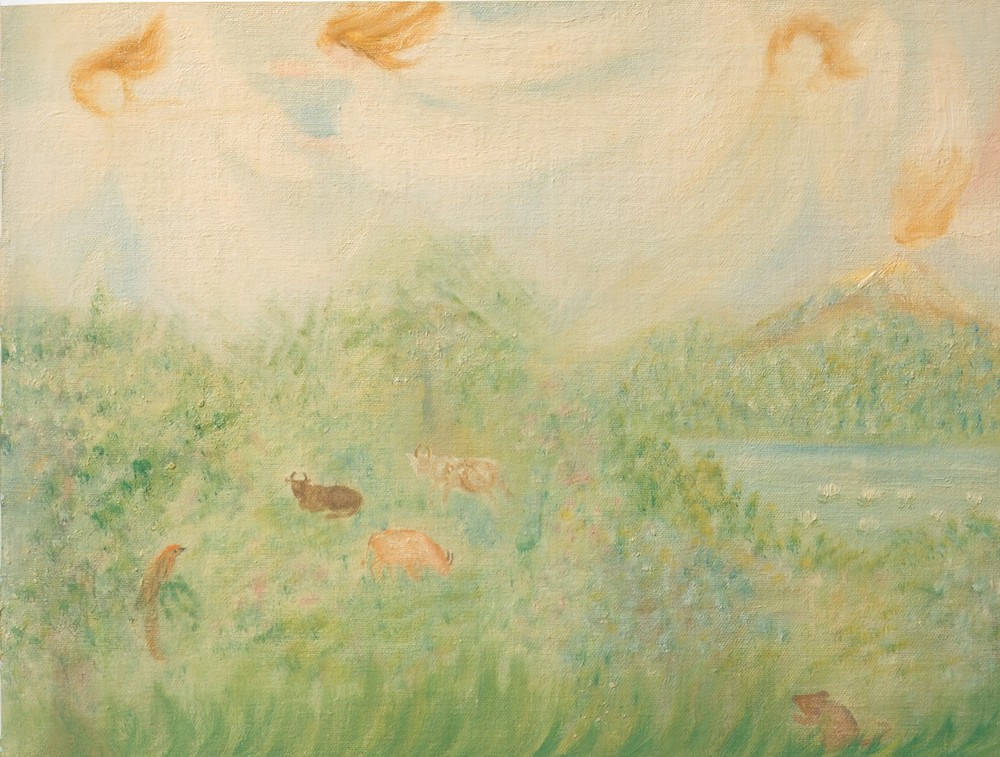
Morning twilight of the gods

Morning twilight of the gods

By

/

2–3 minutes

read

Morning twilight of the gods

There is a morning twilight of the gods;

Miraculous from sleep their forms arise

And God’s long nights are justified by dawn. ||139.1||

Into a happy misty twilit world

Where all ran after light and joy and love

She slipped; there far-off raptures drew more close…. ||139.3||

[Savitri Book 10 Canto 1 – The Dream Twilight of the Ideal]

Night is not our beginning nor is our end. We have entered into the Night to open out her locked precious mysteries, the wonders of truth’s revelations that can and should appear in the manifestation, in the dynamics of growing vastness, splendid in their beauty and joy and power and grandeur. “We came to her from a supernal Light, / By Light we live and to the Light we go.” [138.15] In the process the antagonist Death, deriving his strength from the stubborn Night, turns out just to be a stair, a climbing step on the ladder of progress, he unconsciously driving us towards a deathless state. The spirit of Satyavan is being taken by Death and Savitri, to claim him back for the earth-work, is following him. In the darkness of the Night is now appearing the dream-twilight of the Ideal. But this is not Shakespearian “we are such stuff as dreams are made on”. Savitri is seeing the morning twilight of the gods in which the promise is going to be won.

There is| a morn|+ing twi|+light of| the gods;|

Mi+rac|+u+lous| from sleep| their forms| a+rise|

And God’s| long nights| are jus|+ti+fied| by dawn.|

In+to| a hap|+py mist|+y twi|+lit world|

Where all| ran af|+ter light| and joy| and love|

She slipped;| there far|-off rap|+tures drew| more close|

Featured painting is by Huta X:1#3

Winning Intimations

Telling dreams are not devoid of precious substance,

Wonders of golden essence are held by them;

Their origin is in the superconscient sleep

Which the blazing marvels of becoming knows;

Someone deep within waits for realised beliefs

And is announced absoluteness of the thing;

A perfection of the occult kindles a fire

And winning God takes charge of the valiant.

17 December 2024

I have travelled the whole earth over,

Yet never found

The beautiful body of Pharphar

Or its soul of secret sound.

But all my dreams are an answer

To Pharphar’s blind career;

And the songs that I sing are an image

Of quiets I long to hear.

Ama Kiran (KD Sethna): Pharphar. [Pharpar, phär’-par (Heb.) — borne rapidly; running swiftly; swift fruition; swift. A river of Damascus.]

One response to “Morning twilight of the gods”

  1. RY Deshpande Avatar
    RY Deshpande

    About Amal’s Pharphar Sri Aurobindo comments:

    Very beautiful indeed, subtle and gleaming and delicate. The sound-suggestions are perfect. I suppose it comes from some plane of intuitive inspiration.

    15 October 1936

    I wonder whether you would indicate the resemblances and differences between De la Mare’s Arabia—a charming poem—and this one written by myself [Pharphar] which was partially influenced by his.

    It is indeed charming—De la Mare seems to have an unfailing beauty of language and rhythm and an inspired loveliness of fancy that is captivating. But still it is fancy, the mind playing with its delicate imaginations. A hint of something deeper tries to get through sometimes, but it does not go beyond a hint. That is the difference between his poem and the one it inspired from you. There is some kinship though no sameness in the rhythm and the tone of delicate remoteness it brings with it. But in your poem that something deeper is not hinted, it is caught—throughout—in all the expression, but especially in such lines as

    When the magic ethers of evening
        Wash one the various day

    or

    The beautiful body of Pharphar
        Or its soul of secret sound

    or

    This river of infinite distance,
        Pharphar.

    These expressions give a sort of body to the occult without taking from it its strangeness and do not leave it in mist or in shadowy image or luminous silhouette. That is what a fully successful spiritual or occult poetry has to do, to make the occult and the spiritual real to the vision of the consciousness, the feeling. The occult is most often materialised as by Scott and Shakespeare or else pictured in mists, the spiritual mentalised as in many attempts at spiritual poetry—a reflection in the mind is not enough. For success in the former Arjava’s Totalitarian with the stark occult reality of its vision is a good example; for the latter there are lines both in his poems and yours that I could instance, but I cannot recall them accurately just now,—but have you not somewhere a line

    The mute unshadowed spaces of her mind?

    That would be an instance of the concrete convincing reality of which I am speaking—a spiritual state not hinted at or abstractly put as the metaphysical poets most often do it but presented with a tangible accuracy which one who has lived in the silent wideness of his spiritualised mind can at once recognise as the embodiment in word of his experience.

    I do not mean for a moment to deny the value of the exquisite texture of dream in De la Mare’s representation, but still this completer embodiment achieves more.

    16 October 1936

    Like

Leave a reply to RY Deshpande Cancel reply