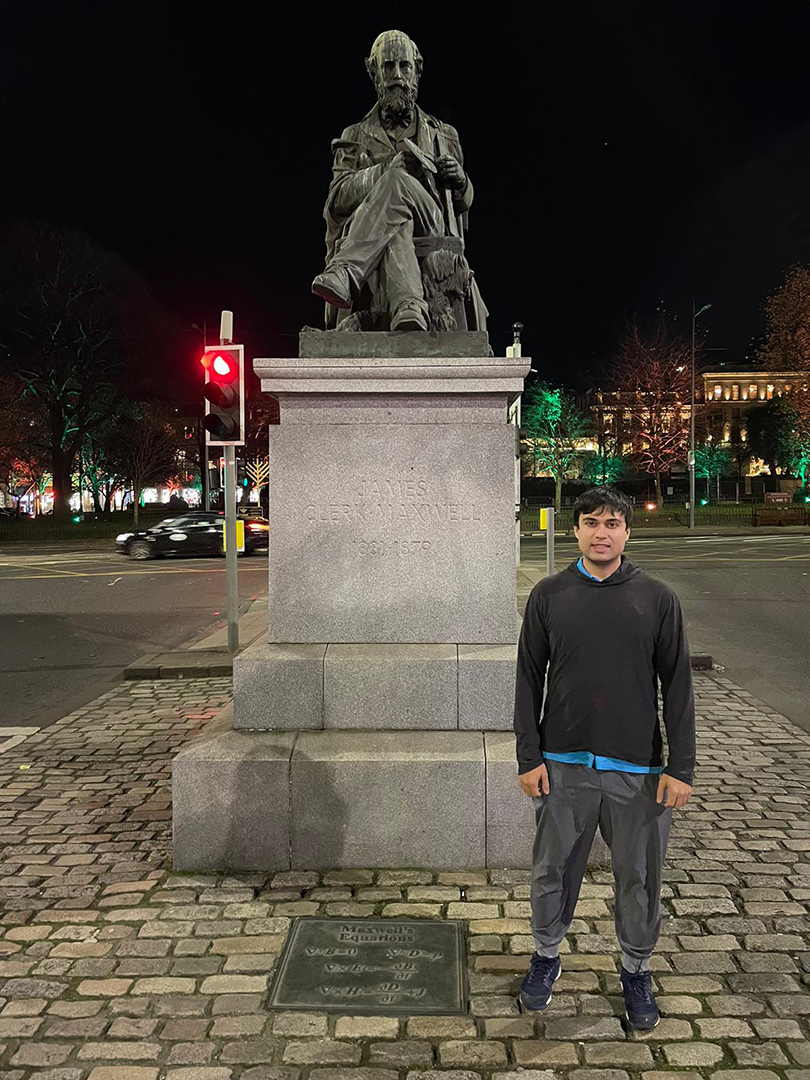
Apropos of Maxwell’s Statue at Edinburg
Maxwell’s Statue at Edinburg was installed on 25 November 2008 and today we celebrate the occasion with a brief account of the inspired and inspiring contribution of the great physicist of past years, outstanding for all time. For more details reference maybe made to the following:
Einstein said that he was standing on the shoulders of not Newton but Maxwell. There is something absolutely marvellous about his equations, certainly greater than Newton’s Laws of Motion or even that theory of gravity. What one sees in Newton is practical wisdom of an extremely high order, logic having its birth or faith in observation, pragmatism in its positivism so much later applauded and impelled by Auguste Comté.
There is no doubt that Maxwell’s mind was far richer and more subtle as well as sophisticated than Newton’s, even perhaps Einstein’s. This could be a hurried hasty unacceptable comment needing substantiation. But let us look into it quickly.
Wordsworth in his poem The Prelude speaks of Newton’s mind forever “Voyaging through strange seas of Thought, alone”. There is no doubt about the strong and powerful singularity and uniqueness about him. But perhaps Wordsworth was too enthusiastic to say that.
Newton’s was a mind voyaging on strange seas of thought and was in want of the deeper and intuitive perceptions of things which were there in abundance, say, in Descartes. But Descartes himself goes far beyond himself, that he is not there just because he thinks, “cogito, ergo sum”. Newton refused to deal with the dilemma of action-at-a-distance when it came to answer the question as how does a body act where it is not, the force of attraction between two bodies directly proportional to the product of their masses and inversely to the square of the distance separating them. His refuge was “I feign no hypotheses, hypotheses non fingo”. For Newton, a ‘hypothesis’ was a “conjectural causal” explanation. It had neither philosophical nor scientific basis. We continue to accept it even today, as a dependable text book, accept and use it in all practical situations, notwithstanding the General Theory of Relativity.
But Maxell’s proposal for the displacement current was not only a masterpiece of intuition; it had the solid trust and efficacy of the classical Continuity Equation. Empiricism combined with strong intuition and faith in something were authentic and promotional.
In that sense Einstein’s Special Theory of Relativity, given in 1905, had certainly a rational basis, connection, a link, with a reason to ponder over. Maxell’s Theory of Electromagnetism, 1865, in free space had absolute constants, of free space, epsilon and mu, producing the dimensions of velocity, rather speed, which numerically gave the speed of light, 3×10^8 m/s.
So here was something which was completely free of the frames of reference, independent of them, it being the same in all the frames of reference, having no relationship with the state of motion of the observer. That was in direct conflict with Newton’s Laws of Motion postulating absolute space and time, with a kind of universal scale and clock placed somewhere for everyone to see the same measures, irrespective of one’s state of motion. Perhaps that was another faux pas of Newton in spite of his mind voyaging through strange seas of thought.
In the inertial frame of reference an object follows Newton’s first law of motion, that, in a given state of motion it remains in that state until and unless an external force acts upon it, external and not from within itself; that gives the definition of force, that it changes the state of motion of an object. That is very logical and beautiful, very satisfying.
Coming to the principles of relativity, special theory of relativity of 1905, we can state this. (1) The laws of physics are the same in all the inertial frames of reference, frames stationary or moving at a constant velocity. (2) The speed of light in a vacuum is the same for all observers, regardless of the motion of the light source or observer.
That independence of the speed of light, with no connection with the state of motion of the observer, has its unmistakable connection with Maxwell’s Equations, with epsilon and mu. And the luminous magic that Maxell had brought was in his “displacement current” in reverence to the Classical Continuity Equation.
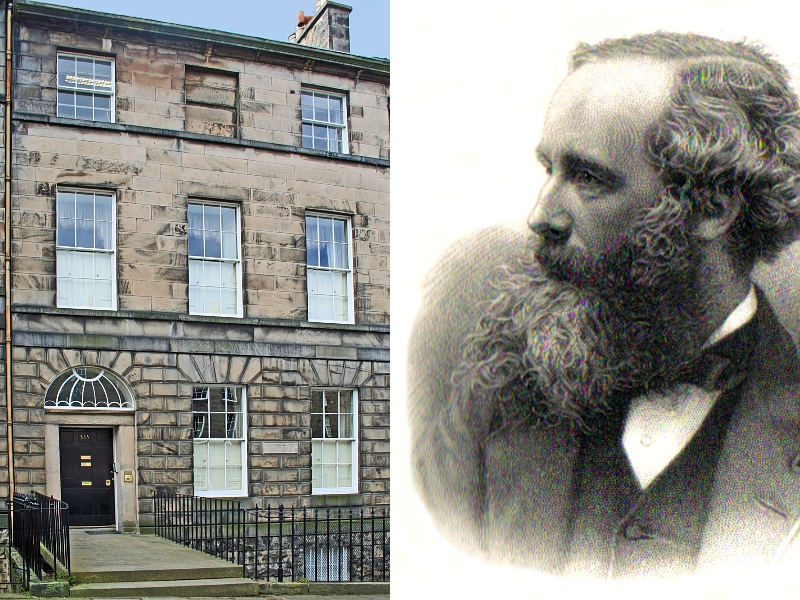
Maxwell’s birthplace in Edinburgh


 The Winds of Wonder
Leave a reply to RY Deshpande Cancel reply