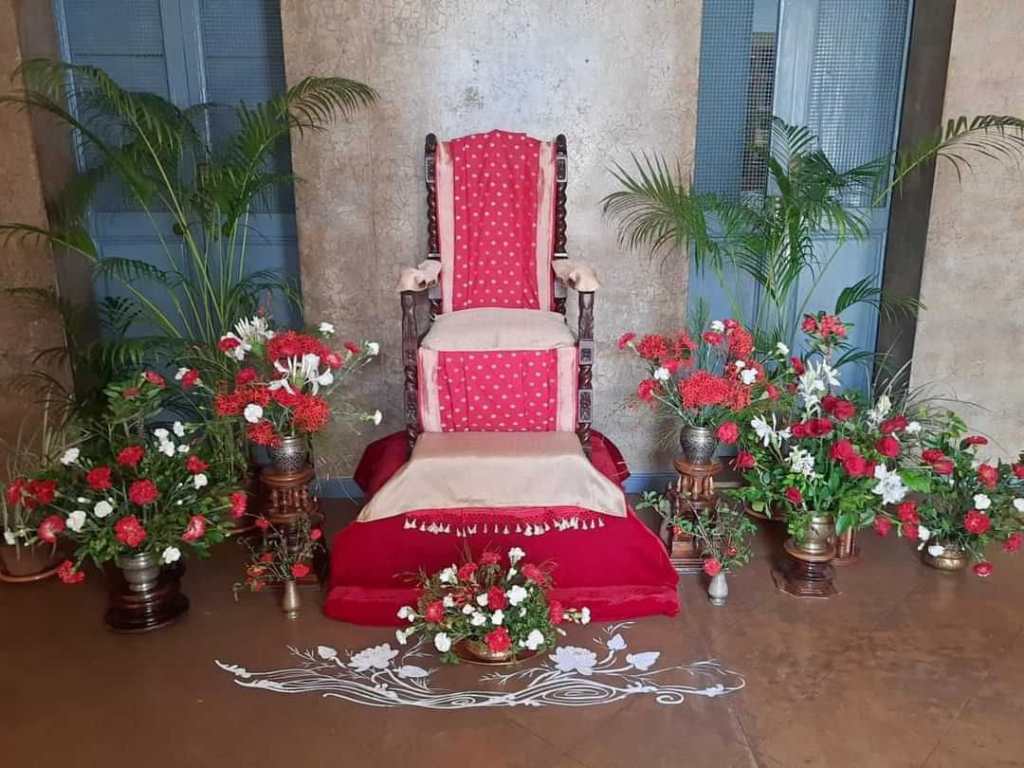
The Mother’s Chair in the Meditation Hall of Sri Aurobindo Ashram, Pondicherry, India. Durga used to visit her year after year on the Pujā occasion.
All of a sudden, yesterday afternoon towards evening (around six, or a little before), there came a sort of atmosphere of … (what should I call it?) a kind of discouraged pessimism in which everything had become lacklustre, grey, dissatisfied. When you see things from above, in a certain atmosphere of totality, each thing plays its part and collaborates in a general manifestation, but there, it was like something shut in itself, with no reason to be except that it was. It had neither aim, nor motive nor reason to be, neither was it a special circumstance or a particular event: it was a kind of self-enclosed formation, a state of being which was obviously morbid, but not violent, nothing violent…. Yes, in which each and everything was without reason or aim, without any satisfaction—neither oneself nor others, nor things. And I was DELIBERATELY shut in it, in order to feel it. The consciousness wondered, “Why? What does it mean? Why is it like this?” And at the same time (you know that yesterday was the day of “Durga’s Victory” for those who worship Durga), so I asked myself, “Why does she choose to shut me in this state just on the day of victory? What does it mean? What does it mean?…” It was indeed like a factual demonstration of the perfect uselessness of that way of being, which had no reason to be, which could be turned to anything, any time, without reason and without motive. It was like the symbol of disgruntled uselessness. But it went on…. I looked and looked at it, trying to find the slightest clue to the cause of that state: what, when, who, how? … And the curious thing is that it’s very, very foreign to my nature, because even when I was in real trouble, I never wasted my time being like that. And it went on, as things go on when I have to study them, understand them, and do what needs to be done. Then, at a certain point I said to myself, “Oh, perhaps this is what Durga intends to conquer this year?” And at the same time I remembered (like that, far away on the fringes of the consciousness), I remembered the time when Sri Aurobindo was there; every year, on the “Victory day,” I would tell him, “Well, this is what Durga has done this year,” and he would corroborate it. I would say, “This is what Durga has conquered, this is what Durga …” Every year, over a long time. And so that memory was there, far away in the light, as if to tell me, “See, do you remember that?” And I said to myself, “Well, this may be what Durga wants to conquer?” Then I thought, “But what’s to be conquered in this? It’s silly!” It’s a silly state. (Lots of people are in that state, I know, but it’s absolutely silly, it has neither reason nor cause nor aim, it’s like something that comes in without one knowing how or why.) It went on for a good while (I don’t remember exactly how long). Then, when I had seen clearly, understood clearly what it was, I asked Durga, “Is this what you want to do?…” And it was suddenly as if … a very strange thing, as if it evaporated before my eyes, pfft!… It went like this (gesture of bursting), and then … I tried and tried—the memory of it and everything had completely vanished! In one second it had completely gone.
While it was there, it was … yes, as if something without any truth in itself, something that didn’t rest on any truth. A morose, dissatisfied, grumpy state, and it was grey, grey, grey, lacklustre, looking at everything from the angle of uselessness and stupidity. Then there was a sort of bursting: all of a sudden, poff! like that, and it was all over. And now it’s a sort of vague memory which I can hardly recapture, which no longer exists.
When it came, I said (laughing), “What a victory!” Then came the memory, the vision of Sri Aurobindo’s time, and the impression, “Well, is this” (Durga was there, watching), “is this what you want to vanquish?” She didn’t answer me, she smiled. And a few minutes later, poff! (same gesture of bursting), like that, I don’t know how to explain it. But it was strange, I had never seen that before…. The other times, when Sri Aurobindo was there, whenever she overcame something, the impression was of a power surrounding a falsehood (gesture as if to pull out a tuft of grass), surrounding it like that, forcibly isolating it, paralyzing it and taking all support away from it; but this time … it was an odd phenomenon. Something totally nonexistent, without any truth in it. And all that way of being was as if hanging over the earth, in contact with certain people, but as if wrapped inside a bag: you understand, it had no contact with the rest, but once you were inside it, impossible to get out! You were shut in, it was impossible. Then it burst all at once: “Ah!…” And nothing was left.
It was interesting in that it was the first time I was the witness to such a thing. And really it was as if I tried to feel, to touch it—I tried, but there was nothing left! It was oppressive, you know: you tried to get out of it, but it was impossible—you were shut in, a slave, powerless.
So now I hope it will have repercussions.
Agamani: A talk in Bengali by Nolini Kanta Gupta, of yesteryears in the Sri Aurobindo Ashram Pondicherry
Agamani (Sanskrit: अगमनि विजया) (Bengali: আগমনী গান) are genres of Bengali folk songs celebrating the return of the Goddess Parvati to the home of her parents on the eve of the Hindu autumn festival of Durga Puja. The Aagamani songs describe the return of Parvati to her rural home, not as Goddess but as daughter, and are followed by Vijaya songs which describe the sorrow of separation three days later as Parvati returns to her husband Shiva.
The folklores that gave origin to the songs are the mythological stories of Goddess Parvati – daughter of the mighty King of the Himalayas – who marries Lord Shiva. Shiva is described in Hindu mythology as the ageless hermit who is also pauper, and as such personifies the poor husband with little interest in the bonds of family life. One night in autumn, Parvati’s mother Goddess Menaka dreamt of her daughter and urged her husband to bring Parvati home, even if just for the festival, and Parvati agrees at her father’s request to return for the three days of the festival.


 The Winds of Wonder
Leave a reply to claudechamberland Cancel reply