Rose of God

Rose of God

By

/

1–2 minutes

read

Rose of God — Sri Aurobindo

Rose of God, vermilion stain on the sapphires of heaven,

Rose of Bliss, fire-sweet, seven-tinged with the ecstasies seven!

Leap up in our heart of humanhood, O miracle, O flame,

Passion-flower of the Nameless, bud of the mystical Name.

Rose of God, great wisdom-bloom on the summits of being,

Rose of Light, immaculate core of the ultimate seeing!

Live in the mind of our earthhood; O golden Mystery, flower,

Sun on the head of the Timeless, guest of the marvellous Hour.

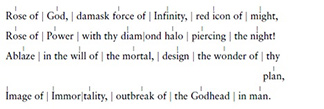
Rose of God, damask force of Infinity, red icon of might,

Rose of Power with thy diamond halo piercing the night!

Ablaze in the will of the mortal, design the wonder of thy plan,

Image of Immortality, outbreak of the Godhead in man.

Rose of God, smitten purple with the incarnate divine Desire,

Rose of Life, crowded with petals, colour’s lyre!

Transform the body of the mortal like a sweet and magical rhyme;

Bridge our earthhood and heavenhood, make deathless the children of Time.

Rose of God like a blush of rapture on Eternity’s face,

Rose of Love, ruby depth of all being, fire-passion of Grace!

Arise from the heart of the yearning that sobs in Nature’s abyss:

Make earth the home of the Wonderful and life Beatitude’s kiss.

https://incarnateword.in/cwsa/02/rose-of-god
7 responses to “Rose of God”

  1. RY Deshpande Avatar
    RY Deshpande

    Two questions have arisen in the mind in connection with Rose of God.

    (1) Does the rose of all flowers most perfectly and aptly express the divine ecstasies or has it not any symbolic allusion in the Veda or the Upanishad?

    There were no roses in those times in India—roses came in with the Mahomedans from Persia. The rose is usually taken by us as the symbol of surrender, love etc. But here it is not used in that sense, but as the most intense of all flowers it is used as symbolic of the divine intensities—Bliss, Light, Love etc.

    (2) Are the seven ecstasies referred to there the following: Bliss, Light, Power, Immortality, Life, Love and Grace?

    No, it is not seven kinds, but seven levels of Ananda that are meant by the seven ecstasies.

    2 January 1935

    https://incarnateword.in/cwsa/27/rose-of-god

    NB: These questions were put by Parichanda who was at that time incharge of the Ashram Gardens.

    Like

  2. RY Deshpande Avatar
    RY Deshpande

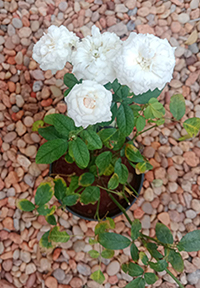
    These white roses are from my garden.

    Like

  3. Shreehari Marathe Avatar
    Shreehari Marathe

    Book 2 Canto 12 Section 2

    The Book of the Traveller of the Worlds

    The Heavens of the Ideal

    “On one side glimmered hue on floating hue,

    A glory of sunrise breaking on the soul,

    In a tremulous rapture of the heart’s insight

    And the spontaneous bliss that beauty gives,

    The lovely kingdoms of the deathless Rose.

    Above the spirit cased in mortal sense

    Are superconscious realms of heavenly peace,

    Below, the Inconscient’s sullen dim abyss,

    Between, behind our life, the deathless Rose.

    Like

  4. RY Deshpande Avatar
    RY Deshpande

    Rose of God is a lyric, an invocation. The metrical plan is—for the first two lines of the stanza, three parts with 2 main stresses in each, the first identical throughout, the other two variable at pleasure; for the last two lines, two parts of equal length, three stresses in each part.

    https://incarnateword.in/cwsa/27/the-genesis-of-thought-the-paraclete-and-rose-of-god

    Like

  5. RY Deshpande Avatar
    RY Deshpande

    Rose of God is written in pure stress metre. As stress and high accentual pitch usually coincide, it is possible to scan accentual metre on the stress principle and stress metre also can be so written that it can be scanned as accentual verse; but pure stress metre depends entirely on stress ictus. In ordinary poetry stress and natural syllabic quantity enter in as elements of the rhythm, but are not, qua stress and quantity, essential elements of the basic metre: in pure stress metre there is a reversal of these values; quantity and accentual inflexion are subordinate and help to build the rhythm, but stress alone determines the metrical basis. In “Rose of God” each line is composed of six stresses, and the whole poem is built of five stanzas, each containing four such lines; the arrangement of feet varies freely to suit the movement of thought and feeling in each line.

    https://incarnateword.in/cwsa/02/poems-note

    Like

  6. RY Deshpande Avatar
    RY Deshpande

    Rose of God. 29-30 December 1934. There is one handwritten and one typed manuscript of this poem. The typed manuscript is dated 31December 1934; however Sri Aurobindo wrote in a letter to a disciple that “Rose of God” was ready “on the 30th having been written on that and the previous day”. On 31 December, he wrote to his secretary that the just-typed “Rose of God” could be “circulated first as a sort of New Year invocation”. On 2 March 1935, his secretary wrote to him saying that the editor of a quarterly journal had asked for a poem to be published, and asking whether “Rose of God” could be sent. Sri Aurobindo replied: “I feel squeamish about publishing the Rose of God’ in a magazine or newspaper. It seems to me the wrong place altogether.”

    Note. This note did not form part of Poems (1941); it was first published in 1942 in Collected Poems and Plays.

    https://incarnateword.in/cwsa/02/part-seven-pondicherry-circa-1927-1947

    Like

  7. RY Deshpande Avatar
    RY Deshpande

    We have been wondering why you should have to write and rewrite your poetry—for instance Savitri—ten or twelve times.

    That is very simple. I used Savitri as a means of ascension. I began with it on a certain mental level, each time I could reach a higher level I rewrote from that level. Moreover I was particular—if part seemed to me to come from any lower level, I was not satisfied to leave it because it was good poetry. All had to be as far as possible of the same mint. In fact, Savitri has not been regarded by me as a poem to be written and finished, but as a field of experimentation to see how far poetry could be written from one’s own Yogic consciousness and how that could be made creative. I did not rewrite Rose of God or the Sonnets except for two or three verbal alterations made at the moment.

    29 March 1936

    https://incarnateword.in/cwsa/27/on-the-inspiration-and-writing-of-the-poem

    Like

Leave a comment