06: Scribbled Notes — The Demons wept with Joy
We are seeing the opening passage of the Book of Fate, Book Six of Savitri. Savitri has chosen in the distant Shalwa Woods Satyavan for her lover and husband and is returning with a joyous heart to speak of it to her parents in the Palace at Madra. But she also finds there already present with them the heavenly sage Narad from Paradise who is making a special visit in the context of her discovering Love which must also discover Death. While coming down from his home he sings five songs in the name of Vishnu the Sustainer of this creation. Here are these:
He sang the name of Vishnu and the birth
And joy and passion of the mystic world,
And how the stars were made and life began
And the mute regions stirred with the throb of a soul. ||106.8||
He sang the Inconscient and its secret self,
Its power omnipotent knowing not what it does,
All shaping without will or thought or sense,
Its blind unerring occult mystery,
And darkness yearning towards the eternal Light,
And Love that broods within the dim abyss
And waits the answer of the human heart,
And death that climbs immortality. ||106.9||
He sang of the Truth that cries from Night’s blind deeps,
And the Mother Wisdom hid in Nature’s breast
And the Idea that through her dumbness works
And the miracle of her transforming hands,
Of life that slumbers in the stone and sun
And mind subliminal in mindless life,
And the consciousness that wakes in beasts and men. ||106.10||
He sang of the glory and marvel still to be born,
Of the Godhead throwing off at last its veil,
Of bodies made divine and life made bliss,
Immortal sweetness clasping immortal might,
Heart sensing heart, thought looking straight at thought,
And the delight when every barrier falls,
And the transfiguration and the ecstasy. ||106.11||
And as he sang the demons wept with joy
Foreseeing the end of their long dreadful task
And the defeat for which they hoped in vain,
And glad release from their self-chosen doom
And return into the One from whom they came. ||106.12||
This is speedy and absolutely marvellous poetry, looks going even beyond the Mantra. The Mantra coming from Infinity and going to Infinity has always classical luminosity and density compacting the Infinite in the Word, radiance gathered in a diamond. The Agastyan Mantra is defined by his Rik in the Rig Veda:
एष वः स्तोमो मरुतो नमस्वान् हृदा तष्टो मनसा धायि देवाः ।
उपेमा यात मनसा जुषाणा यूयं हि ष्ठा नमस इद् वृधासः२॥
Lo, the hymn of your affirmation, O Maruts; it is fraught with my obeisance, it was framed by the heart, it was established by the mind, O ye gods. Approach these my words and embrace them with the mind; for of submission1 are you the increasers. [I:171:2]
But here we have the near and the far in a single joyous rush, they plunging into each other, escaping every attempt to seize in thought and sense and feeling. This Word carries an inspired and revealed vision with the intensity of intuitive poetic thought and expression, it born from a profound rhythm, chhanda, “metres that reflect the moving worlds”, cadence where seeing and hearing, sight and sound, and also sense, are unified acts. It is exalted lyricism full of Ananda Rasa, the sweetest and rapidest Essence of Delight.
Compare this passage with the following in which hermits and ascetics and seers, the spiritual seekers are engaged in mystic and revelatory pursuits away from the busy crowd with energy and excitement. The descriptions of these vānprasthis, the solitary forest-dwellers after living a rich life, is very felicitous and intimately warm yet not quite what we have in Narad’s songs:
A magic happiness flowed from their touch;
Oneness was sovereign in that sylvan peace,
The wild beast joined in friendship with its prey,
Persuading the hatred and the strife to cease
The love that flows from the one Mother’s breast
Healed with their hearts the hard and wounded world. ||99.44||
Others escaped from the confines of thought
To where Mind motionless sleeps waiting Light’s birth,
And came back quivering with a nameless Force
Drunk with a wine of lightning in their cells;
Intuitive knowledge leaping into speech,
Hearing the subtle voice that clothes the heavens,
Carrying the splendour that has lit the suns,
They sang Infinity’s names and deathless powers
In metres that reflect the moving worlds,
Sight’s sound-waves breaking from the soul’s great deeps. ||99.45||
See the last tremendous line. It has all heavy syllables, accented, except three, with three weighty spondees asserting the power of the metres that move the worlds.
According to Sri Aurobindo lyricism is as the “original and spontaneous creator of the poetic form,” emerging from the intensity of spiritualised emotion and deeper sight. It captures the “inevitable cadences of its joy or attraction”. It is a dense moment of heightened and profound experience. It transcends everyday intellectual, vital, or emotional force, reaching a “genuinely imaginative style” imbued and pervaded with beauty and vision and soul-power, fluorescent intuition characterised by a spiritual vision that finds “inspired and inevitable speech,” where all elements, thought, rhythm, and emotion, are transfigured to their highest capacity and gift. This is not merely a style but the essence of poetic expression, creating a profound spiritual Ananda, Bliss, that excels mere aesthetic pleasure, with the “deeper delight of the soul”. This divine Ananda is a reflection of the universal Soul’s joy in creation. Sri Aurobindo speaks of the “first fine careless rapture” of pure lyrical feeling reaching the “lyricism of the inmost spirit” beyond; it reveals the deeper truths of existence, reveals and materialises them. Such joyful spiritual lyricism is not merely an artistic endeavour, not that Art for the sake of Art, but for the sake of a profound act of creation, a profound creation itself.
This enchanting transformative lyrical sweetness, this felicitous intensity, appeal, the charm, the spell of Narad’s song has the power and imperativeness to awaken even in the most self-assertive self-centred creature the essentiality of his true innate self, his authentic being.
In the unbounded unrestrained utmost freedom that was allowed in the entire play, cosmic as well as transcendental where there is no ignorance, there were beings in the Overmental who thought themselves to be the masters and determiners of destiny and fate and fortune of the life and the mortal world. That is the great basis of the Story of Creation narrated by the Mother. But that was not without a purpose. It seems there was a necessity of a long “dreadful task” and they had in that efficacy of freedom lent themselves to perform it. This may appear as a strange logic to the mind of man but the occult is rich, most profound, densely packed for God’s good. He wanted an enemy to carry out a certain awfulness which he couldn’t. The source of that awfulness, of dreadfulness is the Inconscient which is also infinite, the more its abysses one tries to sound the more it stretches. But now time has come for that dreadfulness to end. That is the first fruit of the meeting of Satyavan and Savitri, the symbol and sign of the glory that is to be. The demons had been waiting for that to happen and are now glad that they can return to the One from they had come.
They in the triumph of freedom opt to return into the One. They have no intention to stay into manifestation and do the divine work, that which would have meant getting transformed. They are not in the evolutionary unfolding. They do not have the psychic being. They preferred to get absorbed into the Source. There were battles with the gods but they had remained unvanquished. In Durga Stotra of Sri Aurobindo we have this: “Mother, give to our heart and mind a titan’s strength, a titan’s energy, to our soul and intelligence a god’s character and knowledge.” The solicitation is for the titan’s strength. Isn’t that something remarkable? It be noted that in Greek mythology Titans were vanquished by the Olympians. “The Titanomachy was a ten-year war in Greek mythology between the elder Titans (led by Cronus) and the younger Olympian gods (led by Zeus). The Olympians, based on Mount Olympus, fought the Titans, based on Mount Othrys, to determine dominion over the cosmos. The Olympians were victorious after freeing the Cyclopes and Hecatonchires, ultimately imprisoning most Titans in Tartarus The Titanomachy was a ten-year war in Greek mythology between the elder Titans (led by Cronus) and the younger Olympian gods (led by Zeus). The Olympians, based on Mount Olympus, fought the Titans, based on Mount Othrys, to determine dominion over the cosmos. The Olympians were victorious after freeing the Cyclopes and Hecatonchires, ultimately imprisoning most Titans in Tartarus.” There is no question of these Grecian Titans returning into the One simply because the Greeks don’t know it.
But these demons who wept with joy seem to have still something in them, the totality of the various parameters and purposes in the operations of this creation. That is not only something great and admirable; it is because there is nothing which is otiose.
In the present case Savitri is the cause of their return into the One, into the Origin, Savitri having found love. That must also mean the end of Death. In that end they are happy to go back into the One. However, it is not the end of Death; it is his transfiguration. As long as Death is present there is bound to be present Falsehood; Death is the cause of Falsehood and not the other way round, Falsehood the cause of Death. With the transfiguration of Death goes away Falsehood. It was the Supreme who had put on the mask, the veil of Death and it is that veil or mask which has disappeared.
Death’s sombre cowl was cast from Nature’s brow;
There lightened on her the godhead’s lurking love. ||149.11||
All grace and glory and all divinity
Were here collected in a single form;
All worshipped eyes looked through his from one face;
He bore all godheads in his grandiose limbs. ||149.12||
An oceanic spirit dwelt within;
Intolerant and invincible in joy
A flood of freedom and transcendent bliss
Into immortal lines of beauty rose. ||149.13||
In him the Fourfold Being bore its crown, that mystery wearing a nameless Name.
In him the fourfold Being bore its crown
That wears the mystery of a nameless Name,
The universe writing its tremendous sense
In the inexhaustible meaning of a word. ||149.14||
16 March 2026
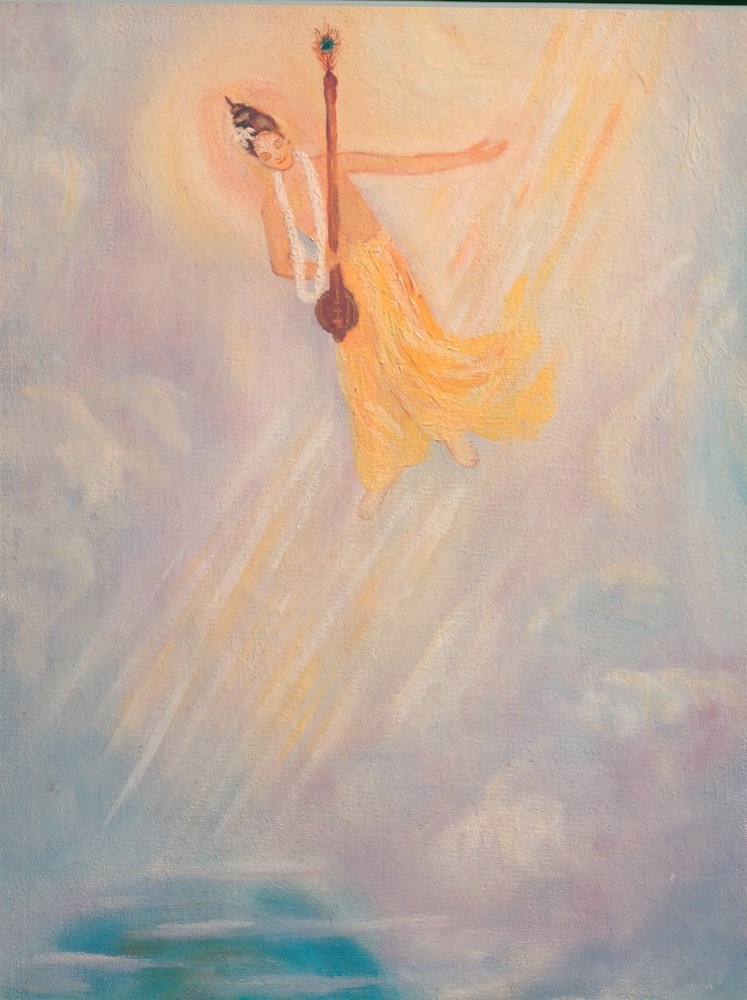
The featured image is a painting by Huta, showing the arrival of Narad.
Savitri Book 6 Canto 1 – The Word of Fate
In silent bounds bordering the mortal’s plane
Crossing a wide expanse of brilliant peace
Narad the heavenly sage from Paradise
Came chanting through the large and lustrous air. ||106.1||
In si|+lent bounds| bor+der+ing| the mor|+tal’s plane|
Cross+ing| a wide| ex+panse| of bril|+liant peace|
Na+rad| the heav|+en+ly sage| from Par|+a+dise|
Came chant|+ing through| the large| and lus|+trous air.|
 The Winds of Wonder
Leave a comment