The Aryan Pursuit of Immortality
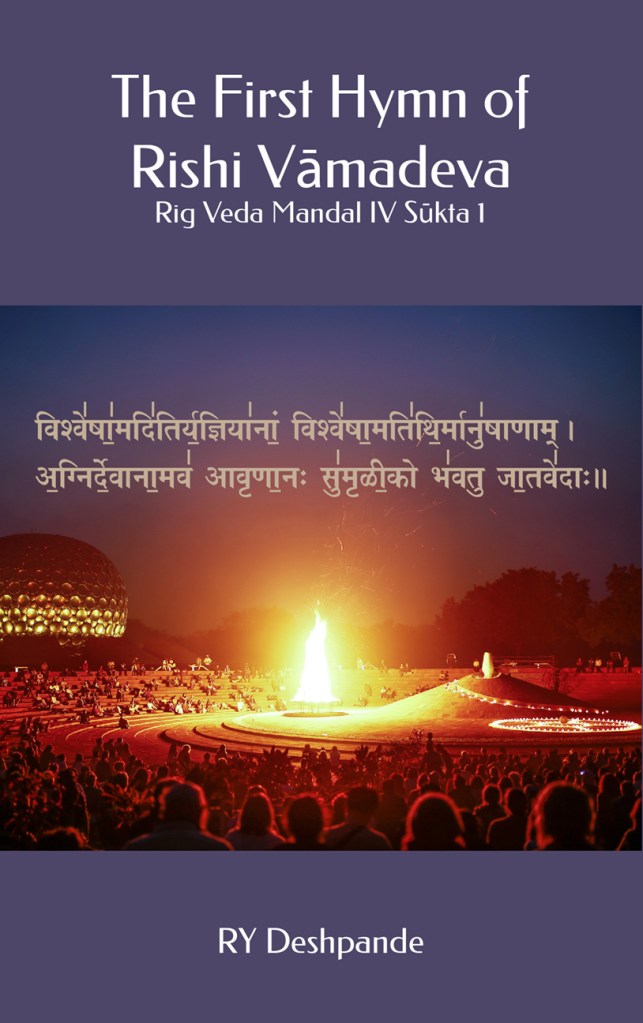
अग्निना रयिमश्नवत् पोषमेव दिवेदिवे ।
यज्ञसं वीरवत्तमम् ॥३॥
3) By the Flame one enjoys a treasure that verily increases day by day, glorious, most full of hero-power.
The divine who brings in the divinity
त्वां ह्य॑ग्ने॒ सद॒मित्स॑म॒न्यवो॑ दे॒वासो॑ दे॒वम॑र॒तिं न्ये॑रि॒र इति॒ क्रत्वा॑ न्येरि॒रे ।
अम॑र्त्यं यजत॒ मर्त्ये॒ष्वा दे॒वमादे॑वं जनत॒ प्रचे॑तसं॒ विश्व॒मादे॑वं जनत॒ प्रचे॑तसम् ॥ ४.००१.०१
1) Thee, O Fire, ever with one passion the gods have sent inwards, the divine Traveller; with the will they sent thee in; O master of sacrifice, they brought to birth the immortal in mortals, the divine who brings in the divinity, the conscious thinker, they brought to birth the universal who brings in the divinity, the conscious thinker.
What is the Aryan Path? The AI tells: The concept of the “Aryan Path” in Sri Aurobindo’s writings is deeply rooted in Vedic symbolism and spiritual philosophy. It represents a journey of self-transcendence, divine aspiration, and the pursuit of immortality through sacrifice, battle, and spiritual evolution. Below is a detailed explanation based on the texts:
1. Definition and Symbolism
- The Aryan Path is described as the journey of the Aryan soul, which is characterized by aspiration, sacrifice, and the pursuit of divine perfection. The Aryan is seen as a “traveller on the Path,” striving for immortality and divine light through continuous self-enlargement and self-transcendence [1 | Vol-15] [2 | Vol-15] .
- Aryaman, a Vedic deity, is closely associated with this path. He embodies the force of sacrifice, aspiration, and the journey towards perfection and celestial bliss. Aryaman is described as the deity of the unbroken path, guiding the human soul through its evolutionary progress [3 | Vol-15] [4 | Vol-15] .
2. The Path as a Sacrificial Journey
- The Aryan Path is depicted as a sacrificial journey, where the human soul offers itself to the divine powers. This sacrifice is not passive but involves active engagement in overcoming obstacles and battling the forces of darkness that obstruct spiritual progress [5 | Vol-15] [6 | Vol-15] .
- The journey is described as arduous yet joyful, involving climbing mountains, crossing rivers, and navigating the ocean of existence to reach the ultimate goal of light and infinity [7 | Vol-15] .
3. Battle Against Darkness
- The Aryan Path is also a battle against the Dasyus, symbolic of ignorance, evil, and obstruction. The Aryan soul must fight these forces to progress on the path of truth and light. This battle is both external and internal, requiring self-conquest and the overcoming of tamasic (inertia), rajasic (passion), and mental limitations [8 | Vol-15] [9 | Vol-15] .
4. Cultural and Ethical Dimensions
- The term “Arya” in its original Vedic context signifies a cultural and ethical ideal rather than a racial identity. It represents qualities such as nobility, courage, purity, and the aspiration for higher knowledge and truth. The Aryan Path thus embodies these ideals in its pursuit of spiritual and ethical perfection [10 | Vol-13] [11 | Vol-13] .
5. Sevenfold Energy and Evolution
- The journey on the Aryan Path involves a sevenfold energy of action, reflecting the sevenfold principle in human existence. This principle must be fulfilled in its integral perfection, leading to the highest summit of immortality [12 | Vol-15] .
6. Integration of Divine Forces
- The path integrates the attributes of Vedic deities like Mitra, Varuna, and Aryaman, who guide and protect the traveller. These deities symbolize light, harmony, knowledge, and power, essential for the journey’s success [13 | Vol-15] [14 | Vol-15] .
7. Aspiration and Divine Beatitude
- The ultimate goal of the Aryan Path is divine beatitude, the illimitable joy of truth and the infinity of being. This is brought into human consciousness by Bhaga, another Vedic deity, who represents the divine enjoyment of existence.
Conclusion
The Aryan Path, as articulated by Sri Aurobindo, is a profound spiritual journey that combines aspiration, sacrifice, battle, and self-transcendence. It is a path of light and truth, guided by divine forces and aimed at achieving immortality and divine perfection. This concept encapsulates the essence of Vedic spirituality and its vision of human evolution towards the divine.
According to Sri Aurobindo who is an Aryan?
Sri Aurobindo’s interpretation of the term “Aryan” transcends racial or ethnological definitions, focusing instead on cultural, ethical, spiritual, and psychological dimensions. Below is a detailed analysis based on his writings:
1. Cultural and Spiritual Identity
- In the Vedic context, Aryans are identified not by race but by their acceptance of a specific type of self-culture, inward and outward practices, ideality, and aspiration. The Aryan gods are described as supraphysical powers aiding mortals in their struggle toward divine nature. The term encapsulates the highest aspirations, religious temper, and idealistic thoughts of early humanity [1 | Vol-13] [2 | Vol-13] .
2. Ethical and Social Ideal
- In later times, “Arya” came to represent a comprehensive ethical and social ideal. This included qualities such as candor, nobility, courage, purity, compassion, and eagerness for knowledge. It was a combined ideal of the Brahmana and Kshatriya, embodying a well-governed life and high moral standards. Anything contrary to these ideals was termed “un-Aryan” [3 | Vol-13] [7 | Vol-15] .
3. Symbol of Striving and Overcoming
- Arya fundamentally signifies effort, uprising, and overcoming. The Aryan is portrayed as one who strives for self-conquest and transcends limitations of body, life, and mind. This involves seeking truth, right action, and freedom, aiming for self-perfection and divine expression in the world. The Aryan is a worker and warrior, laboring and fighting for the realization of divine principles [8 | Vol-14] [9 | Vol-15] .
4. Philological and Mythological Perspectives
- Sri Aurobindo critiques the racial interpretation of Aryan as a term for invaders or a distinct race. He argues that the Vedic terms “Arya” and “Anarya” likely refer to spiritual and moral distinctions rather than racial or cultural differences. He also challenges the philological assumptions that link Aryan identity to linguistic or racial classifications, emphasizing the spiritual and psychological significance of the term [10 | Vol-15] [12 | Vol-15] [13 | Vol-15] .
5. Connection to Light and Truth
- Aryans are associated with light and truth in the Vedic hymns. The “Aryan Light” contrasts with the “Dasa darkness,” symbolizing spiritual illumination and divine aspiration. The term “Arya Varna” (Aryan hue) metaphorically represents the brightness of truth and divine qualities [14 | Vol-15] [15 | Vol-15] .
6. Rejection of Racial Division
- Sri Aurobindo rejects the notion of a sharp racial division between Aryans and Dravidians, suggesting instead a unity of physical and cultural type across India. He critiques the idea of an Aryan invasion and emphasizes the interconnectedness of Aryan and Dravidian languages and cultures.
7. Symbolism in Vedic Struggles
- The opposition between Aryans and Dasyus in the Vedic hymns is interpreted as a symbolic struggle between forces of light and darkness, knowledge and ignorance, rather than a historical conflict between races or tribes.
Conclusion
Sri Aurobindo’s concept of the Aryan is deeply rooted in spiritual, ethical, and cultural ideals rather than racial or ethnological definitions. The Aryan represents a universal archetype of striving for higher truth, self-conquest, and divine realization, embodying nobility, courage, and aspiration toward the divine. This interpretation challenges and transcends conventional historical and philological theories.
Aryaman
Aryaman, third of the four great solar godheads, is the least prominent of them all in the invocations of the seers. No separate hymn is addressed to him and, if his name occurs not unfrequently, it is in scattered verses; there is no strong body of Riks from which we can construct firmly our idea of his functions or recompose his physiognomy. Most often he is simply invoked by his bare name along with Mitra and Varuna or in the larger group of the sons of Aditi, almost always in adjunction to other kindred deities. Still there are half a dozen or more half-riks from which his one chief and characteristic action emerges accompanied by the usual epithets of the Lords of the Truth, epithets expressive of Knowledge, Joy, Infinity and Power.
In the later tradition the name of Aryaman is placed at the head of the Fathers to whom as their appropriate offering is given the symbolic food, the piṇḍa of the Puranic funeral and memorial rites. In the Puranic traditions the Fathers are of two classes, divine and human, the latter being the ancestors, the Manes. But it is in connection with the Fathers as the souls who have attained to heaven, to immortality that we must think of Aryaman. Krishna in the Gita, enumerating the chief powers or manifestations of the eternal Godhead in things and beings, speaks of himself as Ushanas among the seers, Bhrigu among the Rishis, Vyasa among the sages, Vishnu among the children of Aditi, Aryaman among the Fathers. Now in the Veda the Fathers are the ancient illumined ones who discovered the Knowledge, created and followed the Path, reached the Truth, conquered Immortality; and in the few Riks in which Aryaman’s separate personality emerges, it is as the God of the Path that he is hymned.
His name Aryaman, kin etymologically to the words arya, ārya, ari, by which are distinguished the men or peoples who follow the Vedic culture and the Gods who assist them in their battles and their aspirations, is similarly indicative. The Aryan is the traveller on the Path, the aspirant to immortality by divine sacrifice, one of the shining children of Light, a worshipper of the Masters of the Truth, a fighter in the battle against the powers of darkness who obstruct the human journey. Aryaman is the godhead in whose divine power this Aryahood is rooted; he is this Force of sacrifice, aspiration, battle, journey towards perfection and light and celestial bliss by which the path is created, travelled, pursued beyond all resistance and obscuration to its luminous and happy goal.
In consequence, the action of Aryaman takes up the attributes of Mitra and Varuna as leaders of the Path. This Force fulfils the happy impulsions of that Light and Harmony and the movement of infinite knowledge and power of that pure Vastness. Like Mitra and Varuna he makes men travel on the path; he is full of the perfect happiness of Mitra; he is complete in the will and the works of sacrifice; he and Varuna distinguish the path for mortals. He is like Varuna a godhead manifold in his births; like him he oppresses the wrath of the hurter of men. It is by the great path of Aryaman that we shall cross beyond the souls of a false or evil thought who obstruct our path. Aditi, mother of the Kings, and Aryaman carry us by paths of a happy travelling beyond all inimical powers. The man who seeks the straightness of Mitra’s and Varuna’s workings and by the force of the word and the affirmation embraces their law with all his being, is guarded in his progress by Aryaman.
But the Rik most distinctive of the function of Aryaman is that which describes him as “Aryaman of the unbroken path, of the many chariots, who dwells as the sevenfold offerer of sacrifice in births of diverse forms.” He is the deity of the human journey who carries it forward in its irresistible progress which the attacks of the enemy cannot overcome or successfully interrupt so long as this divine Force is our leader. The journey is effected through a manifold movement of our evolution, the many chariots of Aryaman. It is the journey of the human sacrifice which has a sevenfold energy of its action because there is a sevenfold principle in our being which has to be fulfilled in its integral perfection; Aryaman is the master of the sacrificial action who offers this sevenfold working to the godheads of the Divine Birth. Aryaman within us develops our various forms of birth in the ascending planes of our existence by which the Fathers climbed, travellers on his path, and by which it must be the aspiration of the Aryan soul to climb, to the highest summit of Immortality.
Thus Aryaman sums up in himself the whole aspiration and movement of man in a continual self-enlargement and self-transcendence to his divine perfection. By his continuous movement on the unbroken path Mitra and Varuna and the sons of Aditi fulfil themselves in the human birth.
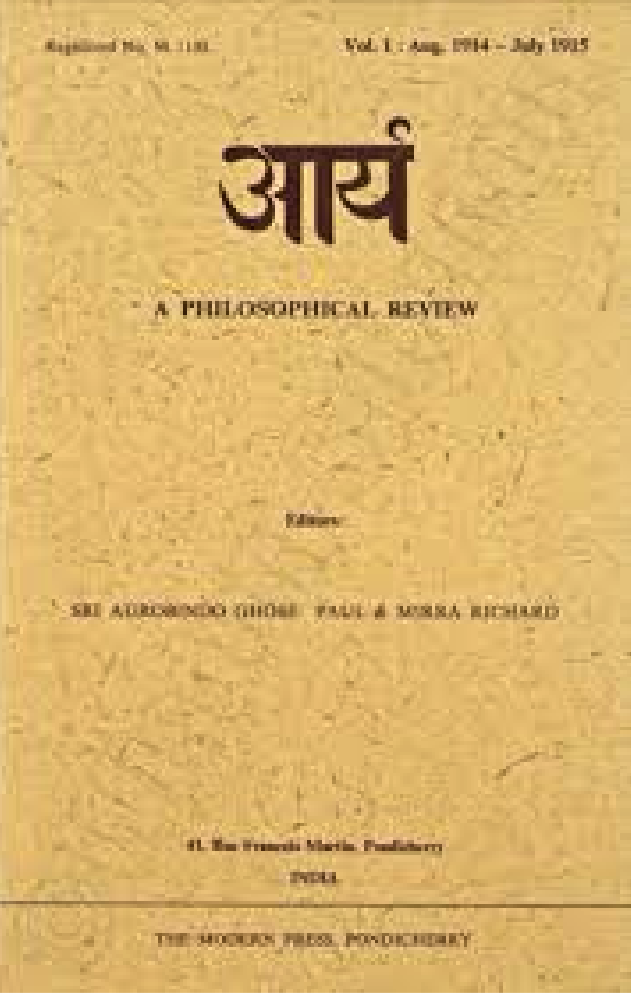
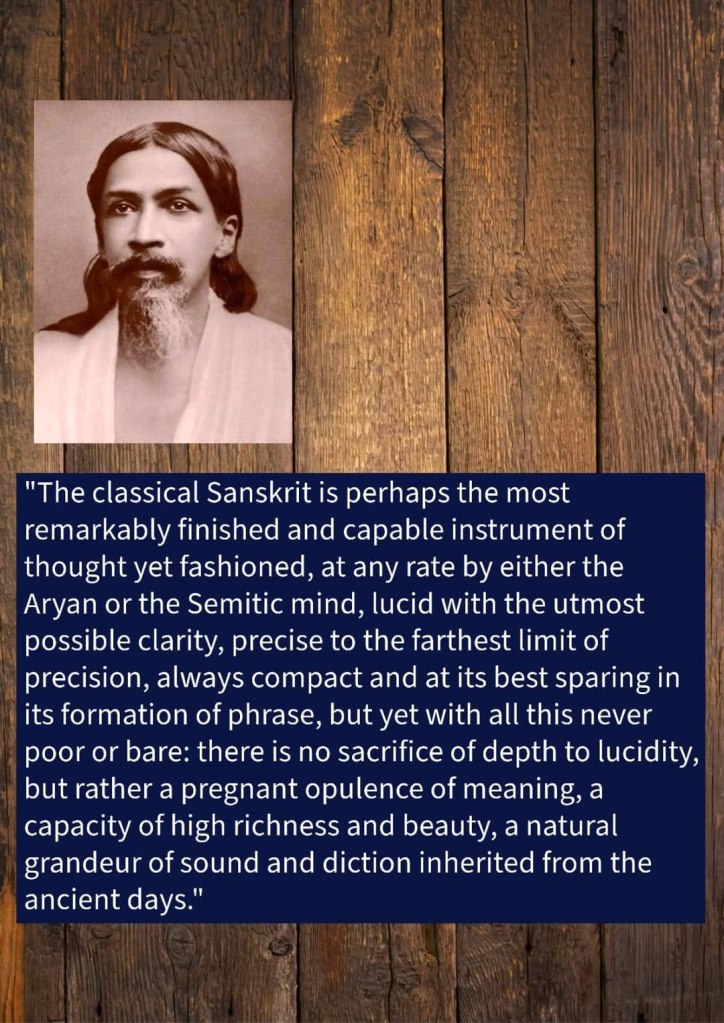
With the arrival of the Mother from Paris at Pondicherry on 29 March 1914 began the Work of Eternity in the epochal time. Its first manifestation is the beginning of a spiritual-philosophical Monthly, decided on 1 June 1914. The revie was named Arya and was launched on 15 August 1914. All the major prose writings of Sri Aurobindo had first appeared in this periodical, it opening the Agenda of the Future. The divine Aryan had, month after month for seven years, started revealing himself, the revelation assimilating and capitalising on the Past and in one golden solar leap jumping into the Future. Here is a photo of Sri Aurobindo of the time.

Sri Aurobindo in 1914 the year when the Arya was launched
 The Winds of Wonder
Leave a comment