Sri Aurobindo’s yoga presents itself …
Apropos of Auroville — A comment
“When I first met Sri Aurobindo in Pondicherry”
I am taking liberty to publish this insightful comment as an independent post itself.
Sri Aurobindo’s yoga presents itself as integral, synthetic, and ultimate in the sense that it seeks to integrate the paths of knowledge, devotion, action, psychic transformation, and even material transformation. It is a living, embodied, evolving, and complete method, aiming to transform all of human nature and manifest a divine life on this earth. “A marvelous idealism and a highly practical divinity dwelt within Sri Aurobindo,” said Sri Chinmoy in *India, My India*. His ambition was not specialization but totalization. He wanted to offer a framework capable of encompassing everything. A synthesis gathers what was scattered, it gives coherence and creates a common language. It can then itself become a form to be transcended because it has succeeded in its role as a bridge. Sri Aurobindo distinguishes himself by theorizing a historical and cosmic possibility for the transformation of the entire world. He posits an objective evolutionary plan linking matter, life, mind, and the supramental, within the very history of the cosmos. A yoga that aims to be integral can achieve this by rendering the very idea of integration superfluous. When the direct recognition of the evidence of Being/evidence of the Divine becomes operative, the question is no longer about combining paths, much less transcending them, but about SEEING what makes every path possible. “…only through surrender to the Divine can this be done.” Entering the path, as well as its completion, rests on the same inner gesture of dispossession and absolute trust. This raises a simple question: if the decisive act is surrender at the beginning and the end, then everything suggests performing it immediately, without waiting for the validation of a path. The system serves as support, clarification, or pedagogy, but it does not create the key it requires. Thus, surrender is not the final product but the timeless condition and the immediate actualization through what is present and necessary from the beginning. In other words, what was understood as “yoga that begins where others leave off” can be understood as one of the last great synthetic systems, and its extension is not an additional system, but a radical simplification, a direct return to the source. As Sri Aurobindo says: “The aim we pursue in our yoga is to enter into the Divine Presence and Consciousness and to be possessed by it… and to be, in our will, our works, and our life, the instrument of the Divine. To be in complete union with the Divine is the ultimate goal.” The explicit aim of pratyabhijñā (direct recognition) is also the recognition of oneself as this sovereign Consciousness: the Divine. This is neither holiness nor mere inner realization, but explicit identification with the Divine. The ultimate goal is indeed recognized divinization, not merely ascetic liberation. Dzogchen also formulates the ultimate goal as recognition of the already perfect primordial state (rigpa,(ye nas sangs rgyas), which corresponds to a divinization through recognized identity. The explicit doctrine of Eastern mystical Christianity is the deification of man AND the transfiguration of creation: Matter can be “energized” by grace. This is indeed a cosmology of the transfiguration of the world (cf. Gregory Palamas, Maximus the Confessor). Esoteric Taoism involves an internal and external alchemy, a refinement of cosmic energy where the world is a process of transformation toward the perfect purity/balance of the Dao. All these metaphysical analogies are philosophical convergences. “The change must be repeated in each consciousness to be truly effective,” Sri Aurobindo tells us. For Auroville, the question becomes pragmatic rather than doctrinal. Auroville was not conceived as a center for adherence to a method, but as a laboratory of consciousness and society. However, a laboratory functions better with a universalizable operational principle than with a highly elaborate metaphysical architecture. Direct recognition does not impose a hierarchy of planes or stages, it requires no expectation of future events, it operates immediately in daily experience; and it does not abolish metaphysics. This means that it can be a transversal language, whereas a particular yoga remains associated with a vocabulary or a cosmology. It is worth recalling that Aurobindo’s metaphysical architecture is largely in line with the great ontologies of ancient India. As such, it remains, for those who adhere to it or are interested in it, a fully valid frame of reference. These frameworks can continue to illuminate experience without their understanding being a prerequisite. In other words, metaphysics can remain a valuable map for some, while direct recognition operates even in the absence of any cartography. Aurobindo’s gesture was to liberate spirituality from religious and ascetic enclosure. The next step might be to free consciousness from the need for an evolutionary framework. Thus, what shifts is not the value or content of intuition, but its mode of expression. One could say: Integral Yoga sought to transform humanity to make the divine manifest within humanity and matter. Recognizing the obvious reveals that the divine is already manifest, and above all, as the very condition of all human experience. This is a recentering. We move from a historical/evolutionary driving force to a point of support and a timeless openness. Sri Aurobindo explicitly acknowledges the possibility of failure, serious obstacles, and blockages on the path to supramental realization if the being does not fully surrender and if its receptive nature does not open itself completely to the “descending force.” Supramental fulfillment is therefore not presented as a pre-guaranteed cosmic obligation: it depends on an extremely demanding and conditional process, which may fail if these conditions are not met. For a collective project like Auroville, a timeless point of reference offers a decisive advantage: it does not compete with other visions, it does not require exclusive adherence, and it does not create a temporal debt or a promise to be verified. It allows each person to operate immediately within their own experience, with the richness of all cultural and spiritual expressions. It is a decompression: integral yoga is the great breath of integration, recognition is the exhalation that gives air back to all. “Your body is the disguise of the Divine in your matter,” Mother said. Transformation arises as direct expression, and recognition acts as a subtle contagion. This idea of transmission is found in: “Prakāśasya prakāśena visphuraṇam.” Light intensifies with light. “Just as one lamp lights another without losing anything, so knowledge sets another in motion.” To realize oneself and to realize the world differently. “Śaktipātaḥ saṅkrāmati.” The descent of Power is transmitted. “Spiritual vibrations are contagious, that’s quite obvious…” says Mother. We can then see that the adventure proposed by Mother continues in the very spirit of her enthusiastic impulse: “Come what may!” This formula embodies a dimension that neither system nor teleology can contain: the trusting openness to reality as it unfolds. Mother: “…No spiritual responsibility: I have nothing to teach anyone, thank God!…(…)…I never told them they were my disciples: I told them they were my children—but, well, children, you don’t have to do everything they want!”Thus, knowledge sets another in motion.” To realize oneself and to realize the world differently. “Śaktipātaḥ saṅkrāmati.” The descent of Power is transmitted. “Spiritual vibrations are contagious, that’s quite obvious…” says Mother. We can then see that the adventure proposed by Mother continues in the very spirit of her enthusiastic impulse: “Come what may!” This formula embodies a dimension that neither system nor teleology can contain: the trusting openness to reality as it unfolds. Mother: “…No spiritual responsibility: I have nothing to teach anyone, thank God!…(…)…I never told them they were my disciples: I told them they were my children—but, well, children, you don’t have to do everything they want!” Thus, knowledge sets another in motion.” To realize oneself and to realize the world differently. “Śaktipātaḥ saṅkrāmati.” The descent of Power is transmitted. “Spiritual vibrations are contagious, that’s quite obvious…” says Mother. We can then see that the adventure proposed by Mother continues in the very spirit of her enthusiastic impulse: “Come what may!” This formula embodies a dimension that neither system nor teleology can contain: the trusting openness to reality as it unfolds. Mother: “…No spiritual responsibility: I have nothing to teach anyone, thank God!…(…)… I never told them they were my disciples: I told them they were my children—but, well, children, you don’t have to do everything they want!”
Agenda 04/1961.
Mother says that nothing has truly been accomplished in this area yet; the path must be invented, and there are no established benchmarks: “We don’t know where to begin—no one has ever done it!… Sri Aurobindo explains that it’s not impossible, but nothing more. And he himself hadn’t done it. For the smallest thing, the entire mechanism must be discovered…” Integration sets things in motion, recognition offers an immediate point of support, and this “Come what may!” keeps the flavor of adventure alive, free from any pressure to achieve a specific outcome. Thus, the challenge is no longer to ensure the success of a scenario, but to lucidly inhabit the unfolding of the world, whatever its rhythms and forms may be. Adventure is a creative availability: presence and participation; a conscious exploration that continues because it is free to unfold. As it always has been. And for those who might be tempted to find this too simple… (“…material consciousness is extremely ACCOMPANIED TO OBSTACLES, to difficulties, to ignorance…” says Mother. Well then, let’s try!…to renounce the obstacle.
Here is the original comment in French:
Syl
February 8, 2026
Le yoga de Sri Aurobindo se présente comme intégral, synthétique, ultime au sens où il cherche à intégrer les voies de connaissance, de dévotion, d’action, de transformation psychique et même de transformation matérielle. Une méthode vivante, incarnée, évolutive et complète, visant à transformer toute la nature humaine et à manifester une vie divine sur cette terre. “Un idéalisme-merveille et une divinité hautement pratique habitait Sri Aurobindo”, disait Sri Chinmoy dans India, my India. Son ambition n’est pas une spécialisation mais une totalisation. Il voulait proposer un cadre capable de tout contenir. Une synthèse rassemble ce qui était dispersé, elle donne une cohérence et crée un langage commun. Elle peut ensuite devenir elle-même une forme à dépasser parce qu’elle a réussi son rôle de pont. Sri Aurobindo se distingue en théorisant une possibilité historique et cosmique de transformation du monde entier. Il postule un plan évolutif objectif reliant matière, vie, mental et supramental, et ce dans l’histoire même du cosmos. Un yoga qui se veut intégral peut avoir pour accomplissement de rendre superflue l’idée même d’intégration. Lorsque la reconnaissance directe de l’évidence d’être/évidence du Divin devient opérante, la question n’est plus de combiner des voies et encore moins de les dépasser, mais de VOIR ce qui rend toute voie possible. “..seulement par abandon au Divin cela peut être fait.” L’entrée dans la voie comme son achèvement reposent sur le même geste intérieur de dépossession et de confiance absolue. Ce qui soulève une question simple : si l’acte décisif est l’abandon au commencement et à la fin, alors tout propose de l’opérer immédiatement, sans attendre la validation d’un parcours. Le système sert de soutien, de clarification ou de pédagogie, mais il ne crée pas la clé qu’il exige. Ainsi, l’abandon n’est pas le produit final mais la condition intemporelle et l’actualisation immédiate par ce qui est présent et nécessaire dès l’origine. Autrement dit, ce qui était compris comme “ yoga qui commence là où les autres s’arrêtent ” peut être compris comme l’un des derniers grands systèmes synthétiques, et son prolongement n’est pas un système supplémentaire, mais une simplification radicale, un retournement direct vers la source. Comme Sri Aurobindo le dit : “Le but que nous poursuivons dans notre yoga est de pénétrer dans la Présence et la Conscience divines et d’en être possédés … et d’être, dans notre volonté, nos œuvres et notre vie, l’instrument du Divin. Être en union complète avec le Divin est le but final.” Le but explicite de la pratyabhijñā (reconnaissance directe) est aussi la reconnaissance de soi comme cette Conscience souveraine: le Divin. Ce n’est ni sainteté ni simple réalisation intérieure, mais identification explicite au Divin. La finalité est bien la divinisation reconnue, non la seule libération ascétique. Le Dzogchen aussi formule la finalité comme reconnaissance de l’état primordial déjà parfait (rigpa, ye nas sangs rgyas), ce qui correspond à une divinisation par identité reconnue. La doctrine explicite du christianisme mystique oriental est la déification de l’homme ET la transfiguration de la création: La matière peut être «énergisée » par la grâce. Il s’agit bien d’une cosmologie de la transfiguration du monde (cf. Grégoire Palamas, Maxime le Confesseur). Le Taoïsme ésotérique relève d’une alchimie interne et externe, un raffinement de l’énergie cosmique où le monde est un processus de transformation vers la pureté/équilibre parfait du Dao. Toutes ces analogies métaphysiques sont des convergences philosophiques. “Le changement doit être répété dans chaque conscience pour être réellement efficace.” Nous dit Sri Aurobindo. Pour Auroville, la question devient pragmatique plutôt que doctrinale. Auroville n’était pas conçu comme un centre d’adhésion à une méthode, mais comme un laboratoire de conscience et de société. Or un laboratoire fonctionne mieux avec un principe opératoire universalisable qu’avec une architecture métaphysique très élaborée. La reconnaissance directe n’impose pas de hiérarchie de plans ou de stades, elle n’exige aucune attente d’événement futur, elle opère immédiatement dans l’expérience quotidienne; et elle n’abolit pas les métaphysiques. Cela signifie qu’elle peut être un langage transversal, là où un yoga particulier demeure associé à un vocabulaire ou une cosmologie. Il convient de rappeler que l’architecture métaphysique d’Aurobindo s’inscrit largement dans la continuité des grandes ontologies de l’Inde ancienne. À ce titre, elle demeure pour ceux qui y adhèrent ou qui s’y intéressent, une base de référence pleinement valable. Ces cadres peuvent continuer d’éclairer l’expérience sans que leur compréhension en soit une condition préalable. Autrement dit, la métaphysique peut rester une carte précieuse pour certains, tandis que la reconnaissance directe opère même en l’absence de toute cartographie. Le geste d’Aurobindo était de libérer la spiritualité de la clôture religieuse et ascétique. Le mouvement suivant peut être de libérer la conscience de la nécessité d’un cadre évolutif. Ainsi, ce qui se déplace n’est pas la valeur ou la teneur de l’intuition, mais son mode d’expression. On pourrait dire : Le yoga intégral cherchait à transformer l’humain pour rendre manifeste le divin dans l’humain et dans la matière. La reconnaissance de l’évidence révèle que le divin se manifeste déjà, et avant tout comme condition même de toute expérience humaine. Il s’agit d’un recentrement. On passe d’un moteur historique/évolutif à un point d’appui et une ouverture intemporelle. Sri Aurobindo reconnaît explicitement la possibilité d’échec, d’obstacles graves et de blocages dans le chemin vers la réalisation supramentale si l’être ne s’abandonne pas pleinement et si sa nature réceptive ne s’ouvre pas intégralement à la “force descendante”. L’accomplissement supramental n’est donc pas présenté comme une obligation cosmique garantie d’avance : il dépend d’un processus extrêmement exigeant et conditionné, qui peut ne pas réussir si ces conditions ne sont pas remplies. Pour un projet collectif comme Auroville, un point d’appui intemporel présente un avantage décisif : il n’entre pas en concurrence avec d’autres visions, il n’exige pas d’adhésion exclusive et il ne produit pas de dette temporelle ni de promesse à vérifier. Il permet à chacun d’opérer immédiatement dans sa propre expérience, avec la richesse de toutes les expressions culturelles et spirituelles. C’est une décompression : le yoga intégral est la grande respiration d’intégration, la reconnaissance est l’expiration qui rend l’air à tous. “Ton corps c’est le déguisement du Divin dans ta matière” disait Mère. La transformation surgit comme expression directe et la reconnaissance agit comme une contagion subtile. Cette idée de transmission se retrouve dans: “Prakāśasya prakāśena visphuraṇam.” La lumière s’intensifie par la lumière. “De même qu’une lampe en allume une autre sans rien perdre, ainsi la connaissance en met une autre en mouvement.” Pour se réaliser et réaliser le monde autrement. “Śaktipātaḥ saṅkrāmati.” La descente de la Puissance se transmet. “Les vibrations spirituelles sont contagieuses, c’est tout à fait évident …” dit Mère. On peut alors voir que l’aventure proposée par Mère se prolonge dans l’esprit même de son élan enthousiaste : « Et advienne que pourra ! ». Cette formule incarne une dimension que ni système ni téléologie ne peuvent enfermer : l’ouverture confiante au réel tel qu’il se déploie. Mère : “..Pas de responsabilité spirituelle: je n’ai rien à enseigner à personne, Dieu merci !..(..)…je ne leur ai jamais dit qu’ils étaient mes disciples: je leur ai dit qu’ils étaient mes enfants – mais enfin, les enfants, on n’a pas besoin de faire tout ce qu’ils veulent !”
Agenda 04/1961.
Mère dit que rien n’a encore été réellement accompli dans ce domaine, on doit inventer la voie, et il n’y a aucun repère établi : “On ne sait pas par quel bout le prendre — personne ne l’a jamais fait ! .. Sri Aurobindo explique que ce n’est pas impossible, mais rien de plus. Et lui-même ne l’avait pas fait. Pour la moindre petite chose, tout le mécanisme doit être découvert… » L’intégration met en mouvement, la reconnaissance offre un point d’appui immédiat, et ce « Advienne que pourra ! » maintient la saveur d’aventure vivante, libérée de toute tension de résultat. Ainsi l’enjeu n’est plus d’assurer la réussite d’un scénario, mais d’habiter lucidement le déploiement du monde, quels qu’en soient les rythmes et les formes. L’aventure est une disponibilité créatrice : présence et participation; une exploration consciente qui continue parce qu’elle est libre de se déployer. Comme elle l’a toujours été. Et pour ceux qui seraient tentés de trouver ça trop simple…(“..la conscience matérielle est extrêmement HABITUÉE À L’OBSTACLE, à la difficulté, à l’ignorance..” dit Mère. Et bien essayons donc !…de renoncer à l’obstacle.
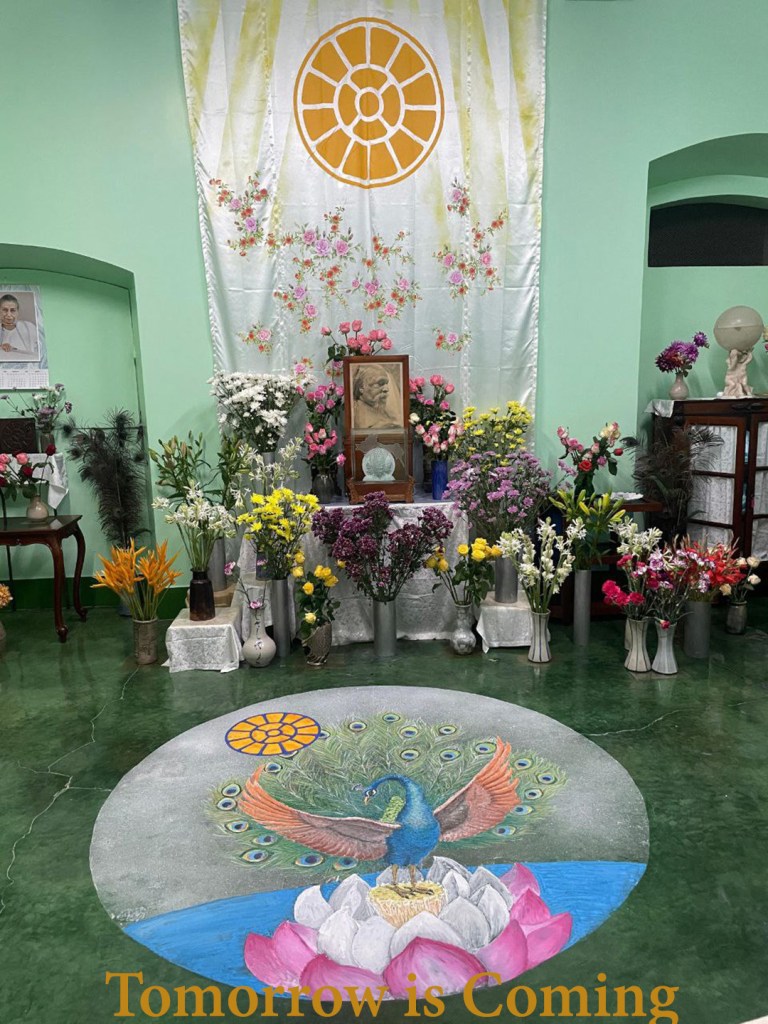
Celebration of the Mother’s Birthday at Playground in Sri Aurobindo Ashram, in her Room there.
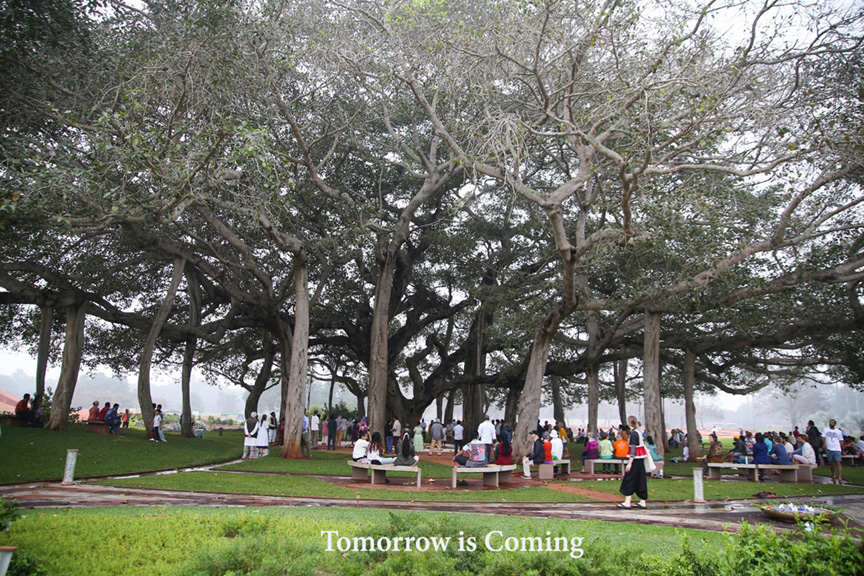
The following is Celebration in Auroville:
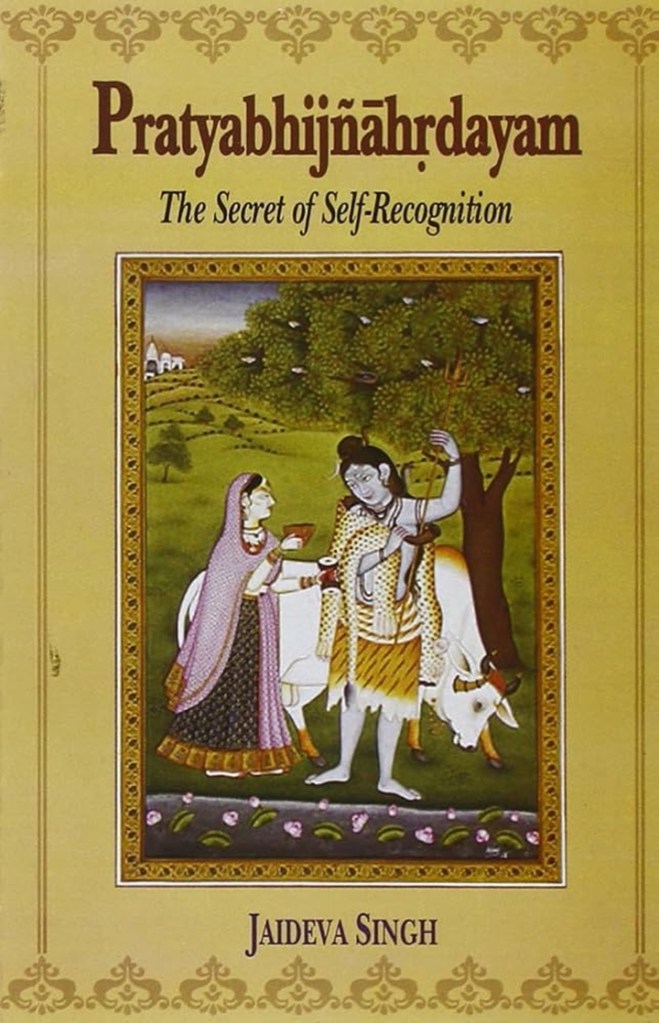
Self-Recognition
 The Winds of Wonder
Leave a comment