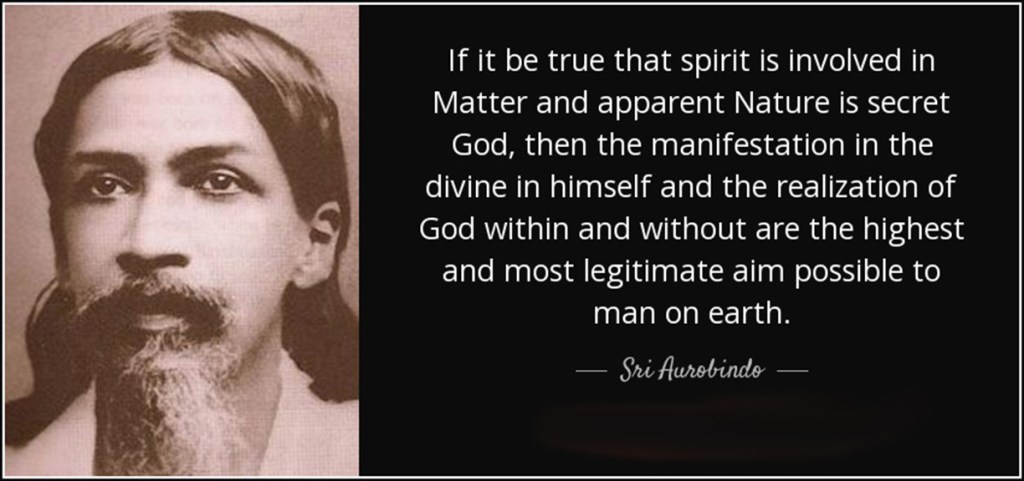
Apropos of Two Vast Negations — 23
The Refusal of the Ascetic
All this is the Brahman; this Self is the Brahman and the Self is fourfold.
Beyond relation, featureless, unthinkable, in which all is still.
Mandukya Upanishad. (Verses 7)
And still there is a beyond.
For on the other side of the cosmic consciousness there is, attainable to us, a consciousness yet more transcendent… . If the materialist is justified from his point of view in insisting on Matter as reality … so also is the Sannyasin, enamoured of that Beyond, justified from his point of view in insisting on pure Spirit as the reality… . Even in the world of Matter there are existences of which the physical senses are incapable of taking cognisance. Yet the denial of the suprasensible as necessarily an illusion or a hallucination depends on this constant sensuous association of the real with the materially perceptible, which is itself a hallucination.
Not only are there physical realities which are suprasensible, but, if evidence and experience are at all a test of truth, there are also senses which are supraphysical1 and can not only take cognisance of the realities of the material world without the aid of the corporeal sense-organs, but can bring us into contact with other realities, supraphysical and belonging to another world—included, that is to say, in an organisation of conscious experiences that are dependent on some other principle than the gross Matter of which our suns and earths seem to be made.
Constantly asserted by human experience and belief since the origins of thought, this truth, now that the necessity of an exclusive preoccupation with the secrets of the material world no longer exists, begins to be justified by new-born forms of scientific research. The increasing evidences, of which only the most obvious and outward are established under the name of telepathy with its cognate phenomena, cannot long be resisted except by minds shut up in the brilliant shell of the past, by intellects limited in spite of their acuteness through the limitation of their field of experience and inquiry, or by those who confuse enlightenment and reason with the faithful repetition of the formulas left to us from a bygone century and the jealous conservation of dead or dying intellectual dogmas. …
The extension of our consciousness, to be satisfying, must necessarily be an inner enlargement from the individual into the cosmic existence. … Entering into that Consciousness, we may continue to dwell, like It, upon universal existence. Then we become aware … of Matter as one existence and of bodies as its formations in which the one existence separates itself physically in the single body from itself in all others and again by physical means establishes communication between these multitudinous points of its being. …
Real then to the man who has had contact with it or lives in it, is this cosmic consciousness, with a greater than the physical reality; real in itself, real in its effects and works. … The world is real precisely because it exists only in consciousness; for it is a Conscious Energy one with Being that creates it. It is the existence of material form in its own right apart from the self-illumined energy which assumes the form, that would be a contradiction of the truth of things, a phantasmagoria, a nightmare, an impossible falsehood. …
We seek indeed a larger and completer affirmation. We perceive that in the Indian ascetic ideal the great Vedantic formula, “One without a second”, has not been read sufficiently in the light of that other formula equally imperative, “All this is the Brahman”. The passionate aspiration of man upward to the Divine has not been sufficiently related to the descending movement of the Divine leaning downward to embrace eternally Its manifestation. Its meaning in Matter has not been so well understood as Its truth in the Spirit. The Reality which the Sannyasin seeks has been grasped in its full height, but not, as by the ancient Vedantins, in its full extent and comprehensiveness. But in our completer affirmation we must not minimise the part of the pure spiritual impulse. As we have seen how greatly Materialism has served the ends of the Divine, so we must acknowledge the still greater service rendered by Asceticism to Life. We shall preserve the truths of material Science and its real utilities in the final harmony, even if many or even if all of its existing forms have to be broken or left aside. An even greater scruple of right preservation must guide us in our dealing with the legacy, however actually diminished or depreciated, of the Aryan past.
The Opposition of Matter to Spirit
But still there is this conceptive difference and practical distinction, and in that, even if Matter is not really cut off from Spirit, yet it seems with such a practical definiteness to be so cut off, it is so different, even so contrary in its law, the material life seems so much to be the negation of all spiritual existence that its rejection might well appear to be the one short cut out of the difficulty,—as undoubtedly it is; but a short cut or any cut is no solution. Still, there, in Matter undoubtedly lies the crux; that raises the obstacle: for because of Matter Life is gross and limited and stricken with death and pain, because of Matter Mind is more than half blind, its wings clipped, its feet tied to a narrow perch and held back from the vastness and freedom above of which it is conscious. Therefore the exclusive spiritual seeker is justified from his view-point if, disgusted with the mud of Matter, revolted by the animal grossness of Life or impatient of the self-imprisoned narrowness and downward vision of Mind, he determines to break from it all and return by inaction and silence to the Spirit’s immobile liberty. But that is not the sole view-point, nor, because it has been sublimely held or glorified by shining and golden examples, need we consider it the integral and ultimate wisdom. Rather, liberating ourselves from all passion and revolt, let us see what this divine order of the universe means, and, as for this great knot and tangle of Matter denying the Spirit, let us seek to find out and separate its strands so as to loosen it by a solution and not cut through it by a violence. We must state the difficulty, the opposition first, entirely, trenchantly, with exaggeration, if need be, rather than with diminution, and then look for the issue.
Matter as the Culmination of Ignorance
First, then, the fundamental opposition Matter presents to Spirit is this that it is the culmination of the principle of Ignorance. Here Consciousness has lost and forgotten itself in a form of its works, as a man might forget in extreme absorption not only who he is but that he is at all and become momentarily only the work that is being done and the force that is doing it. The Spirit self-luminous, infinitely aware of itself behind all workings of force and their master, seems here to have disappeared and not to be at all; somewhere He is perhaps, but here He seems to have left only a brute and inconscient material Force which creates and destroys eternally without knowing itself or what it creates or why it creates at all or why it destroys what once it has created: it does not know, for it has no mind; it does not care, for it has no heart. And if that is not the real truth even of the material universe, if behind all this false phenomenon there is a Mind, a Will and something greater than Mind or mental Will, yet it is this dark semblance that the material universe itself presents as a truth to the consciousness which emerges in it out of its night; and if it be no truth but a lie, yet is it a most effective lie, for it determines the conditions of our phenomenal existence and besieges all our aspiration and effort.
The Spirit shall look out through Matter’s gaze
And Matter shall reveal the Spirit’s face.
Then man and superman shall be at one
And all the earth become a single life.
Sri Aurobindo – Savitri: CWSA, Vol. 34, Book Eleven, p. 709
Spirit is the crown of universal existence; Matter is its basis; Mind is the link between the two. Spirit is that which is eternal; Mind and Matter are its workings. Spirit is that which is concealed and has to be revealed; mind and body are the means by which it seeks to reveal itself. Spirit is the image of the Lord of the Yoga; mind and body are the means He has provided for reproducing that image in phenomenal existence.
Sri Aurobindo – The Synthesis of Yoga: CWSA, Vol. 23, p. 29
“In the world, people generally classify themselves as materialists who believe in nothing but matter, or as spiritualists who reject matter in order to lean on the spirit alone.
“Sri Aurobindo is neither a materialist nor a spiritualist. He admits both, but wants a matter transformed, divinized by the spirit, capable of expressing the truth instead of constantly denying it.”
The Mother – Agenda, Vol. 10, p. 218
I think one of the greatest difficulties in understanding things comes from an arbitrary simplification which puts spirit on one side and matter on the other. It is this foolishness that makes you incapable of understanding anything….The universe is a seemingly infinite gradation of worlds and states of consciousness, and in this increasingly subtle gradation, where does your matter come to an end? Where does your spirit begin?….
….
For the human consciousness as it is, there are certainly infinitely more invisible things than visible things. What you know, the things which are visible to you and which you are conscious of—it’s almost like the skin of an orange compared with the orange itself―and even an orange with a very thin skin, not a thick one! And so, if you know only the skin of the orange, you know nothing about the orange.
And this is more or less what happens. All that you know about the universe is just a superficial little crust―and even this you hardly know. But that is all you know about it, and all the rest escapes you.
The Mother – Questions and Answers : CWM, Vol. 8, pp. 86-87
 The Winds of Wonder
Leave a comment