
The Word
The Word was broken up into four quarters,
And the articulate voice flowed in the streams,
And the seeing sound pierced the hill of substance,
And Agni took Speech for his glowing bride.
Therefore the tongues of fire eat the honey-food.
Then in a vast of silence where no thought moves
Was felt the first stress, the primal urge to be,
And the Ineffable burst in a song of creation,
As if in dense spaces of spiritual light
Exploded the supernova, a golden mass of joy.
The Word was spoken and the Vedas were born,
And the seeds sprang up in richnesses of the earth,
And dissolved in waters it became the fish,
And borne by the breath it filled the mid-region.
The upward trajectory of the loud hymn took wings
And again the Word reached the unseen sky of delight.
Then mounted the flames of sacrifice to Heaven
And All-Grace leaned down in body of the Word.
This is an early poem of mine written some fifty years ago, published in The Rhododendron Valley, 1985, my first book.
About Word here is a powerful and profoundly mystical revelation from St John: “In the beginning was the Word, and the Word was with God, and the Word was God.”
It is from it that the words of poetry should come, they have to come from the Word. The Word has in it simultaneously present all the three —sense and sound and sight, logopoeia, melopoeia, phanopoeia, to use Ezra Pound’s distinctions as three aspects of poetry. But they have to be present together, simultaneously, and not one or the other. That is what a poetic Mantra would mean, coming from the Overmind Plane. And that is precisely what we have in Sri Aurobindo’s epic Savitri, his magnum opus.
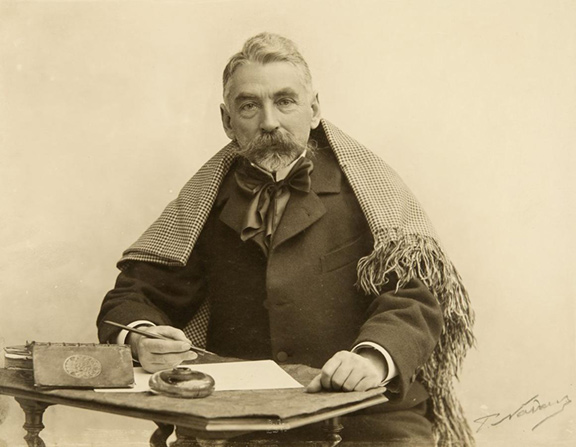
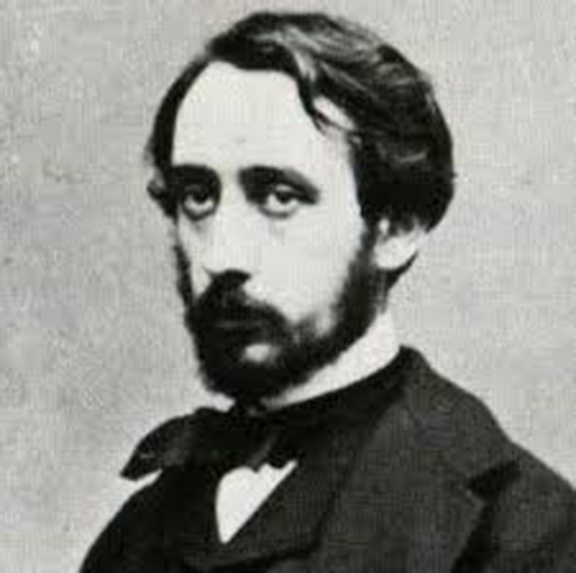
There is an enormous truth in what Stéphane Mallarmé had told Edgar Degas. Degas had great ideas about painting but he had remained unsatisfied. Giving the example of poetry Mallarmé told him: “Poems are made of words, not ideas!” It is in the same way as paintings come not with ideas but with strokes. Paintings are made not of imaginations but strokes. It is not ideas, thoughts howsoever deep and noble and striking these might be will give a poem to the creator. There has to be the rhythm and there has to be power of the vision.
Mallarmé
Degas
A Painting by Degas
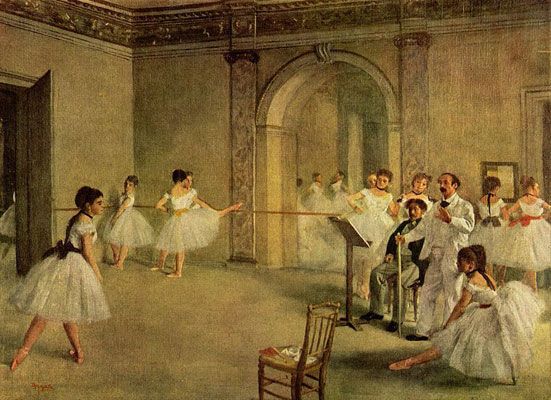
Foyer de la Danse
There is something unique and alluring in all of Degas’s studies of ballerinas, of which there are many. In Foyer de la Danse he presents us with one of the unconventional perspectives that are so typical and distinctive in his work. Rather than evoke the light and atmosphere of the scene, as some of his Impressionist peers might have done, Degas has chosen to create a striking arrangement of space, one which echoes the experiences his contemporaries might have had throughout the new modern city. To achieve this, rather than compose the figures in a more orderly and centered fashion, he has dispersed them about the canvas, leaving a chair incongruously placed in the center foreground. Instead of viewing the room as a traditional box-like container for the figures, he paints it at an angle, suggesting multiple vantage points, almost as if this were an early blueprint for Cubism. The approach is characteristic of his modern, realist approach to composition.
[From the Internet]
 The Winds of Wonder
Leave a comment