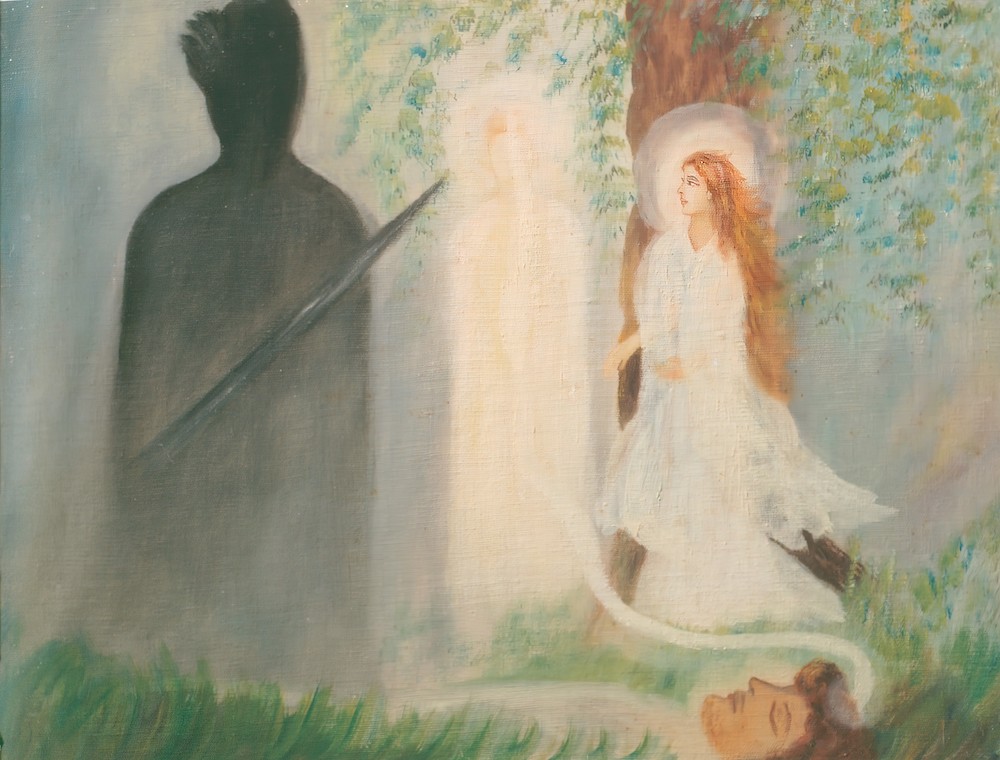
Luminous Satyavan
There are three passages in Savitri, speaking of luminous Satyavan:
Then Death, the king, leaned boundless down, as leans
Night over tired lands when evening pales
And fading gleams break down the horizon’s walls,
Nor yet the dusk grows mystic with the moon. ||135.24||
The dim and awful godhead rose erect
From his brief stooping to his touch on earth,
And like a dream that wakes out of a dream,
Forsaking the poor mould of that dead clay,
Another luminous Satyavan arose,
Starting upright from the recumbent earth
As if someone over viewless borders stepped
Emerging on the edge of unseen worlds. ||135.25||
In the earth’s day the silent marvel stood
Between the mortal woman and the god. ||135.26||
Such seemed he as if one departed came
Wearing the light of a celestial shape
Splendidly alien to the mortal air. ||135.27||
Turning arrested luminous Satyavan
Looked back with his wonderful eyes at Savitri. ||136.25||
There was none with her in the dreadful Vast:
She saw no more the vague tremendous god,
Her eyes had lost their luminous Satyavan. ||137.18||
Yet not for this her spirit failed, but held
More deeply than the bounded senses can
Which grasp externally and find to lose
Its object loved. So when on earth they lived
She had felt him straying through the glades, the glades
A scene in her, its clefts her being’s vistas
Opening their secrets to his search and joy,
Because to jealous sweetness in her heart
Whatever happy space his cherished feet
Preferred, must be at once her soul embracing
His body, passioning dumbly to his tread. ||137.19||
Let us first scan the one having this line: “Another luminous Satyavan arose”.
The dim| and aw|+ful god|+head rose| e+rect|
From his| brief stoop|+ing to| his touch| on earth,|
And like| a dream| that wakes| out of| a dream,|
For+sak|+ing the| poor mould| of that| dead clay,|
An+oth|+er lu|+mi+nous Sat|+ya+van| arose,|
Start+ing| up+right| from the| re+cum|+bent earth|
As if some|+one o|+ver view|+less bor|+ders stepped|
E+merg|+ing on| the edge| of un|+seen worlds.| 135.25
Metrically this is quite straightforward, but the occult is profound. The beauty is, it is Death who is actually revealing this luminous Satyavan. The mortal earthly body had covered it and when that sheath was removed what stood out was the radiant spirit in its splendour and in its dazzling reality. It is only a Seer-Poet who can give us such a greatness of the bright hidden in the gross physical. This occult of Death is supremely marvellous.
We have two instances of such a post-death wonder in Valmiki’s Rāmāyaṇa, in the Araṇyakāṇda, The Book of the Forest, Dandaka, Book Three. The first is an episode related to Rishi Śarabhanga. His intense tapasyā had earned him the favour of going, after casting the physical body, straight to Brahmaloka, the World of Brahma. Indra himself had come in his chariot to take him over there. But the Sage declined it, telling him that soon Rama the supreme Incarnate himself, would be there in his hermitage; that was his beautiful last wish, to leave the body in that benedictive physical presence. Shortly, then, in the presence of Rama the great souled lit a fire and entered into it:
ततो अग्निम् सु समाधाय हुत्वा च आज्येन मंत्रवित् |
शरभंगो महातेजाः प्रविवेश हुताशनम् || ३-५-३९
तस्य रोमाणि केशाम् च तदा वह्निः महात्मनः |
जीर्णम् त्वचम् तद् अस्थीनि यत् च मांसम् च शोणितम् || ३-५-४०
स च पावक संकाशः कुमारः समपद्यत |
उत्थाय अग्निचयात् तस्मात् शरभंगो व्यरोचत || ३-५-४१
स लोकान् आहिताग्नीनाम् ऋषीणाम् च महात्मनाम् |
देवानाम् च व्यतिक्रंय ब्रह्म लोकम् व्यरोहत || ३-५-४२
Making the fire-offerings he of great lustre Śarabhanga entered the kindled fire. First the flames burnt the hair on the body and the head, also the blood and the flesh. Out of the roaring tongues Śarabhanga reappeared as a handsome youngster, luminous, like the fire itself. Transcending the celestial worlds, the worlds of the Fire-worshippers, of saints, and of divinities, Śarabhanga ascended to the world of Brahma.
In the same Book we have a similar instance of Śabarī. This is at Pampa Lake where were the hermitages of sages, such as Rishi Mātanga. She had served the masters with spiritual work and devotion. But then when they left for the heavenly abode she was told by the Rishi to look after the place and serve Rama when he would be visiting it. She was delighted, and offered the divine hosts the fruits of the forest. She was now free to cast off this mortal body in the presence of the Divine.
ज्वलत् पावक संकाशा स्वर्गम् एव जगाम सा |
दिव्यम् आभरण संयुक्ता दिव्य माल्य अनुलेपना || ३-७४-३३
दिव्य अंबर धरा तत्र बभूव प्रिय दर्शन |
विराजयन्ती तम् देशम् विद्युत् सौदामिनी यथा || ३-७४-३४
यत्र ते सुकृत आत्मानो विहरन्ति महर्षयः |
तत् पुण्यम् शबरी स्थानम् जगाम आत्म समाधिना || ३-७४-३५
“She offered herself as an oblation into ritual-fire, and then like a flaring fire, she went to heaven alone. Now she appeared as an angle bejewelled with angelic ornaments, wearing angle’s wraparound and angelical flowery tassels, and bedaubed with suchlike cosmetics, and as with the scintillations of electric sparks she scintillated that province. Śabarī who is a perfect yogin with perfected meditative concentration, now went to that sanctum locus where the blest souls of those sublime sages, namely her masters, saunter.”
Whereas in the Rāmāyaṇa narratives the luminous spirits arise after the fire-offerings, the physical no more existing, in Savitri the dead body of Satyavan is still there under the kingly trunk, in the physical lap of Savitri. It is the power of Savitri that holds it unaffected, it to be ready for the life to be divine in a divine body.
The featured image is a painting by Huta, IX:1 #6
 The Winds of Wonder
Leave a comment