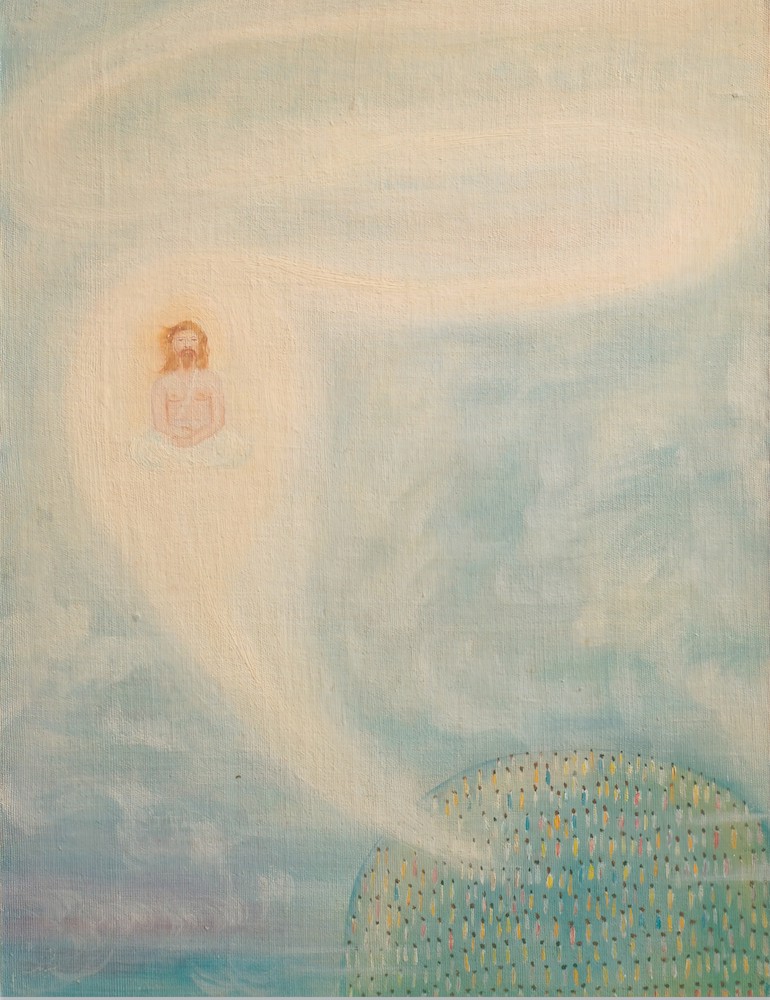
The vast business of created things
Savitri Book 3 Canto 4 – The Vision and the Boon
His soul drew back into the speed of noise
Of the vast business of created things. ||92.8||
The featured painting is by Huta, III:4 # 6
Part-1
Aswapati make a compelling prayer to the creatrix supreme Mother pleading for her mortal birth to resolve the issue of mortality, of death who is standing across the path of the divine manifestation upon the earth. The prayer is granted and they depart to their respective abodes.
Across the light of fast-receding planes
That fled from him as from a falling star
Compelled to fill his human house in Time
His soul drew back into the speed and noise
Of the vast business of created things. ||92.8||
The meeting is over. The minutes have been drafted and passed. The operative clause is the divine Goddess will send a living form of hers to the mortal world. In her coming Fate shall be changed, changed by an unchanging Will. This will happen in Death’s tremendous hour.
That is the text. But in the execution of it there have to enter in the human aspects, human processes as well, human instrumentations, as things have to happen in the human world. It is that human process which will make it contextual, make it relevant, true and substantial, significant to mortality, its functioning participative and meaningful for the human advancement on the spirit-ward path, accepting or exploiting all that the present Nature is offering.
This birth of hers, mortal birth of the Divine Mother, will happen, this birth has to happen only through the available process of Nature, the process as is operational at present, only through it and not through any other occult mechanism, — if at all there is any occult mechanism. It is not going to be a virgin conception. It has to be through the standard established process of sex and reproduction; that is the single way for it to happen. In it is also the mystery of birth, of the soul taking a physical body. There is needed for the incarnation a human intermediary.
Yogi or no Yogi Aswapati must resort to it. He has to father a child. He will have to get back to the business of created things existing as they exist now, the art and craft and technique of the things as are there worked out by the evolutionary wisdom. It may be defective, it may be flawed, full of problems, it may mean perpetuation of falsehood, but there is the enduring quality in it, a dependability. It assures stability, the desired continuity, the steadiness that another leap can be made. It is a marvel Nature should have arrive at this.
In fact this is a marvel of creation the struggling Nature has brought about. Perpetuation of life through sex in the midst of the all-pervasive death is a fabulous innovation in the material creation. That also means that sex is one more step taking one closer to death. That immediately poses a problem to our way of thinking and understanding when we have no hold on knowledge of deeper things, things truer and occult and spiritual. If sex is tabooed in spiritual life of a seeker and aspirant, in fact proscribed, will Aswapati’s this resorting to sex mean his spiritual fall? Yet there is the absolute necessity of it if the divine Boon is to materialise. Does that pose a problem, a difficulty to him, the necessary sex act, he himself having prayed for the incarnation of the Goddess? coming of the Divine in a human body?
Incarnate the white passion of thy force,
Mission to earth some living form of thee. ||90.37||
Did Aswapati anticipate such a situation, that he will have to perform a sex act? Incarnation cannot be without the recognition of the human process, without passing through it, without the sex act coming into play. The undeniable fact is, Savitri of Savitri is the incarnation of the divine Goddess, and her birth has to be through a sex act. She has to pass through the portals of the birth that is a death. There is no escape from it, absolutely no.
So the first puzzle or dilemma is, a Yogi getting engaged in a necessary sex act. Apart from this, there is yet one more dilemma if we go by what the latest biological sciences tell about sex and reproduction which is there for the perpetuation of the species. In the case of Aswapati, vis-à-vis the boon, the issue of this act is, of the sex act is, there is the specificity of a baby-girl being born, it has to be a baby-girl and not a baby-boy.
Part-2
How is a specific sex act going to assure the birth of only a baby-girl only and not a baby-boy? What are the chances of that specificity succeeding? what will determine it? is it in anybody’s control to have this or that, particularly from the genetic point of view which will tell that, it is just a matter of which type of sperm happens to reach the egg first? That would mean chance. That would mean tossing a coin, with head or tail appearing fifty-fifty in a hundred tosses. This is going to be the governance of the type of an offspring by chance, by the flip of a coin.
This is upsetting when it has to be, has to be a baby-girl. Is the birth of a baby-girl, therefore, going to be governed by chance? Yes, says genetics. Are we the outcome of a throw of a dice? Yes, says genetics. That doesn’t appear to be very savoury, doesn’t sound pleasing. The answer according to science is, “Yes, the conception of a baby-girl or baby-boy is a matter of chance.”
But will Savitri’s birth be determined by chance? There is of course the necessity of her birth but is chance going to govern it? That will rob the entire meaning of existence and the spirit’s urge to be splendidly many, bahusyāma. It will rather be a cruel joke. Savitri’s birth being determined by chance? In that case Aswapati need not at all do any Yoga-Tapasyā, need not approach the divine Goddess and receive any boon.
In the theory of chance world’s desire has absolutely no place in the operation of things. Savitri’s coming will not then be a willed response. That will make the entire rendezvous, between Aswapati and the divine Goddess, a mighty, in fact, a pronounced stunning fiction; it will belong to the category of imaginative creation. That will imply the poet indulging in pure fancy and, if it is going to be a fancy, it need not be respected. But the insistent reality behind it refuses to accept it. If you want a baby-girl have sex or, euphemistically speaking, make love on a full moon night. That is the common belief passed on from generation to generation by old women.
Genetics says: The sperm with the X chromosome — or female chromosome — has a longer life span than the male sperm, but exhibits decreased motility. Therefore, intercourse that takes place earlier may provide increased probability of a baby-girl. There has to be the right PH balance to ensure that the X chromosome sperm can reach the egg successfully. It is advisable to go for foods that are high in calcium and magnesium.
All this looks pretty wise but least convincing. It is packed with so many uncertainties that this knowledge starts losing its acceptable absolute validity, legitimacy. It is not dependable. In the case of incarnation it is certainly not the flip of a coin.
Part-3
But there are other factors, other deeper verities, other weighty experiences and certainties that exist. The Mother explains:
If the incarnation takes place at the conception, the whole formation of the child to be born is directed and governed by the consciousness which is going to incarnate: the choice of the elements, the attraction of the substance — a choice of the forces and even the substance of the matter which is assimilated. There is already a selection. And this naturally creates altogether special conditions for the formation of the body, which may already be fairly developed, evolved, harmonised before its birth. This is quite, quite exceptional; but still it does happen.
More frequently there are cases in which, just at the moment of its birth, that is to say, of its first gesture of independence, when the child begins to develop its lungs by crying as much as it can, at that moment, very often, this sort of call from life makes the descent easier and more effective. Sometimes days and at times months pass, and the preparation is slow and the entry takes place very gradually, in quite a subtle and almost imperceptible way.
Sometimes it comes much later, when the child itself becomes a little conscious and feels a very subtle but very real relation with something from above, far above, which is like an influence pressing upon it; and then it can begin to feel the need of being in contact with this something which it does not know, does not understand, but which it can only feel; and this aspiration draws the psychic and makes it descend into the child.
The entire crux of the matter is in “the whole formation of the child to be born is directed and governed by the consciousness which is going to incarnate”. So, everything is already fixed in the Boon itself, the Boon originating from a certain consciousness, the Boon which is a Power, a Force shaping and moulding time and circumstance and events and processes. It is not Matter through the process of Chance but the Spirit through the process of Matter that is going to determine everything, the consciousness that takes care of all contingencies. In the case of developed beings it is the psychic which chooses everything, the time, the place, the parents, favourable circumstances, everything before it plunges into birth. It actually carries its own sex, of a baby-girl or a baby-boy.
Sri Aurobindo writes:
We see that the mystery of the divine Incarnation in man, the assumption by the Godhead of the human type and the human nature, is in the view of the Gita only the other side of the eternal mystery of human birth itself which is always in its essence, though not in its phenomenal appearance, even such a miraculous assumption. … In the ordinary human birth the Nature-aspect of the universal Divine assuming humanity prevails; in the incarnation the God-aspect of the same phenomenon takes its place. In the one he allows the human nature to take possession of his partial being and to dominate it; in the other he takes possession of his partial type of being and its nature and divinely dominates it. Not by evolution or ascent like the ordinary man … not by a growing into the divine birth, but by a direct descent into the stuff of humanity and a taking up of its moulds.
A physical and mental body is prepared fit for the divine incarnation by a pure or great heredity and the descending Godhead takes possession of it. It is “a direct descent into the stuff of humanity and a taking up of its moulds”. The Boon has already fixed it. This should also take care of the specificity of the divine Goddess taking the birth of Aswapati’s daughter, Yogi Aswapati’s only, and nobody else’s. True, she must pass through the portals of the birth that is a death. That is now perfectly clear, perfectly understandable but she has also to choose circumstances, she has to choose time, choose place, choose her parents. In her case, in the case of the divine Goddess, who else could be a better father than Aswapti? Who else? She has made the choice. She comes as his daughter. She comes as Savitri. In it is met the Logic of the Infinite.
Part-4
We have yet the double dilemma, at two different levels. The first is the psycho-spiritual dilemma in which a Yogi must get ready to engage himself in a tabooed sex act, that which is forbidden in every discipline, in every spiritual practice, forbidden not just as an ethical rule, but because there is something valid in tabooing it even as it goes against the occult, inner and spiritual functioning, it delaying and denying all, it upsetting the chemistry of the inner and higher working. We draw ourselves closer to death because of it, of sex. What promotes life promotes perhaps with a greater vehemence death. That is the price we pay for our existence. Each sex act means drawing closer to death. That is the strange irony. Sex enjoyment is but Nature’s bribe to man for the perpetuation of life. He becomes more of a slave to her than he truly enjoying anything, and slavery to Nature means death. The other dilemma, of the soul taking birth in a body without resort anywhere to sex act being made, is of a relatively minor nature; it is not psycho-spiritual as in the case of an individual but universal belonging to the occult, belonging to the working of universal Nature.
If it is not through the instrumentation of sex, maybe the birth could materialise through some occult mechanism, by recourse to the Sankhya process of materialisation, for instance.
Part-5
If it is not through the instrumentation of sex, maybe the birth could materialise through some occult mechanism, by recourse to the Sankhya process of materialisation, for instance. This is certainly possible, and could well be in the domain of some established universal working; but it lacks the necessary evolutionary endurance, it lacks durability, the needed permanence. If such a birth can appear due to the occult, it can then as easily go away due to the occult. In that sense sex act has given a kind of solidity to the creation.
There is no doubt that the modus operandi for perpetuation adopted by Nature has a definite credible merit, something wonderful. The occult precipitation of the higher or subtler is not a part of evolutionary growth, although it may help evolutionary growth, and therefore it is through the evolutionary process that the Boon must materialise. The divine Goddess cannot but pass through the portals of the birth that is a death.
But there remains the most uncomfortable feeling, a Yogi engaged in a sex act. That is not conventional, that is not what the traditions prescribe, that is not what has been taught, there is no example of the sort in the long spiritual history. Not that Rishis have not fallen to sex impulses, not that they did not cohabit with their wives, not that they did not have children some of them becoming famous Rishis; holy and pious people have given themselves to outbursts of passion. Yet abstention from sex, continence, brahmacharya, is the valid rule which is not without foundation. But every rule carries in it the possibility of transcendence.
Here is what the Mother says categorically:
… one must abstain from all pleasure-seeking, including sexual pleasure. For every sexual act is a step towards death. That is why from the most ancient times, in the most sacred and secret schools, this act was prohibited to every aspirant towards immortality. The sexual act is always followed by a longer or shorter period of unconsciousness that opens the door to all kinds of influences and causes a fall in consciousness. But if one wants to prepare oneself for the supramental life, one must never allow one’s consciousness to slip into laxity and inconscience under the pretext of pleasure or even of rest and relaxation. One should find relaxation in force and light, not in darkness and weakness. Continence is therefore the rule for all those who aspire for progress. But especially for those who want to prepare themselves for the supramental manifestation, this continence must be replaced by a total abstinence, achieved not by coercion and suppression but by a kind of inner alchemy, as a result of which the energies that are normally used in the act of procreation are transmuted into energies for progress and integral transformation. It is obvious that for the result to be total and truly beneficial, all sexual impulses and desires must be eliminated from the mental and vital consciousness as well as from the physical will. All radical and durable transformation proceeds from within outwards, so that the external transformation is the normal, almost inevitable result of this process.
But that is a different thing, quite a different thing. Here Aswapati the Yogi who had the most transcendental realisations has to now consciously and deliberately resort to sex act. Aswapati has to father the divine Goddess’s mortal birth. He is a Yogi par excellence no doubt, and is nevermore subject to the laws and influences of Nature. But that cannot preclude him from adopting the mechanism of Nature, her tools and methods, the process of procreation and perpetuation, her art and craft and technique which is her present mode to immortality.
In fact there is no other way for the birth without sex, and Aswapati has to resort to it, be he a Yogi or anyone else. Aswapati has to accept it. Aswapati has to get back to the business of created things. Aswapati had asked for her birth, Aswapati must be ready to bring it about. Aswapati does it not in the smallness or pettiness of man but in the greatness of a Yogi. Only one who is above sex, totally above sex, can triumphantly use sex as a means, as an instrument, as a mechanism for getting the wanted thing done. One may fool oneself in the process but that cannot deny the reality of it.
Aswapati has to become a father, and he does become a father, becomes consciously. It looks, that is a more difficult, a more challenging job he had done than approaching the Goddess and getting a boon. In it a flame-child is born, one who will be the Supreme’s sword and lyre. Indeed, that uncomfortable, that uneasy feeling of ours who are not yogis, is that of any worth, of any consequence? need it be respected? does it deserve any consideration? are we the ones who are going to pass judgements on the acts of yogis although there are any number of Peters in the world who will do it for a coin?
What is our qualification to do that? to pass verdicts on the masters of art and science of spirituality and occultism who have under their command forces natural and supernatual? Our qualification simply is Big Ignorance, Big Ignorance. For one who is given to spiritual life sex act is a retrograde step. That is the general rule. This is particularly so when there is the tendency to yield to sex passion, to gratify sex hunger, to fulfill sex desire, to have unbridled proclivity for it. These come in the way of developing finer and subtler perceptions, perceptions and intuitions entering into our faculties, they clouding our consciousness, they pushing back our life by years.
What is not acceptable, in fact what is certainly deleterious is sex indulgence, and for it sexual abstinence is not the cure; the cure is in sex purification and sex transcendence. That should also mean that the sex act has to be a purposeful spirit-driven function, there has to be a kind of purity in it, the purity of the flame that burns in its golden intensity. It should be free of all turbidity, should not be governed by the vital, by lust and possessiveness, by passion and craving and emotion. without deceitfulness, without deceiving oneself, deceiving which is not that difficult also to spot. It should be of the nature of tranquil Full Moon in the cloudless Autumn Night. It is a purity which is even beyond the possession of the gods.
Possibly, most certainly, we could expect this kind of purity from a Yogi like Aswapati. He is not subject to sex, not at all, he is above sex; but that aboveness does not mean he can’t use sex for a particular purpose. He is above created things, and that does not mean that he can’t or won’t exploit created things — that if he has a specific result to obtain. He remains untinged by such actions of his, because these actions take place with a yogic fire, Yogāgni, ever burning in the fire of the Spirit, Fire that purifies. The chant always is:
अग्ने कविर्वेधा असि होता पावक यक्ष्यः ।
मन्द्रो यजिष्ठो अध्वरेष्वीडयो विप्रेभिः शुक मन्मभिः ॥३॥
3) O Fire, thou art the seer and the ordainer, the Priest of the call, the purifier to whom must be given sacrifice, rapturous, strong for sacrifice, one to be prayed in the pilgrim-rites with illumined thoughts, O brilliant Flame!
Actually it is the birth of this child, the divine girl-child, flaming in her divine-sponsored will, it is that which makes Aswapati’s Yoga-Tapasyā a perfect accomplishment, the reward of high spiritual perfections; it brings fruition to it. Without the birth of this girl-child Aswapati’s great realisations would remain desolate and barren. The birth of a divine child through a sex act itself makes that sex act absolutely super-yogic in which Nature becomes a happy participant:
Him desire and adore, for he is the first and chief who brings to perfect accomplishment your sacrifice, since he takes all offering of the Aryan peoples, the noble ones, Alberts, and makes them to shine with light; he is the son of Energy, the bringer of boons, the flood of strength. The godheads hold the Flame that gives the treasure.
Part-6
Let us read what the Mother had said years ago:
Yoga in its process of purification will lay bare and throw up all hidden impulses and desires in you. And you must learn not to hide things nor leave them aside, you have to face them and conquer and remould them. The first effect of Yoga, however, is to take away the mental control, and the hungers that lie dormant are suddenly set free, they rush up and invade the being. So long as this mental control has not been replaced by the Divine control, there is a period of transition when your sincerity and surrender will be put to the test.
The key is “the Divine control” which is already there with Yogi Aswapati, which is always there with him, unfailingly; for him there is no question of the period of transition. He “takes up human action and uses human methods with the human consciousness in front and the Divine behind.”
Talking about Avatars, Sri Aurobindo makes it clear in a letter:
Avatars can be married and have children and that is not possible without sex.
Obviously that also applies to a Yogi desiring to have a child, but his “desiring” can be of a different kind, of an altogether different kind, of a super-yogin’s tapas-will; it cannot be the human lust, not wolfishly eating into each others vitals, into each others flesh. It has to be the expression of the truth of the godhead of divine Kama, the godhead of divine Love.
…there is an accumulation of energy at the sex-centre, a great accumulation of energy, and those who have control over these energies,” tells the Mother, “succeed in mastering them and raising them up, and they place them here [at the centre of the chest]. And here is the centre of the energies of progress. This is what is called the seat of Agni, but it is the energies of progress, the will to progress, that are here. So the energies concentrated in the sex-centre are pulled upwards and placed here. And they increase considerably, so that the sex-centre becomes absolutely calm, peaceful, immobile.
That is already yogic. That is the passion of Shiva for his Spouse, Pārvati. Writes Sri Aurobindo:
Birth is the first spiritual mystery of the physical universe, death is the second which gives its double point of perplexity to the mystery of birth; for life, which would otherwise be a self-evident fact of existence, becomes itself a mystery by virtue of these two which seem to be its beginning and its end and yet in a thousand ways betray themselves as neither of these things, but rather intermediate stages in an occult processus of life. At first sight birth might seem to be a constant outburst of life in a general death, a persistent circumstance in the universal lifelessness of Matter.
According to one idea Desire is the creator and sustainer of things, — Desire and Ignorance. By losing desire one passes beyond the Ignorance, as by passing beyond Ignorance one loses desire; then the created world is surpassed and the soul enters into the Divine Reality. Kāma or Madan in Love and Death speaks as Desire the Creator, an outgoing power from the Bliss of the Divine Reality to which, abandoning desire, one returns, ānandam brahmaṇo vidvān, possessing the bliss of the Brahman. Here is Madan’s speech:
By me come wedded sweets, by me the wife’s
Busy delight and passionate obedience,
And loving eager service never sated,
And happy lips, and worshipping soft eyes:
And mine the husband’s hungry arms and use
Unwearying of old tender words and ways,
Joy of her hair, and silent pleasure felt
Of nearness to one dear familiar shape. …
Cold lusts that linger and fierce fickleness…
Only with death I wrestle in vain, until
My passionate godhead all becomes a doubt.
Mortal, I am the light in stars, of flowers
The bloom, the nameless fragrance that pervades
Creation: but behind me, older than me,
He comes with night and cold tremendous shade.
Hard is the way to him, most hard to find,
Harder to tread, for perishable feet
Almost impossible. …
O ignorant fond lover, not with tears
Shalt thou persuade immitigable Death.
He will not pity all thy pangs: nor know
His stony eyes with music to grow kind,
Nor lovely words accepts. And how wilt thou
Wrestle with that grim shadow, who canst not save
One bloom from fading? A sole thing the Gods
Demand from all men living, sacrifice:
Nor without this shall any crown be grasped.
This is lyricism of charm and sweetness and felicity and not crude lust and passion of the scarlet vital. This is one of the finest poetic passages in the early narrative poems of Sri Aurobindo.
In this overall context let us read a few things from the writings of Sri Aurobindo, some of them absolutely the last pieces he wrote in 1949-1950; in them he speaks of the issues of sex apropos of the new and marvellous creation poised for descent upon earth.
[i] Sex and sexuality and all that springs from sex and testifies to its existence had to be banned and discarded from the spiritual life, and this, though difficult, is not at all impossible and can be made a cardinal condition for the spiritual seeker. This is natural and inescapable in all ascetic practice and the satisfaction of this condition, though not easy at first to fulfil, becomes after a time quite feasible; the overcoming of the sex instinct and impulse is indeed binding on all who would attain to self-mastery and lead the spiritual life. A total mastery over it is essential for all spiritual seekers, the eradication of it for the complete ascetic. This much has to be recognised and not diminished in its obligatory importance and its principle.
[ii] All recognition of the sex principle, as apart from the gross physical indulgence of the sex impulse, could not be excluded from a divine life upon earth; it is there in life, plays a large part and has to be dealt with, it cannot simply be ignored, merely suppressed or held down or put away out of sight. In the first place, it is in one of its aspects a cosmic and even a divine principle: it takes the spiritual form of the Ishwara and the Shakti and without it there could be no world-creation or manifestation of the world-principle of Purusha and Prakriti which are both necessary for the creation, necessary too in their association and interchange for the play of its psychological working and in their manifestation as soul and Nature fundamental to the whole process of the Lila. In the divine life itself an incarnation or at least in some form a presence of the two powers or their initiating influence through their embodiments or representatives would be indispensable for making the new creation possible. In its human action on the mental and vital level sex is not altogether an undivine principle; it has its nobler aspects and idealities and it has to be seen in what way and to what extent these can be admitted into the new and larger life. All gross animal indulgence of sex desire and impulse would have to be eliminated; it could only continue among those who are not ready for the higher life or not yet ready for a complete spiritual living. In all who aspired to it but could not yet take it up in its fullness sex will have to be refined, submit to the spiritual or psychic impulse and a control by the higher mind and the higher vital and shed all its lighter, frivolous or degraded forms and feel the touch of the purity of the ideal. Love would remain, all forms of the pure truth of love in higher and higher steps till it realised its highest nature, widened into universal love, merged into the love of the Divine. The love of man and woman would also undergo that elevation and consummation; for all that can feel a touch of the ideal and the spiritual must follow the way of ascent till it reaches the divine Reality. The body and its activities must be accepted as part of the divine life and pass under this law; but, as in the other evolutionary transitions, what cannot accept the law of the divine life cannot be accepted and must fall away from the ascending nature.
[iii] There is one problem raised by sex for those who would reject in toto the obligations imposed by the animality of the body and put forward by it as an insistent opposition in the way of the aspirant to a higher life. It is the necessity of the prolongation of the race for which the sex activity is the only means already provided by Nature for living beings and inevitably imposed upon the race. It is not indeed necessary for the individual seeker after a divine life to take up this problem or even for a group who do not seek after it for themselves alone but desire a wide acceptance of it by mankind as at least an ideal.
[iv] In India there has been always from the earliest times a widely spread belief in the possibility and reality of the use of these powers by men with an advanced knowledge of these secret things or with a developed spiritual knowledge and experience and dynamic force and even, in the Tantras, an organised system of their method and practice. The intervention of the Yogi in bringing about a desired birth of offspring is also generally believed in and often appealed to and the bestowal on the child so obtained of a spiritual attainment or destiny by his will or his blessing is sometimes asked for and such a result is recorded not only in the tradition of the past but maintained by the witness of the present. But there is here still the necessity of a resort to the normal means of propagation and the gross method of physical Nature. A purely occult method, a resort to supraphysical processes acting by supraphysical means for a physical result would have to be possible if we are to avoid this necessity: the resort to the sex impulse and its animal process could not be transcended otherwise. If there is some reality in the phenomenon of materialisation and dematerialisation claimed to be possible by occultists and evidenced by occurrences many of us have witnessed, a method of this kind would not be out of the range of possibility. For in the theory of the occultists and in the gradation of the ranges and planes of our being which Yoga-knowledge outlines for us there is not only a subtle physical force but a subtle physical Matter intervening between life and gross Matter, and to create in this subtle physical substance and precipitate the forms thus made into our grosser materiality is feasible. It should be possible and it is believed to be possible for an object formed in this subtle physical substance to make a transit from its subtlety into the state of gross Matter directly by the intervention of an occult force and process, whether with or even without the assistance or intervention of some gross material procedure. A soul wishing to enter into a body or form for itself a body and take part in a divine life upon earth might be assisted to do so or even provided with such a form by this method of direct transmutation, without passing through birth by the sex process or undergoing any degradation or any of the heavy limitations in the growth and development of its mind and material body inevitable to our present way of existence. It might then assume at once the structure and greater powers and functionings of the truly divine material body which must one day emerge in a progressive evolution to a totally transformed existence both of life and form in a divinised earth-nature.
See the complete series at https://savitri.in/blogs/light-of-supreme/series/@prosody-of-savitri


 The Winds of Wonder
Leave a comment