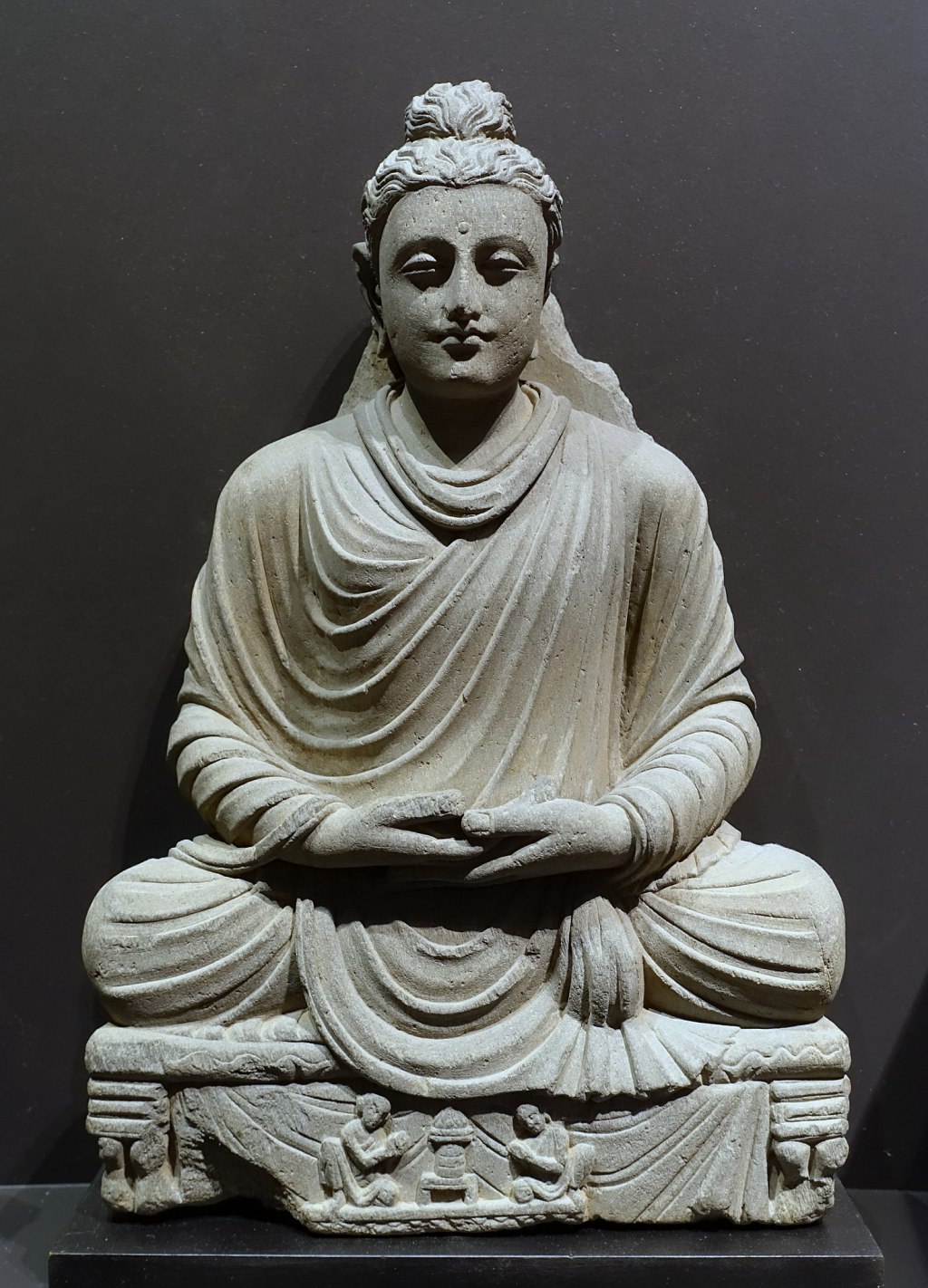
The Mother’s Sakyamuni-experience
Sri Aurobindo revealed the secret of the Veda. It will be wrong to ask why he didn’t do in the case of Buddhism. But he puts Buddha as one of the ten Avatars of Vishnu. Not only that; he mentions that historically, though he came afterwards, his work precedes Krishna’s. But I find the Mother’s Sakyamuni-experience very significant. Is it not Vedic in character, opening the possibility of integration with the Integral Yoga?
“THE days have gone by, stormy and troubled to all appearance but calm and strong in their reality reflecting Thy divine will; they have gone by, deploying, disclosing, developing once more all the unexpected and varied splendour of Thy untiring divine play. And how marvellous it is to watch this when one perceives the infinite criss-crossing of the movements Thy eternal will creates, when one knows that all this is from all eternity and that it is only in our imperfect faculties that it becomes an uninterrupted succession of facts, in which we are gratuitous and ignorant actors. We act with the apparent unconsciousness and blindness of those who do not know, and yet, I do know and, even while being an actor, I am a spectator too. But I am still not pure enough for Thee to unveil before my eyes the totality of the effects and results; it is only partially and imperfectly that I know them before the act and am permitted to act with the knowledge of the “why”, with a full illumination as to what Thou expectest fromme. When, O Lord, shall I have this purity? But for that too I am no longer impatient and no longer implore. I see how much Thy splendours are obscured and veiled in this miserable and poor instrument; but Thou, Thou knowest why it is thus; and these its shadows and weaknesses Thou dost also use for Thy eternal ends. My soul is in prayer and bows down in love before what it can understand and know of Thee. My soul is in prayer and gives itself unreservedly to Thee in one of those sublime fervours which culminate in identification. My soul is in prayer . . . and my body too; and my thought
is silent in a mute ecstasy.
(Communication received at 5.30 in the evening after meditation.)
“ ‘As thou art contemplating me, I shall speak to thee this evening. I see in thy heart a diamond surrounded by a golden light. It is at once pure and warm, something which may manifest impersonal love; but why dost thou keep this treasure enclosed in that dark casket lined with deep purple? The outermost covering is of a deep lustreless blue, a real mantle of darkness. It would seem that thou art afraid of showing thy splendour. Learn to radiate and do not fear the storm: the wind carries us far from the shore but shows us over the world. Wouldst thou be thrifty of thy tenderness? But the source of love is infinite. Dost thou fear to be misunderstood? But where hast thou seen man capable of understanding the Divine? And if the eternal truth finds in thee a means of manifesting itself, what dost thou care for all the rest? Thou art like a pilgrim coming out of the sanctuary; standing on the threshold in front of the crowd, he hesitates before revealing his precious secret, that of his supreme discovery. Listen, I too hesitated for days, for I could foresee both my preaching and its results: the imperfection of expression and the still greater imperfection of understanding. And yet I turned to the earth and men and brought them my message. Turn to the earth and men—isn’t this the command thou always hearest in thy heart?—in thy heart, for it is that which carries a blessed message for those who are athirst for compassion. Henceforth nothing can attack the diamond. It is unassailable in its perfect constitution and the soft radiance that flashes from it can change many things in the hearts of men. Thou doubtest thy power and fearest thy ignorance? It is precisely this that wraps up thy strength in that dark mantle of starless night. Thou hesitatest and tremblest as on the threshold of a mystery, for now the mystery of the manifestation seems to thee more terrible and unfathomable than that of the Eternal Cause. But thou must take courage again and obey the injunction from the depths. It is I who am telling thee this, for I know thee and love thee as thou didst know and love me once. I have appeared clearly before thy sight so that thou mayst in no way doubt my word. And also to thy eyes I have shown thy heart so that thou canst thus see what the supreme Truth has willed for it, so that thou mayst discover in it the law of thy being. The thing still seems to thee quite difficult: a day will come when thou wilt wonder how for so long it could have been otherwise.’ ” (Prayers and Meditations, December 21, 1916)
[This was posted on 20 November 2006 as a comment on a web journal which has now ceased to exist. — RY Deshpande]
Commentaries on the Dhammapada
The Mother based her commentaries on the Dhammapada on a French translation of the Pali text made by a French disciple. The text and commentaries were first published in 1960 under the title Commentaires sur le Dhammapada. A second edition appeared in 1964. An English translation was serialised in the quarterly journal Advent form November 1960 to February 1965.
The Mother tells:
“The Dhammapada begins with conjugate verses; here is the first one:
In all things the primordial element is mind. The Dhammapada contrasts a purified mind with an evil mind. We have already said that there are four successive stages for the purification of the mind. Those who nourish thoughts such as these never appease their hatred. The Dhammapada tells us first of all that bad thoughts bring about suffering and good thoughts bring about happiness.”
Here is one example from her translated text:
Strive, O Brahmin! Seal up the current (of craving), cast away all pleasures of the senses. Knowing how to uproot the elements of existence you shall know the Uncreated.
When the Brahmin has attained the summit of the two paths (concentration and insight), all bonds fall away and he possesses the Knowledge.
One for whom neither the inner nor the outer exist, neither one nor the other, who is free from fear and bondage, him I consider to be a Brahmin.
One who is given to meditation and is freed of impurities, who is without stain, who has fulfilled his duty, who has attained the highest goal, him I consider to be a Brahmin.
By day the sun shines; by night the moon. In his armour the warrior shines; in meditation the Brahmin shines. Day and night, without ceasing, the Buddha is radiant.
The man who has rejected evil is a Brahmin. One whose behaviour is disciplined is a monk; an ascetic is one who is purged of impurities.
One should not strike a Brahmin, and the Brahmin should not strike back. Shame on one who strikes a Brahmin. Shame on the Brahmin who strikes back.
For a Brahmin there is nothing better than to restrain the mind from the pleasures of life. As he removes bad intentions, so he appeases his sufferings.
One who does no evil by act, word or thought, the man who is restrained in these three, him I consider to be a Brahmin.
Whosoever teaches you the Doctrine of the Perfectly Enlightened One, render him homage and venerate him as the Brahmin does the sacred fire.
Neither by matted hair, nor ancestry, nor by birth does one become a Brahmin. One in whom abide truth and righteousness, he is pure, he is a true Brahmin.
What value has your matted hair, O foolish man? What value has the antelope skin you wear? Within you lies a jungle of passions, you have only the appearance of purity.
The man dressed in cast-off robes, who is emaciated, whose veins stand out on his body, who meditates alone in the forest, him I consider to be a Brahmin.
But I do not call him a Brahmin, although he is of brahmin origin or born of a brahmin mother, he who is rich and arrogant. He who possesses nothing, who is attached to nothing, him I consider to be a Brahmin.
He who has broken all bonds, who no longer fears anything, who has overcome all ties, who is liberated, him I consider to be a Brahmin.
One who little by little has broken the thong (of mind) and the straps (of attachment), who has cut the chain (of doubt) with its links (of evil tendencies) and who has rejected the yoke (of ignorance), who is enlightened, him I consider to be a Brahmin.
He who is without resentment, who bears reproaches, blows and chains, whose patience is his true strength, him I consider to be a Brahmin.
He who is free from anger, who is faithful to his faith, good and without craving, who has mastered himself and taken a body for the last time, him I consider to be a Brahmin.
He who is no more attached to the pleasures of the senses than a drop of water to the lotus leaf, or a mustard seed to the point of a needle, him I consider to be a Brahmin.
He who, in this life, has realised the cessation of suffering, who has laid down the burden and has liberated himself (from the yoke of attachment), him I consider to be a Brahmin.
The intelligent man, gifted with profound wisdom, discerning the good and the evil path, who has attained the supreme goal, him I consider to be a Brahmin.
One who seeks the company neither of householders nor of monks, who has no home and few needs, him I consider to be a Brahmin.
One who does no harm to any creature, whether strong or weak, who does not kill nor cause to be killed, him I consider to be a Brahmin.
Friendly amid the unfriendly, calm amid the violent, unselfish amid the selfish, him I consider to be a Brahmin.
He from whom passion and hatred, pride and pretence have fallen away, as a mustard seed falls from the point of a needle, him I consider to be a Brahmin.
One who speaks only words that are sweet, instructive, true, and who offends no one, him I consider to be a Brahmin.
One who in this world takes nothing but what he is given, whether it be little or much, short or long, good or bad, him I consider to be a Brahmin.
One who has no more desires in this world or the other, who has no more craving, who is free, him I consider to be a Brahmin.
One in whom desire exists no more, one who has attained the perfection of knowledge, who has cast away all doubt and who has sounded the depths of immortality, him I consider to be a Brahmin.
One who in this world has broken all ties (of good and evil) and who is delivered from grief, from taints and impurities, him I consider to be a Brahmin.
One who, like the moon, is spotless, pure, clear, serene, from whom the thirst of earthly desires has vanished, him I consider to be a Brahmin.
One who has escaped from the cycle of births, this muddy path, this thorny road, and who has attained the other shore, is given to meditation, void of desire, free from doubt, detached from all things and at peace, him I consider to be a Brahmin.
One in whom all passion is destroyed and who, renouncing worldly pleasures, has left the household life and taken to the homeless life, him I consider to be a Brahmin.
He in whom all craving is dead and who, renouncing worldly pleasures, has left the household life, who has quenched the thirst of becoming, him I consider to be a Brahmin.
One who has rejected all earthly ties and has gone beyond all heavenly ties, who is delivered from all ties, him I consider to be a Brahmin.
One who has put aside liking and disliking, who is indifferent, who is freed from all attachment and all fetters, who has conquered all the worlds, this hero I consider to be a Brahmin.
He who possesses the perfect knowledge of the birth and death of all beings and who is freed from all ties, he is a Blessed One, an Awakened One, him I consider to be a Brahmin.
He whose future state is unknown to the gods, the demigods and mortals, who is without desire and without impurity, who has become an adept, him I consider to be a Brahmin.
He who no longer possesses anything, neither past nor present nor future, who owns nothing, who no longer clings to anything, that one I consider to be a Brahmin.
The Noble, the Excellent, the Hero, the great Sage, the Victor, the Impassive, the Pure, the Enlightened, him I consider to be a Brahmin.
One who knows his previous lives, one who perceives the heavens and the hells, who has come to the end of births, who has attained perfect vision, the Sage accomplished in all accomplishments, him in truth I consider to be a Brahmin.
Such is the conclusion of the Dhammapada and if we have put into practice—to use its image—only a mustard seed of all that has been taught to us, well, we have not wasted our time.
There is one thing which is not spoken of here, in the Dhammapada: a supreme disinterestedness and a supreme liberation is to follow the discipline of self-perfection, the march of progress, not with a precise end in view as described here, the liberation of Nirvana, but because this march of progress is the profound law and the purpose of earthly life, the truth of universal existence and because you put yourself in harmony with it, spontaneously, whatever the result may be.
There is a deep trust in the divine Grace, a total surrender to the divine Will, an integral adhesion to the divine Plan which makes one do the thing to be done without concern for the result. That is the perfect liberation.
That is truly the abolition of suffering. The consciousness is filled with an unchanging delight and each step you take reveals a marvel of splendour.
We are grateful to the Buddha for what he has brought for human progress and, as I told you at the beginning, we shall try to realise a little of all the beautiful things he has taught us, but we shall leave the goal and the result of our endeavour to the Supreme Wisdom that surpasses all understanding.
5 September 1958
 The Winds of Wonder
Leave a comment