About Avatarhood
Here is a comment posted on an old website, dated 19 November 2006.
I greatly admire your patience, not only the patience; but the thoroughness and the competence make them highly rewarding. But perhaps for promoting the issues raised by X something else also needs to be looked into. He says “the problem with positing an avatar as being the necessary condition for the mutation of species is that this assertion undermines the very potential of species itself to realize its own intrinsic potential for transcendence.” What is expected here is, whether the concept of avatarhood is connected with the biological evolution of the species; in my opinion it is for the purposes of the spiritual evolution, which may in the long run and perhaps more indirectly bring about certain physical changes. The real, the radical transformation envisaged by Sri Aurobindo and for which the Mother was invoking the Will of the Lord belongs to another category altogether. Care is taken by saying that to believe “the human species has its own intrinsic potential for transcendence” is “just a belief” another onto-theology, a preferred ethics belonging to “humanism”. What we need is a new language and a new method, not a policing of experience due to possible social misuse. That of course is true. But we need not be concerned with the use or abuse of genuine experience. But from the scientific point of view there is no scientific theory to tell us that the intrinsic potential in a species has the possibility for transcendence. Will science arrive at this? One wonders.
Here en passant let me also quote one of Sri Aurobindo’s letters on the Ten Avatars described in the Puranas: “The Hindu procession of the ten Avatars is itself, as it were, a parable of evolution. First the Fish Avatar, then the amphibious animal between land and water, then the land animal, then the Man-Lion Avatar, bridging man and animal, then man as dwarf, small and undeveloped and physical but containing in himself the godhead and taking possession of existence, then the rajasic, sattwic, nirguna Avatars, leading the human development from the vital rajasic to the sattwic mental man and again the overmental superman. Krishna, Buddha and Kalki depict the last three stages, the stages of the spiritual development—Krishna opens the possibility of overmind, Buddha tries to shoot beyond to the supreme liberation but that liberation is still negative, not returning upon earth to complete positively the evolution; Kalki is to correct this by bringing the Kingdom of the Divine upon earth, destroying the opposing Asura forces. The progression is striking and unmistakable. As for the lives in between the Avatar lives, it must be remembered that Krishna speaks of many lives in the past, not only a few supreme ones, and secondly that while he speaks of himself as the Divine, in one passage he describes himself as a Vibhuti. We may therefore fairly assume that in many lives he manifested as the Vibhuti veiling the fuller Divine Consciousness. If we admit that the object of Avatarhood is to lead the evolution, this is quite reasonable, the Divine appearing as Avatar in the great transitional stages and as Vibhutis to aid the lesser transitions.”
Yes, I am sure the Avatar is enjoying it. He is ready to ignore all our “wise talk” about him. And yet he comes and tells us that the mysteries of Avatarhood are unfathomable indeed. At one point Sri Aurobindo kind of gives up by saying that this “is going far into the mystic field.”
In one place in the Essays on the Gita he says: “For to the modern mind Avatarhood is one of the most difficult to accept or to understand of all the ideas that are streaming in from the East upon the rationalised human consciousness. It is apt to take it at the best for a mere figure for some high manifestation of human power, character, genius, great work done for the world or in the world, and at the worst to regard it as a superstition,—to the heathen a foolishness and to the Greeks a stumbling-block. The materialist, necessarily, cannot even look at it, since he does not believe in God; to the rationalist or the Deist it is a folly and a thing of derision; to the thoroughgoing dualist who sees an unbridgeable gulf between the human and the divine nature, it sounds like a blasphemy. The rationalist objects that if God exists, he is extracosmic or supracosmic and does not intervene in the affairs of the world, but allows them to be governed by a fixed machinery of law,—he is, in fact, a sort of far-off constitutional monarch or spiritual King Log, at the best an indifferent inactive Spirit behind the activity of Nature, like some generalised or abstract witness Purusha of the Sankhyas; he is pure Spirit and cannot put on a body, infinite and cannot be finite as the human being is finite, the ever unborn creator and cannot be the creature born into the world,—these things are impossible even to his absolute omnipotence. To these objections the thoroughgoing dualist would add that God is in his person, his role and his nature different and separate from man; the perfect cannot put on human imperfection; the unborn personal God cannot be born as a human personality; the Ruler of the worlds cannot be limited in a nature-bound human action and in a perishable human body. These objections, so formidable at first sight to the reason, seem to have been present to the mind of the Teacher in the Gita when he says that although the Divine is unborn, imperishable in his self-existence, the Lord of all beings, yet he assumes birth by a supreme resort to the action of his Nature and by force of his self-Maya; that he whom the deluded despise because lodged in a human body, is verily in his supreme being the Lord of all; that he is in the action of the divine consciousness the creator of the fourfold Law and the doer of the works of the world and at the same time in the silence of the divine consciousness the impartial witness of the works of his own Nature,—for he is always, beyond both the silence and the action, the supreme Purushottama. And the Gita is able to meet all these oppositions and to reconcile all these contraries because it starts from the Vedantic view of existence, of God and the universe.” (pp. 150-51)
The Vedas and the early Upanishads do not speak of Avatarhood anywhere, at least explicitly. I don’t know why. Can someone comment upon this? Was Overmental consciousness necessary for it to emerge? Or is there some other aspect?
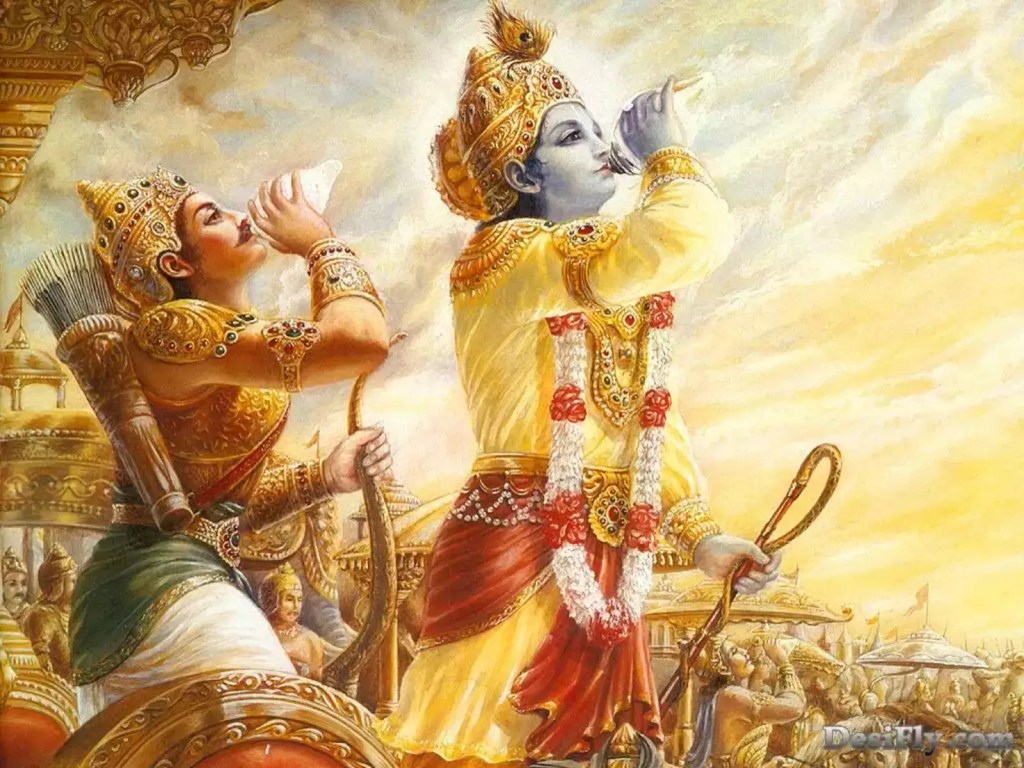
In the Gita Krishna, as if, goes out of his way to introduce this concept, of Avatarhood,—he has practically created an occasion to proclaim it. Certainly, he wanted to give that knowledge—perhaps the necessary condition of the Overmental consciousness having been established here in the cosmic working. It means, as the Gita is a part of the Mahabharata, we have that knowledge with us since then. It is stated that the present Kali Yuga began immediately after the Mahabharata War. According to one reckoning this was in the year 3101 BC. Some scholars go further and put the end of the Mahabharata War on 22 February of that year. So, we have the concept of Avatarhood with us for at least 5000 years. But the full development of that concept came much later, in the Puranas. The Bhagavat Purana in particular narrates in great manner the incarnations of Vishnu, Dashāwatāra, the ten Avatars, with the longest description reserved for Krishna. In fact, we can say that this is a vigorous and beautiful biography of Vishnu himself, in his evolutionary role, what Sri Aurobindo has called the Parable of Evolution. The Bhakti movement in India had its beginning in it. When were the Puranas written? Nobody knows for certain, like the ancient Indian history. But the period could be from 400 BC to 400 AD for various Puranas—the post-Buddhistic period that witnessed the revival of the Brahminical traditions and practices. This Avatar-parable marks the earliest statement of the theory of evolution, given some 2000 years ago. Its knowledge came from another faculty, the intuitive-perceptive faculty which has another kind of contact with the reality of this world. It is certainly not Newtonian-Darwinian in its methodology. Can that knowledge, that intuitive-perceptive sense be recovered? Perhaps it is necessary also in the context of the future evolutionary possibilities. Should not sooner than later the Dawn of supra-rational Age appear in our skies? How do we prepare ourselves for its arrival? And when it shall arrive, in spite of us, will we welcome it?
 The Winds of Wonder
Leave a comment