
A new book by RY Deshpande
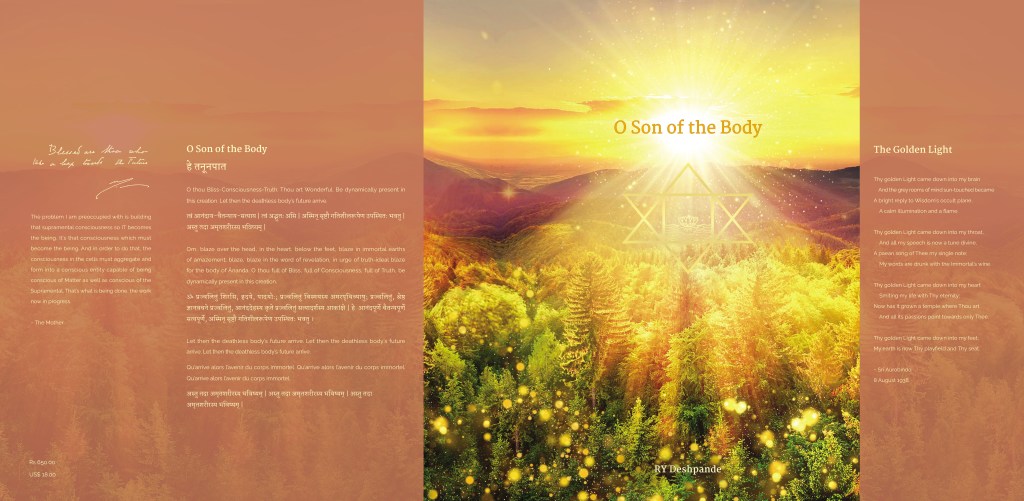
Here is a leaflet describing briefly a new book by RY Deshpande, offered to Sri Aurobindo and the Mother on 15 August 2024. The book is of a large format on art paper with illustrations and sketches related to the themes of the text. The attempt is to have some insight and intuition into the revelations present in the Rig Veda, Sri Aurobindo’s Savitri, and the Mother’s Essential Agenda, revelations absolutely splendid bringing the Tomorrow closer to us.
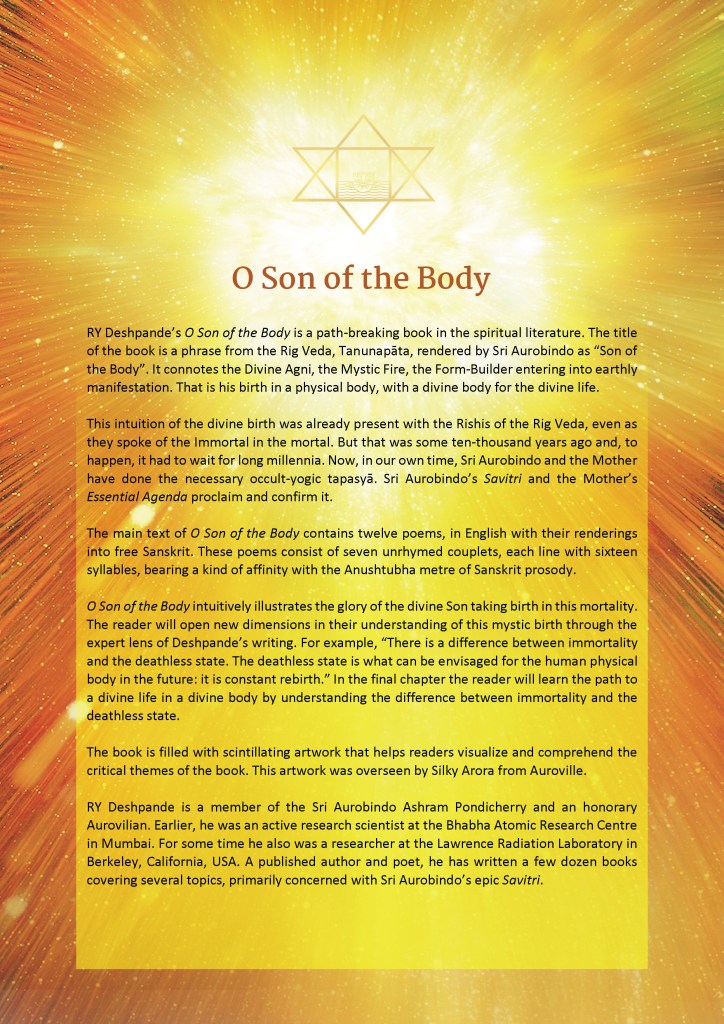
RY Deshpande’s O Son of the Body is a path-breaking book in the spiritual literature. The title of the book is a phrase from the Rig Veda, Tanunapāta, rendered by Sri Aurobindo as “Son of the Body”. It connotes the Divine Agni, the Mystic Fire, the Form-Builder entering into earthly manifestation. That is his birth in a physical body, with a divine body for the divine life.
This intuition of the divine birth was already present with the Rishis of the Rig Veda, even as they spoke of the Immortal in the mortal. But that was some ten-thousand years ago and, to happen, it had to wait for long millennia. Now, in our own time, Sri Aurobindo and the Mother have done the necessary occult-yogic tapasyā. Sri Aurobindo’s Savitri and the Mother’s Essential Agenda proclaim and confirm it.
The main text of O Son of the Body contains twelve poems, in English with their renderings into free Sanskrit. These poems consist of seven unrhymed couplets, each line with sixteen syllables, bearing a kind of affinity with the Anushtubha metre of Sanskrit prosody.
O Son of the Body intuitively illustrates the glory of the divine Son taking birth in this mortality. The reader will open new dimensions in his understanding of the divine through the expert lens of Deshpande’s writing. For example, “There is a difference between immortality and the deathless state. The deathless state is what can be envisaged for the human physical body in the future: it is constant rebirth.” In the final chapter the reader will learn the path to a divine life in a divine body by understanding the difference between immortality and the deathless state.
The book is filled with scintillating artwork that helps readers visualize and comprehend the critical themes of the book. This artwork was overseen by Silky Arora from Auroville.
RY Deshpande is a member of the Sri Aurobindo Ashram Pondicherry and an honorary Aurovilian. Earlier, he was an active research scientist at the Bhabha Atomic Research Centre in Mumbai. For some time he also was a researcher at the Lawrence Radiation Laboratory in Berkeley, California, USA. A published author and poet, he has written a few dozen books covering several topics, primarily concerned with Sri Aurobindo’s epic Savitri.


 The Winds of Wonder
Leave a comment