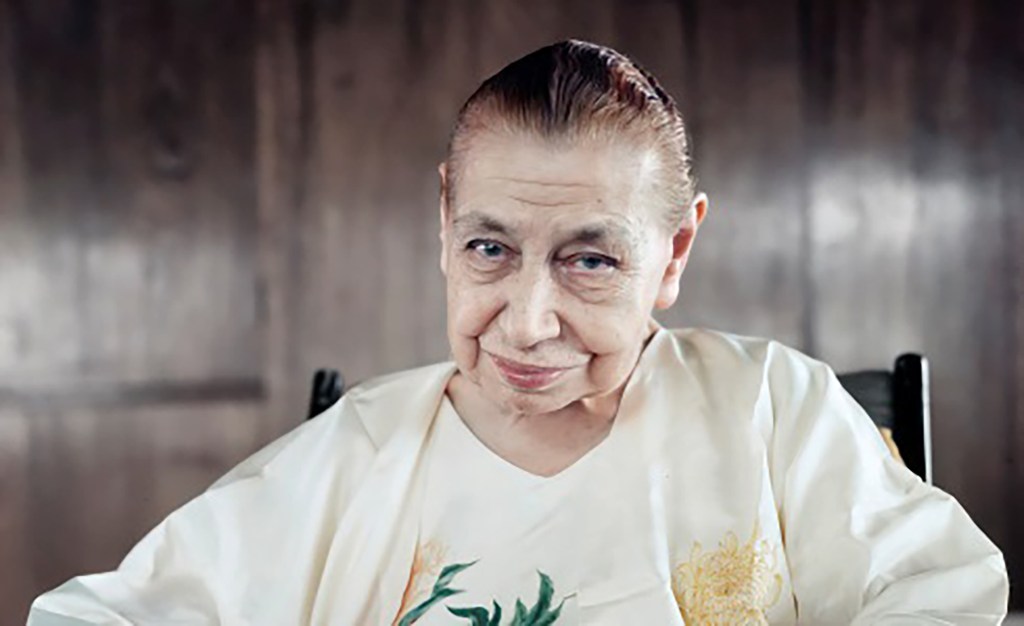
Passing through portals of the birth that is a death
We have in Savitri the following:
A world’s desire compelled her mortal birth
and
Answering earth’s yearning and her cry for bliss,
A greatness from our other countries came.
Her mortal birth, but when did she come? This is what Sri Aurobindo writes in a letter to Amal Kiran:
Savitri is represented in the poem as an incarnation of the Divine Mother. This incarnation is supposed to have taken place in far past times when the whole thing had to be opened, so as to ‘hew the ways of Immortality’.
Aswapati carried the “world’s desire” to the Divine Mother. Then, in answer to that earth’s yearning, Savitri came from our other countries. She came in the “far past times when the whole thing had to be opened”. She has been here all along. She will continue to be here even as the evolution marches from Ignorance into Knowledge.
What is true for Savitri must be so for Aswapati also. He is Savitri’s human father, is the Lord of Tapasyā, the concentrated energy of spiritual endeavour that helps us to rise from the mortal to the immortal planes. He is also an incarnation which must have occurred “in far past times”.
They have accepted “to pass through the portals of the birth that is a death”. If Savitri’s “mortal birth” conveys that sense, then it is also true in the case of Aswapati.
[ https://incarnateword.in/cwsa/32/the-mother-vi ]
About Satyavan: “Well, he is the Avatar. He is the incarnation of the Supreme,” says the Mother.
If we identify the Mother and Sri Aurobindo with Savitri and Aswapati, then their incarnations occurred “in far past times”. The purpose is to hew the ways of Immortality. They have taken, as we know, many human births in the meanwhile, have “passed through the portals of the birth that is a death”, but have appeared as Avatars only now. They were certainly not Avatars earlier. So the question of “(repeated) avatarhood” does not arise.
When in the Gita Krishna makes known to Arjuna that he had many births, that he had been coming here from age to age, yugé-yugé, he does not mean that he was speaking of his “repeated avatarhood”; he was an Avatar on the Kurukshetra Battlefield, and not earlier. Of the divine birth, divya janma, there are two aspects, explains Sri Aurobindo:
…one is a descent, the birth of God in humanity, the Godhead manifesting itself in the human form and nature, the eternal Avatar; the other is an ascent, the birth of man into the Godhead, man rising into the divine nature and consciousness, madbhāvam āgatah; it is the being born anew in a second birth of the soul.
What is an Avatar? The Mother answers: “Avatar—the Supreme manifested on earth in a body.” And what is the work of the Avatar? “To go up and down and join the top to the bottom, the whole secret of realisation.”
In the context of incarnation of Savitri we may say that she has ever been engaged in the work of the Lord. Her yoga-tapasyā progresses in the Will of the Lord, her power grows in the Will of the Lord, her action in the Will of the Lord. A prayer of the Mother speaks of amplitude and majesty, nobility and grace, charm and grandeur, variety and strength, “for it is the will of the Lord to manifest.” For that purpose she is ready to suffer, she is ready to accept “lamentable limitations”, climb up the Calvary of deep-rooted frustration, bear ignominy of human births.
Thus:
O My Lord, my sweet Master, for the accomplishment of Thy work I have sunk down into the unfathomable depths of Matter, I have touched with my finger the horror of the falsehood and the inconscience, I have reached the seat of oblivion and a supreme obscurity. But in my heart was the Remembrance, from my heart there leaped the call which could arrive to Thee: ‘Lord, Lord, everywhere Thy enemies appear triumphant; falsehood is the monarch of the world… Lord, give the command to conquer and victory will be there. I know we are unworthy, I know the world is not yet ready. But I cry to Thee with an absolute faith in Thy Grace and I know that Thy Grace will save.’ Thus, my prayer rushed up towards Thee… (24 November 1931)
Such intensity of anguish! Such totality of commitment to do the work the Lord has given to her! She is prepared to bear the assaults of the adversary force, the extreme of pain and suffering. Hers is the work connected with the evolutionary soul of the earth into which she has entered and no hardship she discounts in making it progress towards the Divine. It is for that purpose she passes through the portals of the life that is a death.
Other powers of the Divine Mother don’t do that. The Mother told Durga the magic of surrender to the Lord, and then did Durga with considerable hesitation see its wonder and its power. Gauri, Uma, Parvati, Kali, Lakshmai, Saraswati, and in a way even the Madonnas who are present in the cosmic field are powers and personalities of the Divine Mother. But they are essentially typal in character. There are goddesses and goddesses, devis, matrikas, lesser vital embodiments of the Divine Mother which have drifted far away from her. The Mother of Compassion we meet in Savitri suffers no doubt, but not the way does Savitri. Thus we have her description as follows:
Here from a low and prone and listless ground
The passion of the first ascent began;
A moon-bright face in a sombre cloud of hair,
A Woman sat in a pale lustrous robe.
A rugged and ragged soil was her bare seat,
Beneath her feet a sharp and wounding stone.
A divine pity on the peaks of the world,
A spirit touched by the grief of all that lives,
She looked out far and saw from inner mind
This questionable world of outward things,
Of false appearances and plausible shapes,
This dubious cosmos stretched in the ignorant Void,
The pangs of earth, the toil and speed of the stars
And the difficult birth and dolorous end of life.
Accepting the universe as her body of woe,
The Mother of the seven sorrows bore
The seven stabs that pierced her bleeding heart:
The beauty of sadness lingered on her face,
Her eyes were dim with the ancient stain of tears.
Her heart was riven with the world’s agony
And burdened with the sorrow and struggle in Time,
An anguished music trailed in her rapt voice…
And she herself says:
O Savitri, I am thy secret soul.
To share the suffering of the world I came,
I draw my children’s pangs into my breast.
I am the nurse of the dolour beneath the stars;
I am the soul of all who wailing writhe
Under the ruthless harrow of the Gods.
I am woman, nurse and slave and beaten beast;
I tend the hands that gave me cruel blows…
I am in all that suffers and that cries.
Mine is the prayer that climbs in vain from earth,
I am traversed by my creatures’ agonies,
I am the spirit in a world of pain.
The scream of tortured flesh and tortured hearts
Fall’n back on heart and flesh unheard by Heaven
Has rent with helpless grief and wrath my soul.
I have seen the peasant burning in his hut,
I have seen the slashed corpse of the slaughtered child,
Heard woman’s cry ravished and stripped and haled
Amid the bayings of the hell-hound mob,
I have looked on, I had no power to save.
I have brought no arm of strength to aid or slay;
God gave me love, he gave me not his force.
I have shared the toil of the yoked animal drudge
Pushed by the goad, encouraged by the whip;
I have shared the fear-filled life of bird and beast,
Its long hunt for the day’s precarious food,
Its covert slink and crouch and hungry prowl,
Its pain and terror seized by beak and claw.
I have shared the daily life of common men…
I have borne the calm indifference of Heaven,
Watched Nature’s cruelty to suffering things
While God passed silent by nor turned to help.
Yet have I cried not out against his will,
Yet have I not accused his cosmic Law.
Only to change this great hard world of pain
A patient prayer has risen from my breast;
A pallid resignation lights my brow,
Within me a blind faith and mercy dwell;
I carry the fire that never can be quenched
And the compassion that supports the suns.
I am the hope that looks towards my God,
My God who never came to me till now;
His voice I hear that ever says `I come’:
I know that one day he shall come at last.”
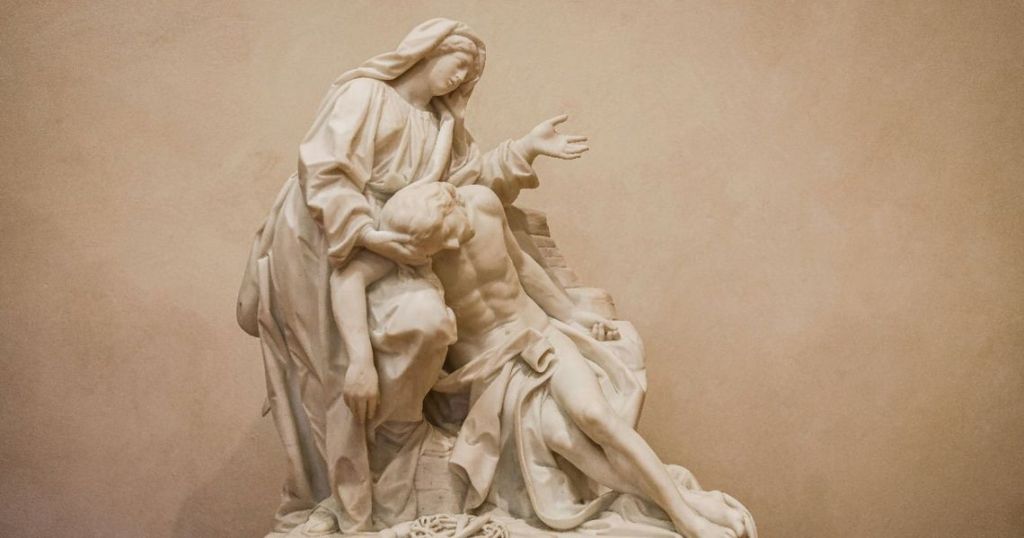
What are the seven stabs she bore? Here is Stabat Mater, with emotions of Our Lady at the Cross and at the Manger—Calvary and Bethlehem—respectively. Here is Mary at the Cross, but not at the Cradle. Her Seven Sorrows are:
The Prophecy of Simeon
The Flight into Egypt
The Loss of Jesus in the Temple
Mary meets Jesus Carrying the Cross
The Crucifixion
Mary Receives the Dead Body of Her Son
The Burial of Her Son and Closing of the Tomb
Fourth Dolor: Meeting with Jesus Carrying His Cross
As Mary’s heart bled with anguish at seeing her Son tortured and carrying His heavy Cross, many families throughout the world have crushed hearts at what is done to their children—the physical and spiritual deprivations of the slums, the dangers of gang warfare, the unjust arrests, the misery and horror of prison life—all these wring with anguish the hearts of mothers and fathers.
And the prayer is: Mother of Sorrows have compassion on them, and grant us the privilege to be present to them.
Fifth Dolor: The Crucifixion
As Mary stood beneath the Cross and watched her Son suffer and die, her heart was united with his, and she prayed for all those who suffer more at the agony of loved ones than at their own—all who are powerless to relieve suffering and whose hearts are torn because of their helplessness, like parents whose children are kidnapped and murdered or who watch their adult children die each day, in a sense, because of addictions. Mother of Sorrows have compassion on them, and grant us the privilege to be present to them. Great as the sea was her sorrow.
This may be very touching, very poignant, even to some extent psychic; but the spiritual which is there in Savitri’s Mother of Compassion, Grief Divine does not come with that reassuring definiteness. Perhaps this is because she is typal, one who has not passed through the portals of the birth that is a death, which Savitri has. In that sense this incarnation of the Divine Mother as Savitri is of a different kind.
 The Winds of Wonder
Leave a comment